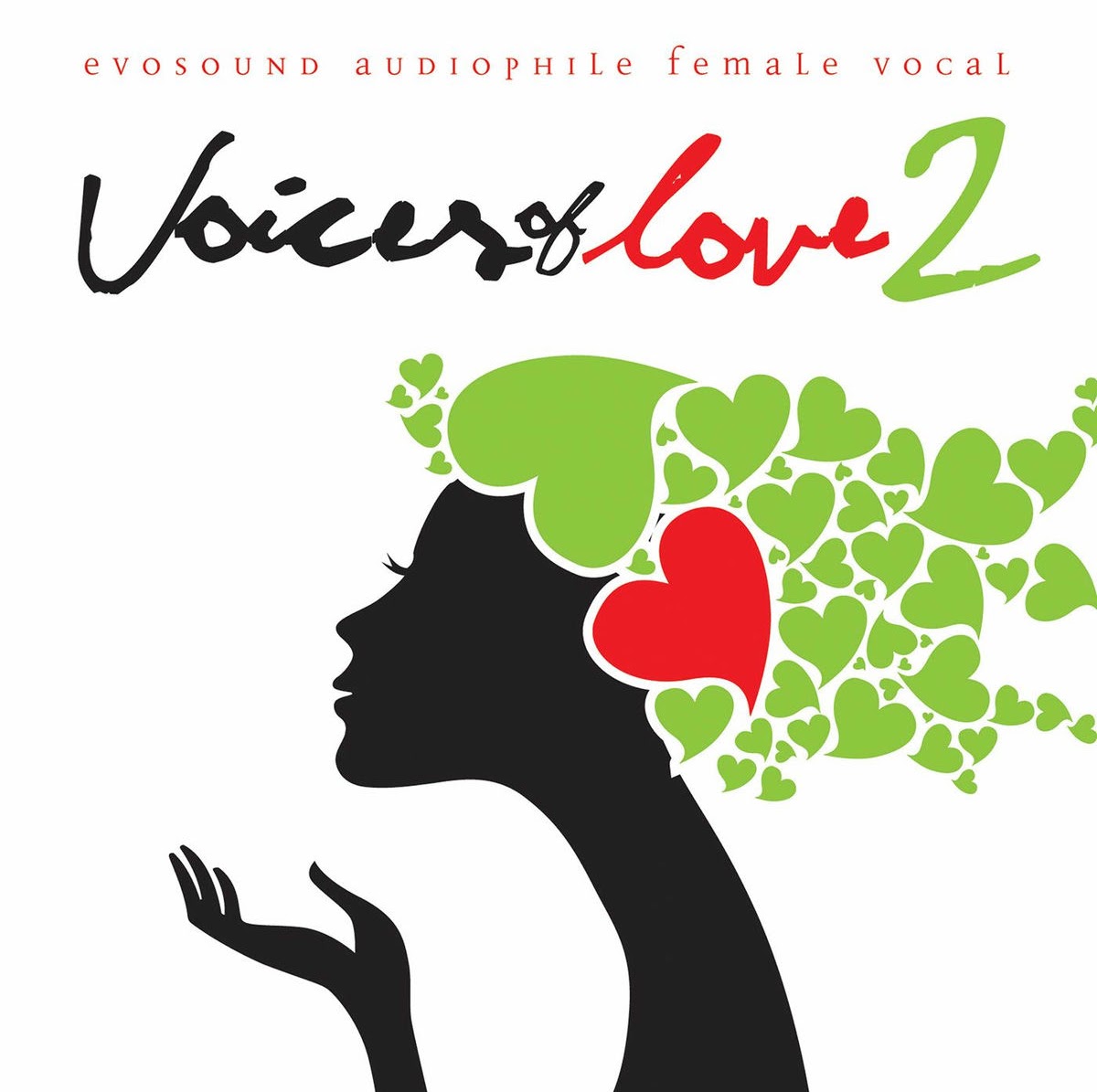
Evosound
Audiophile Female Vocal
Voices of Love 2
Evosound Audiophile Female Vocal: Voices of Love 2 – Familiar Songs, Beautiful Voices, Extraordinary Sound
Some records impress immediately. They announce themselves with enormous dynamics, spectacular bass or a soundstage so wide that you instinctively look beyond the loudspeakers. Evosound Audiophile Female Vocal: Voices of Love 2 takes a more subtle approach. It invites you into the music through voices you want to keep listening to and songs that somehow feel familiar even when the interpretation is completely new.
Released by Evosound in 2014, the second Voices of Love collection brings together fourteen carefully selected female vocal performances. Stacey Kent, Gretchen Parlato, Jacqui Naylor, Nina Vidal, Julienne Taylor, Olivia Ong, Katie Melua, Susan Wong, Chantal Chamberland, Woong San, Cheryl Bentyne, Chlara, Jeanette Lindström and Clare Teal each bring their own personality to the album. The result is a journey through jazz, acoustic pop and intimate vocal music that feels remarkably coherent despite the variety of singers.
For lovers of audiophile female vocals, high-end audio and beautifully recorded voices, it is exactly the kind of album that begins as a listening session and ends several tracks later than you originally intended.
A Familiar Melody Opens the Door
The album begins with Stacey Kent’s “What the World Needs Now.” It is a song that hardly needs an introduction, yet Kent’s understated delivery gives it an intimacy that immediately establishes the atmosphere of the collection. There is no attempt to overwhelm the listener. Instead, the attraction lies in the relationship between voice, instruments and the space surrounding them.
That makes it particularly revealing on a good stereo system. Listen to where the voice appears between the loudspeakers and to how naturally the accompanying instruments occupy the space around it. A great audiophile vocal recording doesn’t simply produce more detail; it creates a believable acoustic picture in which every element seems to have its own place.
Gretchen Parlato follows with “Holding Back the Years,” and suddenly a familiar Simply Red song enters a completely different world. Parlato’s distinctive phrasing transforms the melody into something more intimate and delicate, demonstrating one of the great pleasures of this collection: songs you thought you knew begin to reveal another personality.
Then Jacqui Naylor takes on “Losing My Religion.”
Again, familiarity works in the album’s favour. Because you already know the song, you are free to concentrate on the interpretation, the character of the voice and the recording itself. It becomes less about recognizing the melody and more about discovering what another artist can find inside it.
Time After Time, but Never Quite the Same
Nina Vidal’s “Time After Time” continues that idea beautifully, followed by Julienne Taylor’s interpretation of “Hard to Say I’m Sorry.” These are songs deeply embedded in popular music, but here they are presented in arrangements that favour intimacy over spectacle.
This is also where Voices of Love 2 becomes useful as audiophile reference music. Female vocals can reveal the tonal character of a system remarkably quickly. An overly bright loudspeaker may exaggerate sibilance, while an unbalanced midrange can make voices sound thin or unnaturally warm. When everything is right, however, you stop noticing individual frequency ranges and begin hearing something far more convincing: a person.
Olivia Ong’s “First of May” and Katie Melua’s “Call Off the Search” continue the journey, each offering a different vocal texture and atmosphere. Rather than sounding like fourteen variations of the same audiophile demonstration track, the collection constantly changes character while maintaining its relaxed late-night mood.
Then Susan Wong Steps Into the Room
There are certain names that appear again and again in audiophile music collections, and Susan Wong is one of them. Her interpretation of “You’ve Got a Friend” feels perfectly at home here.
On a revealing high-end system, resist the temptation to concentrate immediately on treble extension or bass definition. Listen instead to the size of the voice. It shouldn’t stretch unnaturally between the speakers, nor should it sound like a tiny point suspended in space. A convincing recording gives the singer believable dimensions while preserving the acoustic environment around her.
This is one of those moments where stereo imaging and vocal realism become more than technical terminology. Close your eyes and the physical loudspeakers should become considerably less important.
Chantal Chamberland follows with “You’re My Hero,” bringing her darker, smoky vocal character into the collection before Woong San’s interpretation of “Feel Like Making Love” shifts the atmosphere towards jazz and soul.
By this point the album has become something more interesting than a collection of beautiful voices. You begin hearing just how different those voices actually are.
Every Voice Has Its Own Texture
That difference matters.
A truly transparent audio system shouldn’t make every recording sound spectacular in exactly the same way. It should preserve differences. One singer may sound warm and intimate, another lighter and more delicate. One recording might place the vocalist close to the listener, while another reveals considerably more acoustic space.
Cheryl Bentyne’s “Get Here” provides another change of character before Chlara performs “Songbird.” Jeanette Lindström then takes on Joni Mitchell’s “Both Sides Now,” and Clare Teal closes the album with “Why.”
Fourteen tracks, fourteen voices and fourteen opportunities to hear how recording, performance and interpretation interact.
This is precisely why collections of audiophile female vocals remain so popular among listeners who care about sound quality. The human voice is extraordinarily difficult to fake convincingly. We spend our entire lives listening to people speak and sing, so our ears recognize surprisingly quickly when something doesn’t sound natural.
When reproduction is right, however, the effect can be almost physical.
The singer doesn’t merely sound clearer.
She appears.
Turn Down the Lights—and the Volume
There is another way to enjoy Voices of Love 2 that has very little to do with conventional hi-fi demonstrations. Instead of turning the volume up, try turning it down.
Wait until the room is quiet. Sit in your usual listening position and play the album at a natural level. Listen to whether the voices retain their presence. Notice whether the soundstage remains open and whether the smallest vocal details survive without needing additional volume.
A genuinely good high-end audio system should remain involving when playing quietly. These recordings are particularly suitable for discovering whether yours does.
At lower levels, something else happens too. The music becomes more personal. Instead of feeling like a performance projected into the room, it begins to feel as though you have moved closer to the performers.
For an album called Voices of Love, that seems entirely appropriate.
When You Forget You’re Testing the System
Of course, Evosound Audiophile Female Vocal: Voices of Love 2 can easily become an audiophile test album. Its combination of beautifully recorded vocals and acoustic arrangements provides excellent material for evaluating speakers, headphones, amplifiers and DACs, particularly when listening for midrange transparency, tonal balance, soundstage depth and stereo imaging.
But there comes a point when analysing an album like this becomes counterproductive.
Perhaps you started with Stacey Kent because you wanted to evaluate the center image. By Gretchen Parlato you were listening to vocal texture. Jacqui Naylor made you notice the arrangement, Katie Melua made you forget what you were supposed to be testing, and somewhere around Susan Wong you stopped thinking about the system altogether.
That is exactly what should happen.
The purpose of high-end audio isn’t to keep reminding us how good our equipment is. The equipment is there to remove as many barriers as possible between the recording and the listener.
Voices of Love 2 understands that beautifully. Behind its polished audiophile sound quality is something much simpler: fourteen singers taking familiar songs and making them their own.
So put away the specifications, stop looking at the loudspeakers and allow the album to play.
If, by the final notes of Clare Teal’s “Why,” you have forgotten whether you were listening to the recording or testing your system, then Voices of Love 2 has already passed the most important audiophile test of all.
You wanted to hear the equipment.
Instead, you heard the music.
Hi-Fi(ve),
Ronald – Your EarFluencer 🎧


