Inakustik
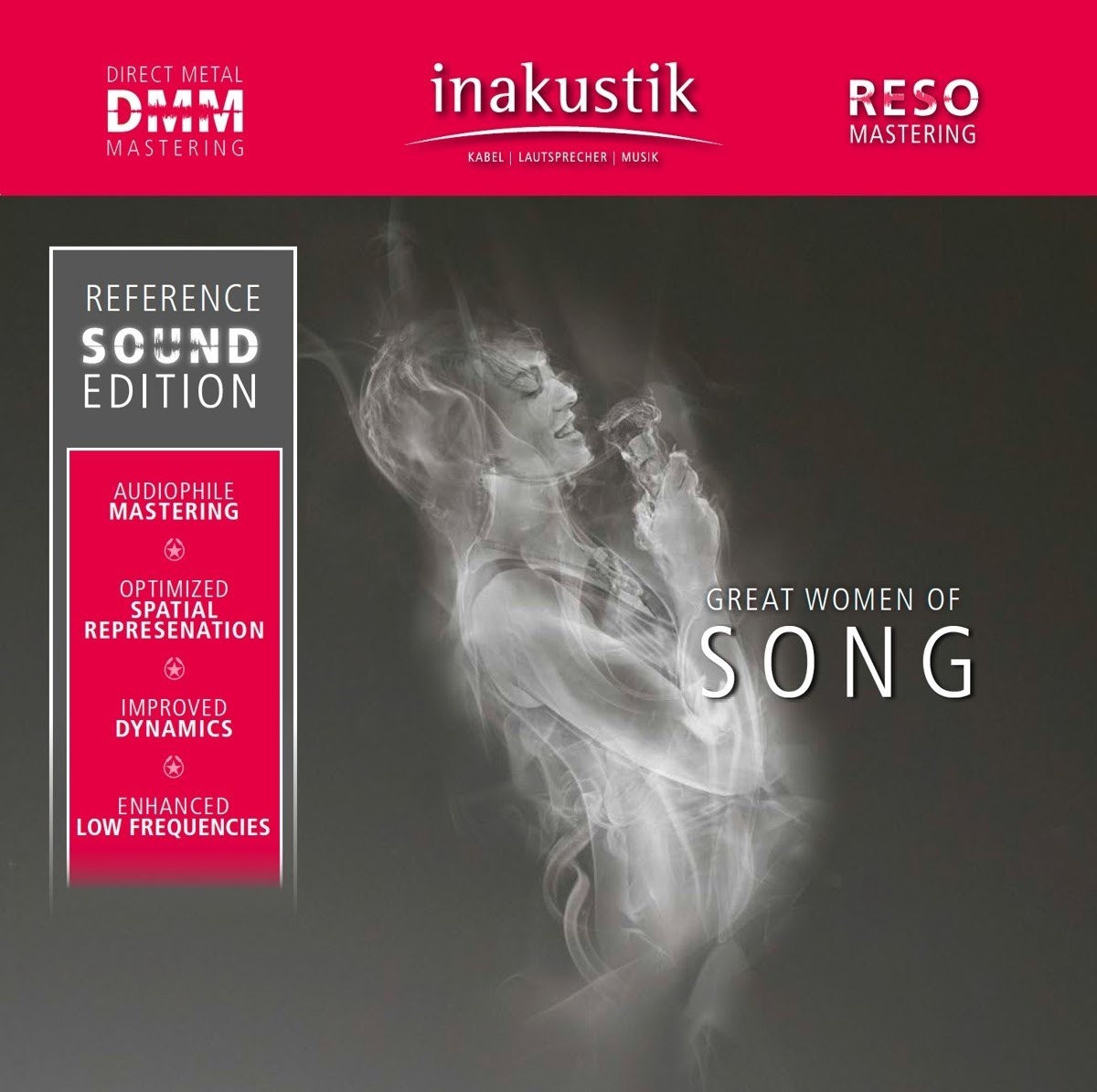
Great Women Of Song

In-Akustik Great Women Of Song – Sixteen Voices, One Remarkable Audiophile Journey

There is a moment during a great vocal recording when the loudspeakers seem to surrender their role in the performance. The voice is no longer coming from two cabinets somewhere in front of you; instead, a singer appears in the space between them, with a presence that can feel surprisingly real. In-Akustik Great Women Of Song is built around exactly that experience, bringing together sixteen distinctive female voices in a collection where musical character and exceptional recording quality are given equal importance.

Part of the celebrated In-Akustik Reference Sound Edition, Great Women Of Song moves through singer-songwriter music, blues, folk, rock and jazz without losing its sense of unity. Mary Black, Inga Rumpf, Kara Grainger, Meg Hutchinson, Tracy Bonham, Eliza Gilkyson, Emma-Lee, Tracy Nelson, Carrie Newcomer, Kasia Lins, Lynn Miles, Colleen Rennison, Lucy Kaplansky, Lisa Doby, Mindi Abair and Christy Baron all bring something different to the journey. The result is not simply another compilation of audiophile female vocals, but an album that demonstrates how much personality can be contained in a human voice.

It Begins With Mary Black

The journey opens with Mary Black and “Babes In The Wood,” and immediately there is a sense that this collection isn’t interested in spectacular hi-fi tricks. The attraction is subtler. Black’s voice establishes the center of the recording while the instruments around her create an acoustic picture that rewards careful listening. On a transparent high-end audio system, small details begin to emerge naturally: the texture of the voice, the decay surrounding instruments and the space extending behind the performers.

Then Inga Rumpf changes the atmosphere completely with “It’s A Man’s World.” Her voice carries considerably more weight and raw character, making the transition from Mary Black particularly revealing. A good audio system should preserve those differences rather than imposing the same polished sound on every performer. Rumpf should sound like Rumpf, with all the strength and texture that make her performance distinctive.

That contrast establishes one of the great pleasures of Great Women Of Song. This isn’t sixteen variations on the same beautiful audiophile voice. These are sixteen individual performers with different tones, styles and personalities.

From Kara Grainger to Tracy Bonham

With Kara Grainger’s “Little Pack Of Lies,” the collection moves towards blues, while Meg Hutchinson’s “I’d Like To Know” introduces a more intimate singer-songwriter atmosphere. Then comes Tracy Bonham with “Big Red Heart,” changing the musical landscape once again.

This diversity makes the album particularly useful as audiophile reference music. When recordings differ significantly in instrumentation and vocal character, a system has nowhere to hide. An overly bright loudspeaker can make vocal sibilance unnecessarily prominent, while poor midrange balance can rob voices of body and warmth. A system with good stereo imaging allows each singer to occupy a believable position without artificially enlarging the voice or attaching it to the loudspeakers.

Yet concentrating only on these technical qualities would miss what makes the album enjoyable. The finest audiophile recordings don’t constantly remind you how impressive they sound. They simply make the performers easier to believe.

The Space Around the Voice

The Reference Sound Edition has always been closely associated with the pursuit of transparency, dynamics and spatial depth, and those qualities become especially valuable with vocal music. Eliza Gilkyson’s “Rare Bird” and Emma-Lee’s “Backseat Heroine” provide excellent examples of how the space surrounding a performer can become part of the listening experience.

Listen beyond the singer for a moment. Notice where the accompanying instruments appear and how long individual notes remain audible after they have been played. Those tiny pieces of acoustic information help the brain reconstruct a three-dimensional space from a two-channel recording.

That is the strange magic of stereo. Two loudspeakers are standing in front of you, yet a great recording can create sounds between them, behind them and occasionally beyond their outer edges. Nothing has physically moved, but the listening room suddenly feels larger.

Tracy Nelson’s “Lead A Horse To Water” completes the first half of the collection with another change in vocal texture and musical character. By now it becomes clear that Great Women Of Song isn’t asking you to admire one particular recording technique. It is asking you to listen to differences.

A Second Journey Begins

Carrie Newcomer’s “Every Little Bit Of It” opens the second half with the kind of natural singer-songwriter presentation that works beautifully at realistic listening levels. There is no need to turn the volume excessively high to appreciate what is happening. In fact, this is an album worth playing quietly.

At lower levels, a good system still preserves vocal presence, fine detail and soundstage depth. That can be considerably more revealing than the traditional audiophile demonstration where everything is played loudly enough to make an immediate impression.

Kasia Lins follows with “Liar,” while Lynn Miles brings “Love Is Red” and Colleen Rennison performs “See The Sky About To Rain.” Each voice introduces another color into the collection, and each recording gives the system a slightly different challenge.

By the time Lucy Kaplansky’s “Manhattan Moon” begins, the temptation to keep evaluating the equipment starts to fade. Instead of wondering about frequency response or resolution, you begin following the stories and performances.

That is exactly where an audiophile album should take you.

More Than Detail

Audiophiles talk a great deal about detail, but detail by itself isn’t particularly musical. Hearing the smallest sound hidden inside a recording is impressive for a few minutes; hearing how all those small sounds combine into a believable performance is far more rewarding.

The RESO-Mastering used for the In-Akustik Reference Sound Edition is intended to improve qualities such as transparency, dynamics, bass reproduction and depth differentiation. Those are impressive technical objectives, but the musical result is what matters. When transparency improves, a voice can become more natural. When depth is preserved, the singer gains space around her. When dynamics remain intact, subtle changes in intensity carry more emotion.

In other words, better sound should eventually result in better storytelling.

That becomes particularly apparent towards the end of the collection. Lisa Doby’s “Glad” is followed by Mindi Abair with “I’ll Be Your Home,” before Christy Baron closes the journey with “Happy Together.”

Sixteen tracks later, the album has travelled through very different voices without ever losing sight of its central subject: the extraordinary expressive power of a singer captured well.

Why Female Vocals Remain an Audiophile Favorite

There is a simple reason female vocal audiophile recordings appear so often in high-end demonstrations. We know instinctively what a human voice should sound like. Unlike an instrument we may rarely hear in real life, voices surround us every day, making unnatural reproduction surprisingly easy to recognize.

When the tonal balance is wrong, we notice. When sibilance becomes exaggerated, we notice. When the soundstage collapses and the singer seems to be coming directly from the loudspeakers, the illusion disappears.

But when everything is right, something rather wonderful happens. The voice develops body and position, the acoustic space becomes audible and the electronics seem to retreat into the background.

This makes In-Akustik Great Women Of Song excellent material for evaluating loudspeakers, headphones, amplifiers and DACs, particularly when listening for vocal realism, midrange transparency, dynamics, tonal balance and stereo imaging.

Just don’t spend the entire album testing your system.

When Sixteen Voices Become More Important Than the Equipment

Perhaps you started listening because you wanted to hear what your system could do. Mary Black helped you judge the center image, Inga Rumpf revealed the character of the midrange and Kara Grainger made you listen to instrumental texture. Somewhere around Carrie Newcomer or Lucy Kaplansky, however, the technical checklist disappeared.

That’s when Great Women Of Song becomes most successful.

The best high-end audio system isn’t necessarily the one that constantly reminds you how detailed or expensive it is. It is the one that allows sixteen very different singers to enter the listening room without getting in their way.

So let the album play from beginning to end. Don’t skip immediately to the track you normally use for testing loudspeakers and don’t spend every song listening for another technical improvement.

Listen to Mary Black. Then Inga Rumpf. Kara Grainger. Eliza Gilkyson. Carrie Newcomer. Lucy Kaplansky. Mindi Abair. Christy Baron.

Listen to how different they are.

And if, by the end of In-Akustik Great Women Of Song, you have forgotten about the DAC, amplifier and loudspeakers entirely, the recording has achieved something far more important than impressive sound quality.

It has brought you closer to the women behind the songs.

Hi-Fi(ve),

Ronald – Your EarFluencer 🎧