
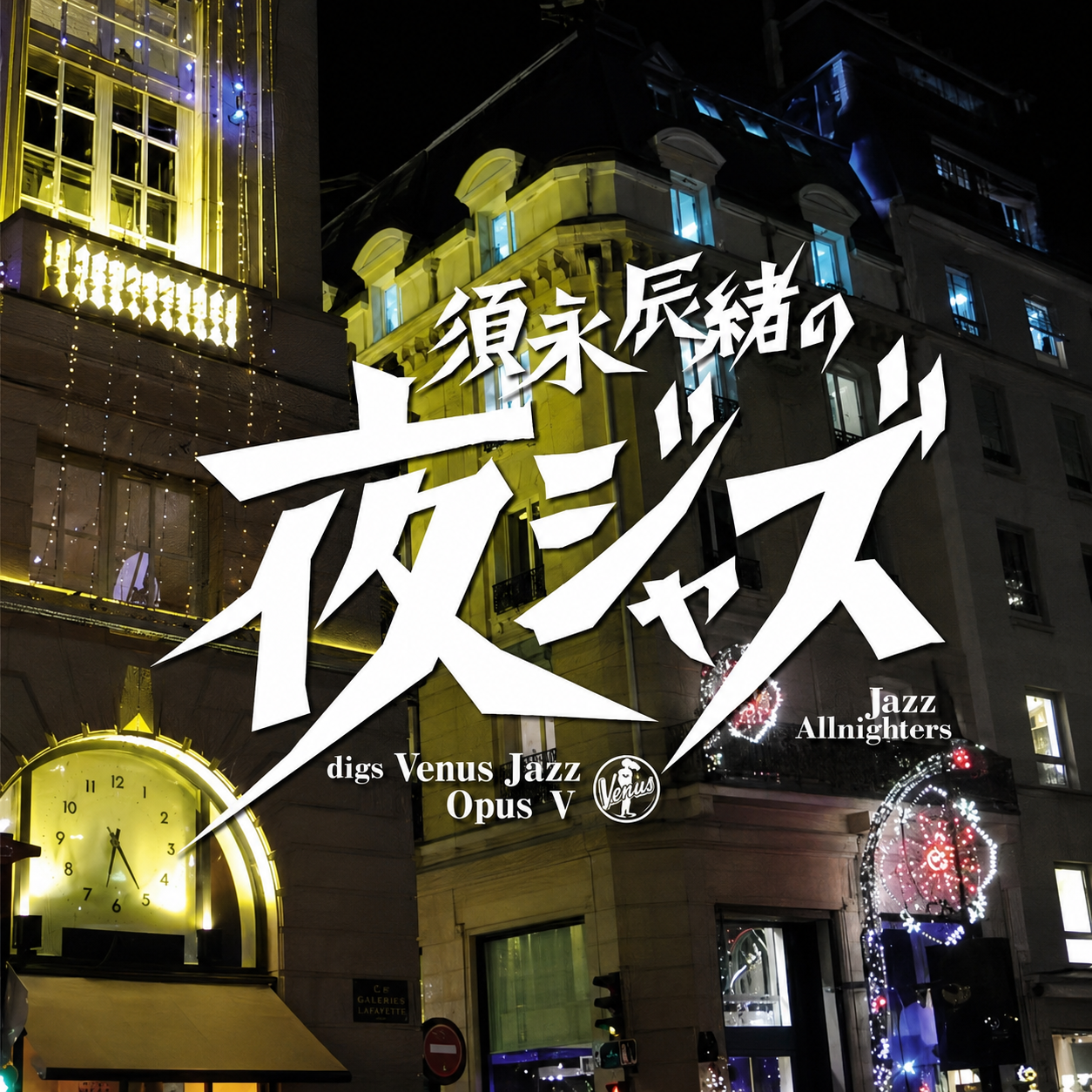
Jazz Allnighters
Digs Venus Jazz Opus 5
GREAT CHOICE: Jazz Allnighters Digs Venus Jazz Opus 5!
Great music deserves to be discovered, enjoyed and shared.
CAN YOU SPARE A CUP OF COFFEE?
Audiophile-Streaming is a personal passion project, built with countless hours of discovering, selecting and sharing exceptional music.
I personally cover, without sponsors, the ongoing costs of hosting, software and subscriptions to keep the music discoveries coming. If you enjoy my work, your support is always appreciated.
A LITTLE THANK YOU IN RETURN
Just one coffee gives you lifetime access to the Coffee Club and all its playlists.
No subscriptions. No recurring fees.
Jazz Allnighters Digs Venus Jazz Opus 5: A Journey Into the Deepest Hours of the Venus Records Sound
Midnight has already passed when the first notes emerge. The room is dark except for the glow of the amplifier, the streets outside have lost their urgency, and Thelonious Monk’s “’Round Midnight” begins to unfold through the Bill Crow Quartet. It is difficult to imagine a more appropriate entrance into Jazz Allnighters Digs Venus Jazz Opus 5, an album built around the mysterious moment when jazz stops being entertainment and becomes part of the night itself.
Released in Japan on February 15, 2012, Jazz Allnighters Digs Venus Jazz Opus 5 is the fifth volume in Tatsuo Sunaga’s celebrated exploration of the Venus Records catalogue. The twelve-track compilation was produced by Wakana, compiled by Sunaga and mixed and mastered by Venus Records founder Tetsuo Hara using the label’s distinctive Hyper Magnum Sound Direct Mix Stereo approach. (venusrecord.com)
Sunaga enters the project not merely as a collector choosing favourite recordings, but as a storyteller arranging scenes. Known for his deep knowledge of jazz, club culture and record collecting, he understands that a successful compilation must create more than variety. It must create movement. Each track on Jazz Allnighters Digs Venus Jazz Opus 5 appears at the precise moment when the atmosphere is ready to change.
The opening performance of “’Round Midnight” immediately establishes the album’s after-dark identity. The composition has long represented the nocturnal side of modern jazz, carrying loneliness, elegance and unresolved tension inside one unforgettable melody. In the hands of the Bill Crow Quartet, it becomes the doorway into Sunaga’s imaginary jazz club.
There is no need to rush. The bass moves patiently, the melody hangs in the air, and the spaces between the notes become as meaningful as the notes themselves. Venus Records’ powerful recording style brings the musicians close, creating the sensation that the quartet is playing only a few metres away. The performance does not simply begin the album; it changes the temperature of the room.
The Eddie Allen Quintet follows with “Baptized in the Fire,” introducing a sharper and more urgent mood. The title suggests transformation, and the music delivers it. Where “’Round Midnight” moved through shadows, Eddie Allen brings flame. The horn lines push forward, the rhythm section tightens and the compilation begins to reveal the dramatic contrasts that define Sunaga’s sequencing.
This transition is essential to the appeal of Jazz Allnighters Digs Venus Jazz Opus 5. The album never remains in one emotional position for too long. It moves between contemplation and propulsion, romance and tension, sophistication and raw swing. It sounds like a night that refuses to follow a predictable plan.
Dino Rubino’s interpretation of “You and the Night and the Music” returns the listener to the album’s central theme. Even the title seems to describe the world Sunaga is constructing: one listener, one room and music that becomes more vivid as the outside world disappears.
The song has always carried a sense of seductive danger. Its melody promises intimacy, but its harmony suggests that the night cannot last forever. Rubino’s performance preserves that tension. The music sounds elegant, but never comfortable enough to become background listening. It asks for attention while maintaining the relaxed surface of classic late-night jazz.
The Phil Woods Quintet then introduces “C.K.’s Bossa,” composed by Brian Lynch. The rhythm softens, but the momentum continues. Bossa nova enters the album not as a decorative change of style, but as another shade of the night. The track brings warmth and movement without breaking the compilation’s sophisticated mood.
Phil Woods’ alto saxophone has the clarity and confidence of a musician who knows exactly how much to say. His phrases move easily across the rhythm, combining bebop intelligence with melodic directness. The surrounding ensemble remains alert, giving the performance the conversational quality that separates living jazz from simple technical display.
Walter Bishop Jr.’s “Keiko’s Samba” carries the rhythmic journey further. The piano becomes the driving voice, moving through the samba pulse with authority and lightness. The performance adds colour to the album, but it never sounds disconnected from what came before. Sunaga has built a gradual passage from the darkness of “’Round Midnight” toward a more physical, rhythmically open form of jazz.
The arrival of Nicki Parrott’s “Fever” changes everything again. The instrumental conversation gives way to a voice that is intimate, playful and completely aware of the song’s seductive history. Parrott does not attempt to overpower the familiar composition. Instead, she lowers the temperature and draws the listener closer.
Her performance creates one of the album’s most cinematic moments. The imaginary club is quieter now. Glasses rest on tables, conversations have stopped and the bass line moves with deliberate restraint. “Fever” is a song built from controlled tension, and Parrott understands that its power lies in what is withheld.
This is also where the Venus Records sound becomes especially important. The bass possesses physical weight, the vocal remains present and natural, and the smallest rhythmic details are allowed to emerge from the arrangement. For audiophile jazz listeners, Jazz Allnighters Digs Venus Jazz Opus 5 offers the immediacy and tonal richness associated with the Japanese label’s recording philosophy.
Yet this is not an audiophile test album disguised as a compilation. The sound quality matters because it brings the emotional details closer. A breath before a lyric, the resonance of a piano chord or the fading edge of a cymbal can alter the entire meaning of a performance. The production serves the musicians rather than distracting from them.
The David Hazeltine Trio follows with Bud Powell’s “Cleopatra’s Dream,” one of the most recognisable piano compositions in bebop. Hazeltine approaches the piece with precision, but also with an understanding of its playful, slightly restless character. The piano moves rapidly through the melodic turns while the bass and drums maintain a firm rhythmic frame.
After the slow-burning intimacy of “Fever,” “Cleopatra’s Dream” feels like the room suddenly coming back to life. The tempo rises, conversation returns and the album’s energy shifts upward. Sunaga’s sequencing once again proves that contrast can create continuity when handled with care.
Steve Kuhn’s interpretation of “This Is New” brings another change in emotional direction. The Kurt Weill composition carries theatrical elegance, and Kuhn’s trio explores its harmonic possibilities without losing sight of the melody. His playing is thoughtful and spacious, allowing each phrase to develop naturally.
There is a reflective quality to Kuhn’s performance that suits the later stages of the album. The night is now fully established. The opening excitement has passed, but dawn remains distant. This is the hour when time appears to slow down and familiar melodies begin to carry unexpected memories.
Barney Wilen enters with “Blue Lou,” adding the unmistakable character of his tenor saxophone. Wilen’s relationship with European jazz history gives the track a slightly different atmosphere from the American hard-bop performances surrounding it. His sound is stylish but never superficial, balancing cool control with an underlying emotional roughness.
“Blue Lou” swings with an ease that hides its sophistication. The performance feels relaxed, yet every phrase is carefully placed. It is exactly the kind of recording that suits a late-night jazz compilation: accessible on the surface, but increasingly rewarding when heard through a revealing hi-fi system.
The Richie Beirach Trio then takes on Miles Davis’ “Milestones.” The familiar composition becomes a platform for harmonic exploration and rhythmic conversation. Beirach brings intellectual intensity to the performance, but the trio never allows the music to become cold or academic.
“Milestones” pushes the album toward its final act. The rhythm is more insistent, the improvisation more exploratory and the atmosphere more alert. Instead of allowing the programme to fade gradually, Sunaga introduces another surge of energy, reminding the listener that jazz after midnight can be as urgent as it is romantic.
The Moffett Family Jazz Band continues that momentum with John Coltrane’s “Mr. P.C.” The composition was originally written as a tribute to bassist Paul Chambers, and its powerful minor-key structure has made it a lasting vehicle for improvisation. Here it becomes one of the most driving performances on Jazz Allnighters Digs Venus Jazz Opus 5.
The bass is central, the rhythm section presses forward and the ensemble plays with the intensity of musicians fully committed to the groove. After the elegance, bossa nova and vocal intimacy heard earlier, “Mr. P.C.” returns the album to the muscular heart of modern jazz.
Then, just when the listener expects another forceful conclusion, One for All closes the programme with Antonio Carlos Jobim’s “Corcovado.” The tension dissolves. The rhythm relaxes, the city beyond the window seems to grow lighter and the album moves toward its final silence.
“Corcovado,” often known in English as “Quiet Nights of Quiet Stars,” is an ideal closing statement. Its melody contains calm, romance and a subtle awareness that peaceful moments are temporary. One for All treats the composition with restraint, allowing the beauty of the theme to carry the emotional weight.
The track completes a journey that began with Monk’s portrait of midnight. From “’Round Midnight” to “Corcovado,” Tatsuo Sunaga guides the listener through hard bop, bebop, vocal jazz, bossa nova, samba and piano-trio improvisation. The styles change, but the atmosphere remains unified by his understanding of how jazz functions after dark.
That is the real achievement of Jazz Allnighters Digs Venus Jazz Opus 5. It does not sound like twelve unrelated tracks selected from a record label’s archives. It sounds like one continuous evening, programmed by someone who understands the emotional relationship between tempo, tone, silence and sequence.
For listeners discovering Venus Records, the compilation provides an accessible entrance into the label’s extensive catalogue. Bill Crow, Eddie Allen, Dino Rubino, Phil Woods, Walter Bishop Jr., Nicki Parrott, David Hazeltine, Steve Kuhn, Barney Wilen, Richie Beirach, the Moffett Family Jazz Band and One for All appear as individual voices, yet Sunaga connects them through a shared sense of atmosphere. The complete official programme contains twelve recordings and runs from “’Round Midnight” through “Corcovado.” (venusrecord.com)
For established collectors, the pleasure lies in hearing familiar performances placed in a new context. A track taken from an original studio album may acquire another emotional meaning when it follows a contrasting voice or prepares the way for a different rhythm. This ability to create new relationships between existing recordings is the hidden art behind the finest jazz compilations.
The production reinforces the narrative. Tetsuo Hara’s mixing and mastering gives the instruments the bold, immediate presentation associated with Venus Records and its Hyper Magnum Sound. Pianos sound full and percussive, double bass has body, horns appear vivid and forward, and drums carry both impact and detail. (venusrecord.com)
On an audiophile stereo system, the album can become a test of dynamics, instrument separation and tonal realism. On headphones, quieter details become easier to notice. But the equipment is never the final destination. The purpose of the recording is to make the performance feel present, and the finest moments arrive when the listener stops analysing the sound and becomes absorbed in the music.
Jazz Allnighters Digs Venus Jazz Opus 5 is therefore more than a Japanese jazz compilation, more than a Venus Records sampler and more than an audiophile showcase. It is a carefully structured story about the different faces of the night.
It begins in the loneliness of midnight, passes through fire, romance, rhythm and improvisation, and ends beneath Jobim’s quiet stars. When “Corcovado” finally fades, the room returns to silence, but it no longer feels empty.
The album has left something behind: the sensation of having visited a jazz club that may never have existed, during a night that seemed to last much longer than twelve tracks.
