
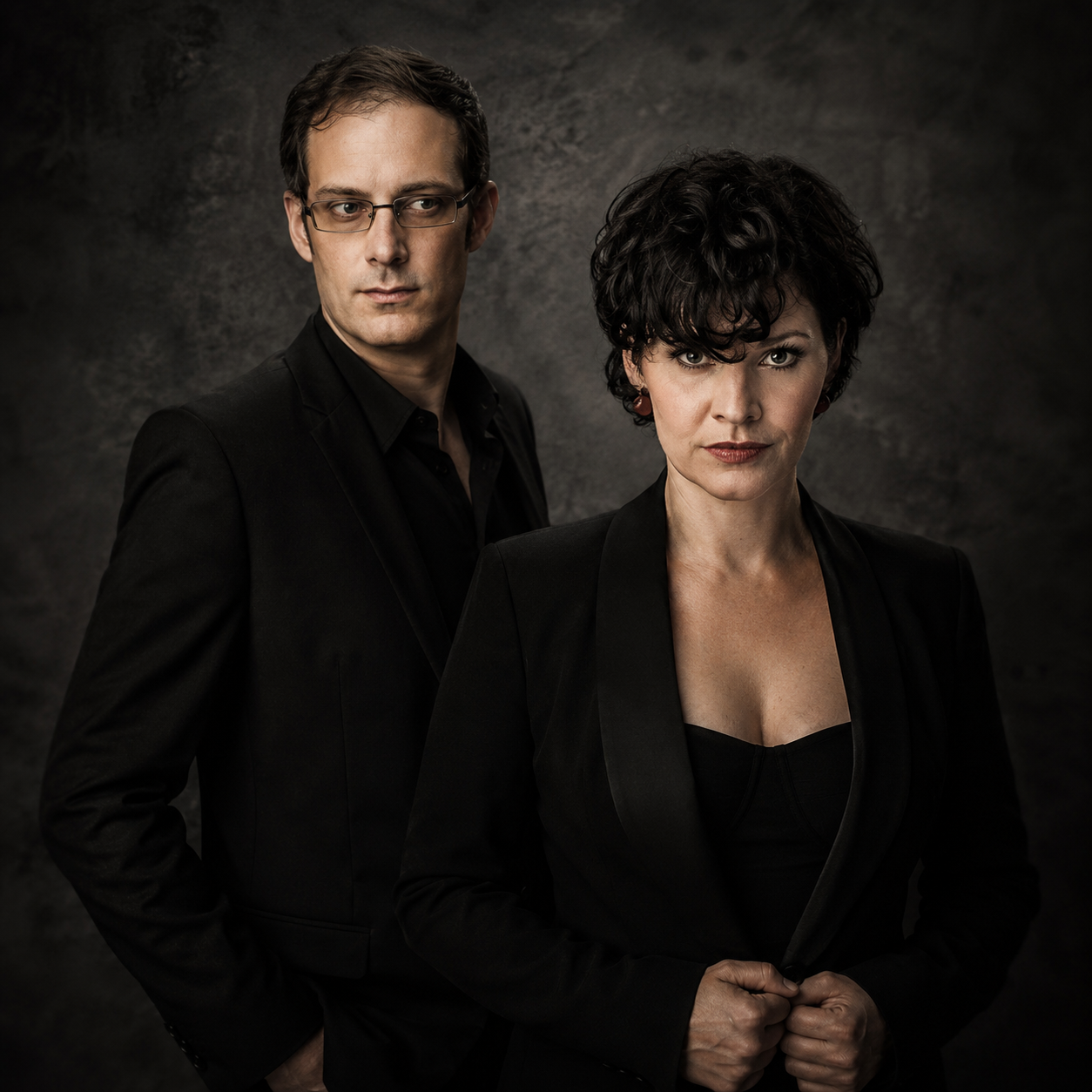
Le Bang Bang
GREAT CHOICE: Le Bang Bang!
Great music deserves to be discovered, enjoyed and shared.
CAN YOU SPARE A CUP OF COFFEE?
Audiophile-Streaming is a personal passion project, built with countless hours of discovering, selecting and sharing exceptional music.
I personally cover, without sponsors, the ongoing costs of hosting, software and subscriptions to keep the music discoveries coming. If you enjoy my work, your support is always appreciated.
A LITTLE THANK YOU IN RETURN
Just one coffee gives you lifetime access to the Coffee Club and all its playlists.
No subscriptions. No recurring fees.
There is something wonderfully uncomplicated about Le Bang Bang. One voice, one double bass and absolutely nowhere to hide. German singer Stefanie Boltz and bassist Sven Faller have built their musical partnership around this seemingly simple combination, turning familiar jazz standards, pop songs and rock classics into something entirely their own. What interests me most is how complete their arrangements can sound without drums, keyboards or guitars. Boltz has an expressive voice that can move from a delicate whisper to a powerful, almost bluesy delivery, while Faller provides considerably more than the usual bass accompaniment. Together, they demonstrate that musical chemistry and imagination can be far more important than the number of musicians in a recording.
Two Musicians, One Remarkable Combination
The story of Le Bang Bang began in Munich in 2010, when Boltz and Faller came together for a spontaneously arranged performance in a bar. Their musical connection was immediately apparent, and the enthusiastic audience response helped turn that first encounter into a lasting partnership. Both musicians already had considerable experience, but their backgrounds were different enough to make the combination particularly interesting. Boltz, born in Munich in 1973, had explored a cappella singing, jazz, theatrical performance and popular music. She performed with the vocal formations Stouxingers and The Croonettes and worked with guitarist Philipp Stauber in the jazz duo Boltz & Stauber. Her experience across these different musical settings helps explain her remarkable flexibility as a singer.
Faller, born in Bad Kreuznach in 1969, brought an equally varied musical background to the partnership. He studied bass in Linz and Munich before moving to New York, where he graduated from the Mannes College of Music in 1997. During his years in the United States, he worked with musicians including Randy Brecker and Jane Monheit, developing an approach to bass playing that extends well beyond traditional jazz accompaniment. After returning to Germany in 2000, he worked with singer-songwriter Konstantin Wecker and became a member of the adventurous jazz group Trio ELF. His experience with jazz, pop and electronic effects gave him an unusually broad musical vocabulary. Listening to Le Bang Bang, I particularly appreciate how naturally he moves between providing a rhythmic foundation and taking a leading melodic role.
Their first album, Bang Bang, appeared in 2011 on GLM Music’s Edition Collage label. Much of the material was recorded during the first weeks of their collaboration, and the album introduced an approach that would become their trademark. Songs associated with Billie Holiday and Duke Ellington appeared alongside material by Paul Simon, Fleetwood Mac and Nirvana. Their version of “Smells Like Teen Spirit” is a particularly interesting example of what happens when a familiar rock arrangement is stripped of its electric guitars and aggressive drumming. Instead of attempting to reproduce the original, they concentrate on the underlying melody, rhythm and emotional character. I particularly enjoy this approach because it encourages me to listen to familiar compositions from a completely different perspective.
One of the qualities I appreciate about Boltz is her ability to change her vocal character without making the performance feel artificial. She can deliver a jazz standard with considerable restraint before approaching a rock composition with an entirely different kind of energy. Her phrasing is flexible, and she is comfortable leaving space between words rather than filling every musical moment. Faller understands exactly how to use that space, sometimes supporting a melody with a simple bass line and sometimes introducing rhythmic accents or unexpected melodic phrases. Their performances work because neither musician appears interested in dominating the other. Instead, they continually respond to what the other is doing.
From Rock Classics to Pure Musical Intimacy
Their second album, Headbang, released in 2013, took the concept considerably further. The track selection includes AC/DC’s “Back in Black,” Metallica’s “Nothing Else Matters,” David Bowie’s “Life on Mars?” and Radiohead’s “Creep.” These are songs that most listeners associate with much larger arrangements, making them particularly interesting material for a voice-and-bass duo. Alongside the rock compositions, they included Joni Mitchell’s “A Case of You” and jazz standards such as “Skylark” and “Midnight Sun.” Original compositions by Boltz and Faller also became part of the programme, demonstrating that the partnership was developing its own musical identity rather than simply producing unusual cover versions.
For me, Headbang is an excellent introduction to their adventurous side. “Nothing Else Matters” is particularly suitable for this kind of treatment because its familiar melody remains effective without the original instrumentation. “Back in Black” presents a completely different challenge, with its identity so closely connected to its famous guitar riff and driving rhythm. I enjoy hearing how the duo approach these contrasting compositions using exactly the same limited collection of musical resources. The absence of a conventional rhythm section also makes me more aware of Faller’s timing and the way Boltz places her vocals against his bass lines. Occasionally, I find myself missing the physical impact of the original rock recordings, but that is part of the interesting contrast rather than a weakness in their musicianship.
The 2017 album Pure is especially relevant to my interest in audiophile music. Recorded directly on stage during their 2016 tour, largely after the audiences had left, it was intended to capture the intimacy of their live performances. The selection includes “Nature Boy,” “Time After Time,” “My Old Flame,” “You Send Me” and Tom Waits’ “San Diego Serenade,” alongside original material. What makes this album particularly attractive to me is the opportunity to concentrate on two musicians interacting in a relatively exposed acoustic setting. Every change in vocal delivery and every movement of the bass becomes an important part of the performance.
“Nature Boy” is an excellent starting point for appreciating the duo’s quieter side, while “Time After Time” offers another opportunity to hear how they approach a familiar composition without relying on its established arrangement. I particularly value the contrast between Boltz’s vocal expression and the physical character of Faller’s double bass. The instrument can provide a deep, rounded foundation, but its upper register and melodic possibilities are equally important to their music. For audiophile listeners, this combination offers an interesting opportunity to concentrate on vocal realism, bass articulation and the relationship between two instruments. A revealing pair of headphones or a well-balanced stereo system can make these small musical details particularly enjoyable.
I would not describe their recordings as conventional audiophile demonstration material designed to impress listeners with spectacular sound effects or exaggerated bass. Their appeal is much more closely connected to musical expression and the ability to hear the relationship between performers. With so little instrumentation, there is nowhere for uncertain timing or an unconvincing interpretation to disappear. The quality of the midrange becomes particularly important because the human voice occupies such a central position in their arrangements. The double bass also provides an excellent opportunity to distinguish between the actual notes being played and the physical resonance of the instrument. These are qualities I value far more than an artificially enormous soundstage.
The duo subsequently expanded its musical possibilities through a collaboration with multi-instrumentalist Martin Kälberer on In Our Blood. His contribution introduced additional instrumental colours while preserving the close musical interaction that characterises Boltz and Faller’s work. The pair also celebrated their first decade together with Greatest Hits Vol. 10, a retrospective released in 2023. The title reflects their playful attitude, something that has always been an important part of their musical personality. Although their unusual instrumentation attracts immediate attention, I believe their longevity is better explained by the strength of their arrangements and their ability to make contrasting musical styles feel compatible.
The Pleasure of Listening Closely
What distinguishes Le Bang Bang from many other jazz and acoustic projects is their refusal to treat familiar songs as untouchable compositions. They are willing to change the rhythmic character, simplify the harmony or approach a melody from an unexpected direction, provided the result remains musically convincing. Their repertoire also makes the traditional boundaries between jazz, pop and rock seem relatively unimportant. I appreciate that freedom, especially when it produces interpretations that reveal details I had previously overlooked in songs I thought I knew extremely well. Their contribution is not about introducing a completely new musical genre, but about demonstrating how much can be accomplished through imaginative arrangements and genuine interaction between two experienced performers.
For somebody discovering Le Bang Bang for the first time, I would begin with Pure to appreciate their more intimate musical character before exploring the adventurous arrangements on Headbang. Their 2011 debut provides the background to that development, capturing the early excitement of two musicians discovering what they could accomplish together. Across these recordings, Boltz’s expressive singing and Faller’s inventive double bass playing remain the essential ingredients. Sometimes the arrangements are playful, sometimes restrained and occasionally quite unexpected, but the communication between the musicians is consistently fascinating. Ultimately, what I admire most about Le Bang Bang is their ability to make two performers sound musically complete through exceptional timing, expressive phrasing and, above all, genuine musical chemistry.
HiFi’ve, Ronald – Your EarFluencer
