
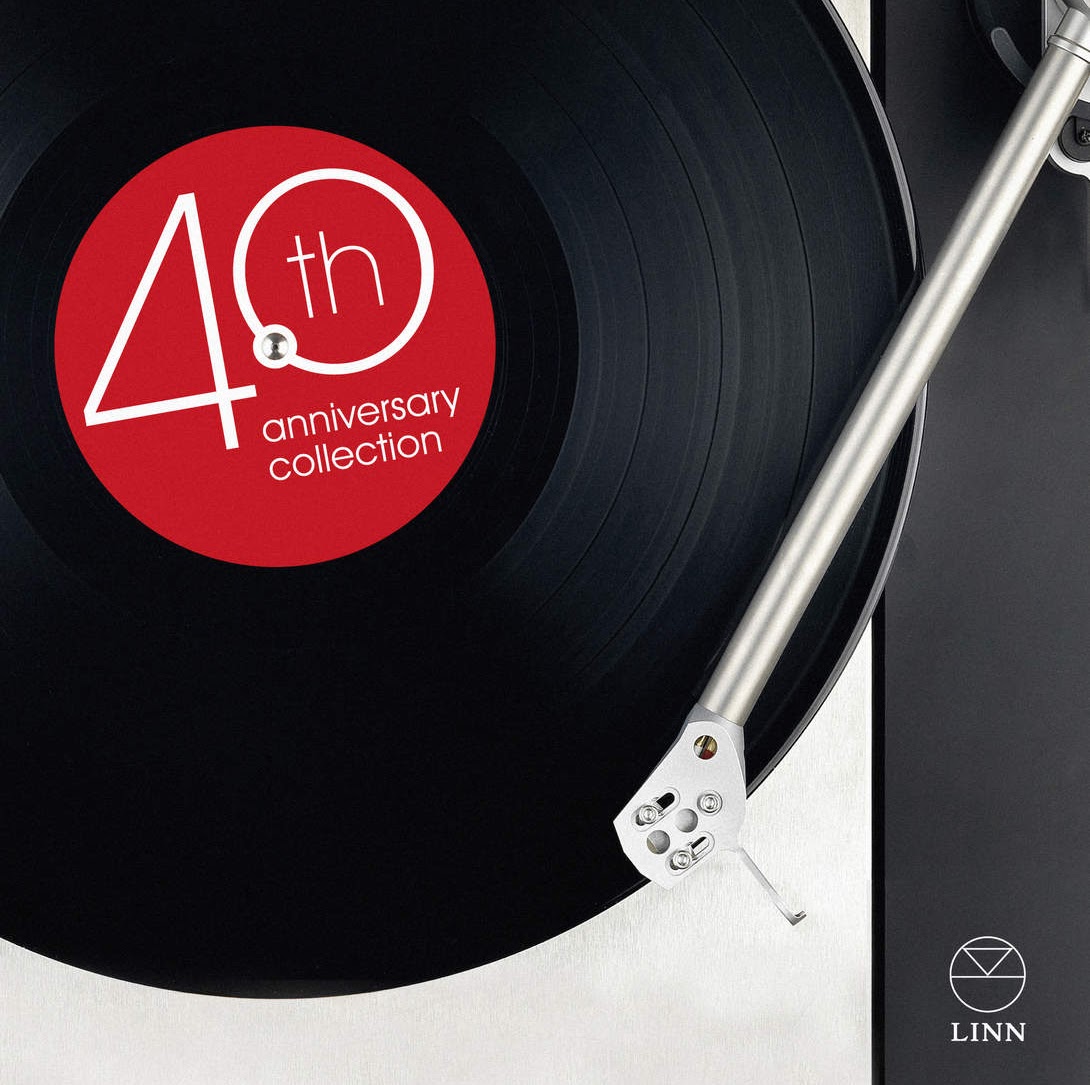
Linn 40th Anniversary Collection
GREAT CHOICE: Linn 40th Anniversary Collection!
Great music deserves to be discovered, enjoyed and shared.
CAN YOU SPARE A CUP OF COFFEE?
Audiophile-Streaming is a personal passion project, built with countless hours of discovering, selecting and sharing exceptional music.
I personally cover, without sponsors, the ongoing costs of hosting, software and subscriptions to keep the music discoveries coming. If you enjoy my work, your support is always appreciated.
A LITTLE THANK YOU IN RETURN
Just one coffee gives you lifetime access to the Coffee Club and all its playlists.
No subscriptions. No recurring fees.
Forty years of music, innovation and a commitment to sound quality are at the heart of the Linn 40th Anniversary Collection. Released in 2013, this compilation celebrates the history of Scottish audio manufacturer Linn Products and its record label, Linn Records. It brings together jazz singers, folk musicians, instrumental soloists, chamber ensembles and full orchestras in a collection that demonstrates just how varied the Linn catalogue had become. For me, this is much more interesting than a conventional audiophile demonstration album. The music comes first, and the recording quality gives me an opportunity to hear what makes each performance special. With 40 tracks spread across two discs and approximately two and a half hours of music, there is plenty to explore.
The story begins in Scotland in 1973, when Ivor Tiefenbrun founded Linn Products and introduced the Sondek LP12 turntable. His belief was that the quality of music reproduction mattered at every stage, particularly at the source. In 1982, Linn expanded that thinking into record production by establishing Linn Records. The label’s early catalogue included jazz singer Carol Kidd and Scottish group The Blue Nile, whose 1984 album A Walk Across the Rooftops became an important part of Linn’s recording history. What I find interesting is that Linn did not simply make recordings to demonstrate expensive audio equipment. It developed a genuine musical identity, working with artists whose performances deserved careful recording and presentation.
From Jazz Vocals to Classical Music
Linn Records gradually established itself as an independent label with a particular interest in jazz, classical music and Scottish performers. Its catalogue grew through relationships with musicians including Carol Kidd, Claire Martin, Martin Taylor and the Scottish Chamber Orchestra. Later recordings by the Dunedin Consort, conducted by John Butt, strengthened Linn’s reputation in historically informed classical performance. In 2010, the label received Gramophone’s Label of the Year award, recognition that reflected its musical achievements as well as its recording standards. I think that distinction is important because a recording can sound technically impressive without being particularly engaging. Linn’s strongest releases manage to combine convincing performances with excellent sound.
The anniversary collection reflects those different sides of the label. Its first disc concentrates on jazz, popular music and folk, while the second moves into classical repertoire, early music and contemporary compositions. I particularly like this arrangement because it allows me to enjoy the voices and smaller ensembles before exploring the different demands of orchestral and acoustic recordings. There is a clear contrast between a close, intimate vocal performance and an orchestra occupying a much larger acoustic space. Both can be revealing on a high-end audio system, but they reveal different things. For me, that variety is one of the strongest reasons to spend time with this collection.
Claire Martin’s interpretation of John Martyn’s Man in the Station is a good example of Linn’s approach to vocal music. Martin has been associated with the label since the early 1990s, developing an extensive catalogue that includes jazz standards, contemporary compositions and interpretations of songs from outside traditional jazz. Her phrasing is confident without becoming predictable, and she knows how to give individual words their proper weight. In Man in the Station, I appreciate the controlled delivery and the way she allows the song’s character to emerge without unnecessary vocal decoration. A good recording of a singer like Martin should make changes in tone, breath and emphasis easy to follow. That natural vocal presentation is far more valuable to me than an artificially enlarged soundstage or exaggerated detail.
Carol Kidd’s Haven’t We Met offers another example of what I enjoy about the label’s vocal recordings. Kidd’s association with Linn stretches back to the beginning of its recording activities, and her relaxed interpretation of jazz standards became an important part of its identity. Her self-titled album Carol Kidd, released in 1984, helped establish a relationship that continued through albums such as All My Tomorrows and Nice Work. On Haven’t We Met, her singing has a conversational quality, with careful timing and a pleasing sense of ease. I particularly value singers who can make a familiar song feel natural without constantly drawing attention to their technique. Kidd achieves that through clear diction, controlled phrasing and an understanding of when simplicity works best.
Another musician worth mentioning is guitarist Martin Taylor, whose interpretation of Robert Palmer’s Johnny and Mary appears on the collection. Taylor is particularly interesting because his fingerstyle technique allows him to carry melody, harmony and rhythm together on the guitar. Rather than depending on a large ensemble to fill every space, his playing creates a complete musical arrangement through the relationship between individual notes and chords. I enjoy listening to the separation between the melodic line and the accompanying figures, especially when the recording preserves the guitar’s natural body and attack. The collection also includes Taylor alongside violinist Stéphane Grappelli on I Thought About You, a reminder of his important connection with the European jazz tradition. These performances demonstrate how much musical information a carefully recorded acoustic instrument can communicate without elaborate production.
The Classical Side of Linn
The second disc introduces a different listening experience, beginning with the first movement of Mozart’s Symphony No. 40 in G minor, K. 550, performed by the Scottish Chamber Orchestra under Sir Charles Mackerras. This performance comes from the orchestra’s acclaimed recording of Mozart’s final four symphonies, Mozart Symphonies 38-41. Mackerras was known for his detailed understanding of Mozart’s music, and his approach gives the orchestral lines a lively, purposeful character. I enjoy the way the music moves forward without sounding unnecessarily heavy. The different string sections and woodwinds each have their own musical role, and a convincing recording helps me follow those relationships. It is an excellent choice for judging stereo imaging, orchestral balance and the ability of speakers to reproduce rapid changes in dynamics without losing clarity.
Handel’s Messiah provides another important connection with Linn’s classical catalogue. The collection includes And He Shall Purify, performed by the Dunedin Consort under John Butt, from their recording of the 1742 Dublin version of Handel’s famous oratorio. That complete recording became one of the label’s major classical achievements and received a Gramophone Award. What interests me is the clarity of the vocal lines and the lively relationship between choir and instruments. With music of this kind, I want to hear individual parts within the ensemble rather than one large, indistinct mass of sound. A good audio system should preserve the energy of the chorus while allowing the different musical textures to remain understandable.
The collection also includes music by Bach, Ravel, Liszt, Berlioz and Arvo Pärt, performed by artists and ensembles associated with Linn. Among these, KUNIKO’s interpretation of Pärt’s Für Alina, arranged for vibraphone and crotales, offers a particularly interesting contrast with the larger orchestral works. The music is restrained, and the spaces between the notes are as important to its character as the notes themselves. I find this kind of performance useful for evaluating the decay of an instrument, the quiet background of a recording and the way individual tones develop naturally. It also demonstrates that impressive dynamics do not always require great volume or a large orchestra. Sometimes a few carefully played notes reveal more about the quality of a recording than an entire symphonic climax.
More Than an Audiophile Sampler
One of the most interesting aspects of Linn’s development was its willingness to embrace different recording and distribution formats. The label released music on vinyl and CD, adopted technologies including HDCD and SACD, and became an early advocate of high-resolution digital downloads. Its Studio Master service made high-quality recordings available to listeners who wanted more than standard compressed audio files. By the time the anniversary collection appeared in 2013, Linn had established a reputation for combining music production with developments in home audio reproduction. I see that history reflected in the collection itself. The emphasis is not simply on producing spectacular bass or unusually bright high frequencies, but on preserving the musical character of very different performances.
As a collection of audiophile music, it has considerable practical value. The jazz recordings are useful for listening to vocal realism, the natural tone of acoustic instruments and midrange transparency. The classical performances introduce larger soundstages, more complex instrumental combinations and a wider range of dynamics. On headphones, I would pay particular attention to the position and separation of individual instruments, while a good pair of speakers can give a stronger impression of the recording space and the scale of an orchestra. However, I would not treat every track as having exactly the same sonic character. These recordings come from different artists, sessions and periods, and their individual production choices remain audible. That variety is part of the appeal rather than a weakness.
There is also a small limitation to this kind of anniversary release. A compilation built from many different recordings cannot always provide the continuity of a carefully planned studio album. Some performances invite deeper listening, while others function mainly as introductions to a larger work. I notice this particularly with the classical selections, where a single movement or excerpt can leave me wanting to hear the complete composition. Fortunately, that is also one of the collection’s strengths. It points toward full-length Linn recordings worth discovering, including Mozart Symphonies 38-41, the Dunedin Consort’s Messiah and the many albums by Claire Martin and Carol Kidd.
For someone discovering Linn Records for the first time, I would suggest beginning with Claire Martin’s Man in the Station, followed by Martin Taylor’s Johnny and Mary and the Scottish Chamber Orchestra’s Mozart performance. These three selections offer a useful introduction to the label’s musical range without requiring any special knowledge of jazz or classical music. They also reveal different qualities in a sound system, from the intimacy of a human voice to the precision of solo guitar and the scale of an orchestra. More importantly, they provide three enjoyable musical experiences that stand on their own. I believe reference music should always be worth hearing even when nobody is evaluating an amplifier, DAC or pair of speakers.
The Linn 40th Anniversary Collection succeeds because it represents a genuine musical history rather than a selection of recordings chosen only for impressive sound effects. From the label’s early work with Carol Kidd to its later achievements with Claire Martin, the Scottish Chamber Orchestra and the Dunedin Consort, Linn developed a catalogue that values musicianship alongside recording quality. Not every selection will appeal equally to every listener, and some of the classical excerpts deserve to be heard in their complete original context. Still, I find this a rewarding introduction to a label that has contributed significantly to audiophile recordings and high-resolution music distribution. For me, the most convincing achievement is not the technology behind these recordings but the way it serves the singers and instrumentalists. Natural musical presence is the quality that best explains why I value Linn’s approach.
HiFi’ve, Ronald – Your EarFluencer