
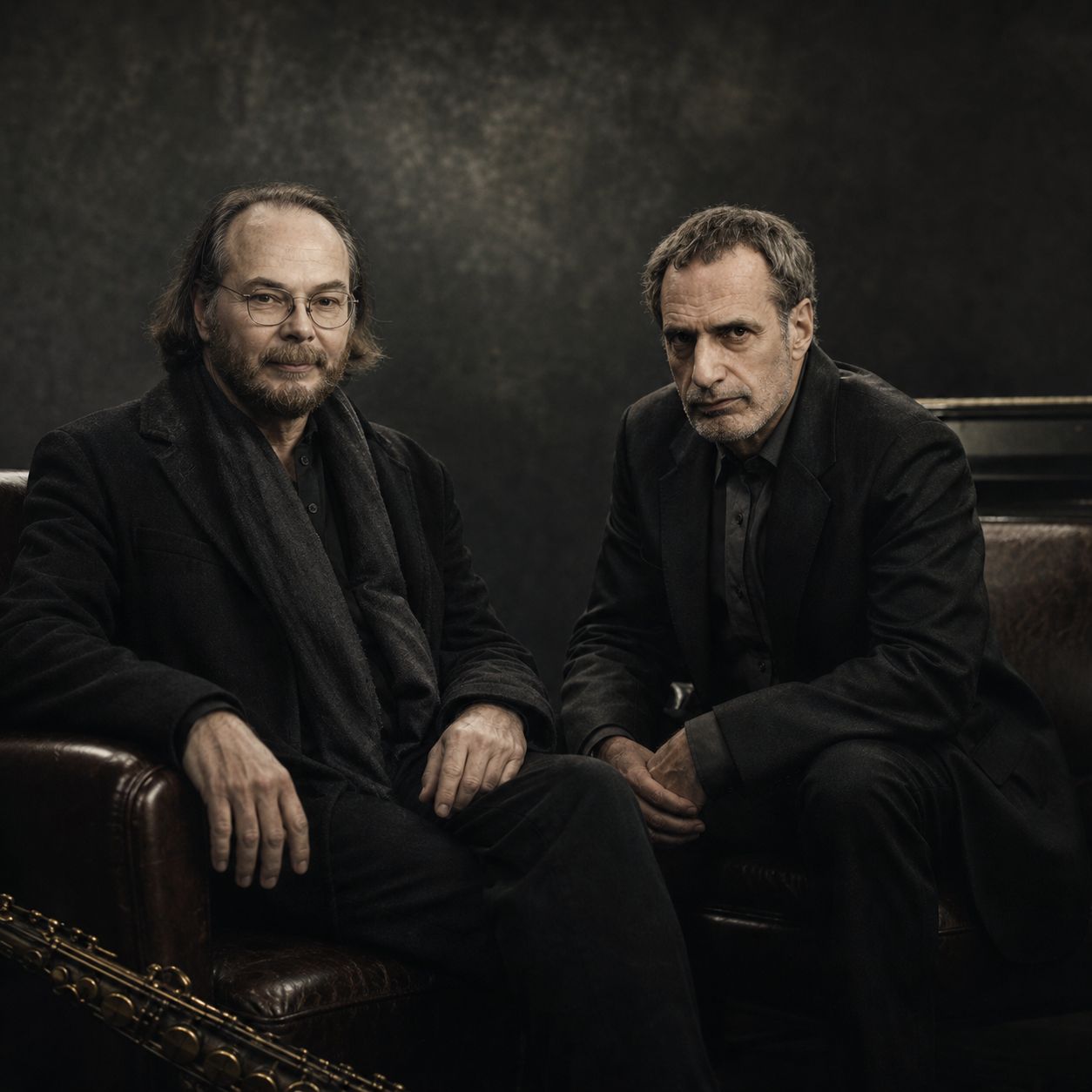
Steely Dan
GREAT CHOICE: Steely Dan!
Great music deserves to be discovered, enjoyed and shared.
CAN YOU SPARE A CUP OF COFFEE?
Audiophile-Streaming is a personal passion project, built with countless hours of discovering, selecting and sharing exceptional music.
I personally cover, without sponsors, the ongoing costs of hosting, software and subscriptions to keep the music discoveries coming. If you enjoy my work, your support is always appreciated.
A LITTLE THANK YOU IN RETURN
Just one coffee gives you lifetime access to the Coffee Club and all its playlists.
No subscriptions. No recurring fees.
Steely Dan created some of the most carefully produced music of the 1970s, but their recordings were never just exercises in technical perfection. Behind the sophisticated arrangements, jazz harmonies and remarkably clean sound was a songwriting partnership with a very particular sense of humour. Donald Fagen and Walter Becker could make a song sound relaxed and accessible while telling a story about disappointment, questionable decisions or people who were not quite as successful as they pretended to be. That contrast is one of the reasons I find their music so interesting. For anyone interested in audiophile music, Steely Dan offers another attraction: recordings in which every instrument has a purpose, every rhythm feels considered and the smallest musical details can change the character of a song.
The story began with two young musicians who shared an interest in jazz, literature and unconventional songwriting. Donald Jay Fagen was born on January 10, 1948, in Passaic, New Jersey, while Walter Becker was born on February 20, 1950, in Queens, New York. They met while studying at Bard College in New York State and discovered that their musical tastes and sense of humour were remarkably similar. Both admired jazz musicians and were interested in combining complex musical ideas with the direct appeal of popular songs. Their influences included jazz, rhythm and blues, soul and the American popular songwriting tradition. What developed between them was more than a conventional writing partnership: Fagen and Becker shared a musical language that would eventually make Steely Dan immediately recognisable.
In 1971, the pair moved to Los Angeles, where producer Gary Katz helped them secure songwriting positions with ABC/Dunhill Records. Their unusual compositions were not always suitable for other performers, so they began putting together a band to record the material themselves. The original Steely Dan included guitarist Denny Dias, guitarist Jeff Baxter and drummer Jim Hodder, with Becker playing bass and Fagen handling keyboards and most of the lead vocals. Their debut album, Can’t Buy a Thrill, appeared in 1972 on ABC Records and introduced a group that sounded quite different from the typical American rock band of the period. The songs had strong melodies and memorable guitar parts, but the arrangements already revealed a fascination with unusual chord changes and unexpected rhythmic details. I hear the beginnings of their later sophistication in these recordings, even though the production is more straightforward than on their subsequent albums.
From Rock Band to Studio Perfectionists
Can’t Buy a Thrill remains an excellent introduction to the early Steely Dan sound. The single “Do It Again” combines a steady, almost hypnotic rhythm with electric piano, guitar and Fagen’s distinctive voice. The instrumental passages are particularly interesting because the musicians create movement without making the arrangement unnecessarily busy. “Reelin’ in the Years” offers a different side of the group, with its energetic guitars and a memorable solo by Elliott Randall. I particularly enjoy how these tracks balance accessible songwriting with instrumental performances that reward closer attention. They are not yet the highly polished audiophile recordings associated with the band’s later years, but their musical identity is already clear.
As Steely Dan developed, Fagen and Becker became increasingly dissatisfied with the limitations of touring and conventional band arrangements. In 1974, they stopped regular touring and concentrated on recording, gradually replacing the permanent band structure with a flexible collection of accomplished studio musicians. This decision changed their music considerably. Instead of adapting their compositions to a fixed group of players, they could select musicians whose particular strengths suited each recording. Guitarists Larry Carlton and Lee Ritenour, bassist Chuck Rainey, drummers Bernard Purdie and Steve Gadd, and keyboardist Victor Feldman were among the many musicians who contributed to their work. Producer Gary Katz and recording engineer Roger Nichols also became central figures in developing the exceptionally detailed Steely Dan studio sound.
This approach produced albums such as Katy Lied in 1975 and The Royal Scam in 1976, where jazz harmony, rock instrumentation and increasingly sophisticated arrangements came together. Listening to this period, I hear a growing confidence in the way the musicians use rhythm and space. The bass lines often carry as much personality as the melodies, while guitar parts appear exactly where they are needed rather than filling every available moment. Fagen’s voice is another important part of the identity. He is not a conventional, powerful rock singer, and his slightly nasal delivery will not appeal to everyone, but I find his phrasing particularly effective. He often sounds detached or amused by the characters in his songs, which makes the lyrics more convincing than a dramatic vocal performance would.
Aja: The Audiophile Reference
The release of Aja in 1977 marked the point where Steely Dan’s musical ambitions and recording techniques came together most successfully. Originally released by ABC Records and produced by Gary Katz, the album featured an extraordinary group of session musicians, including Wayne Shorter, Steve Gadd, Bernard Purdie, Chuck Rainey, Larry Carlton and Michael McDonald. The arrangements became more spacious, the jazz influences more pronounced and the production exceptionally controlled. Yet the album never loses its connection with memorable melodies and strong rhythms. For me, Aja is one of the clearest examples of how sophisticated recording quality can serve the music rather than distract from it.
The title track is particularly rewarding on a revealing hi-fi system. Steve Gadd’s drumming brings an almost conversational quality to the rhythm, while Wayne Shorter’s saxophone solo introduces an expressive jazz element that fits naturally into the composition. The arrangement moves through several sections without losing its sense of direction, and the individual instruments remain easy to follow. On good speakers or headphones, I pay attention to the separation between the drums, bass, keyboards and guitars, but also to how naturally these elements work together. The recording has impressive dynamics without sounding artificially exaggerated. It is the combination of musical freedom and careful arrangement that makes this track special to me.
“Deacon Blues” reveals another side of the album. The song develops at a relaxed pace, with electric piano, bass, restrained drums and horns supporting one of Fagen’s most recognisable vocal performances. The lyrics describe an outsider attracted to an imagined life of jazz, freedom and personal reinvention, and Fagen delivers them with a mixture of sympathy and dry humour. I particularly appreciate how the musicians resist the temptation to make the arrangement unnecessarily dramatic. The rhythm section remains steady, the horns add warmth and the vocal stays clearly positioned within the recording. For listeners interested in vocal realism, midrange transparency and stereo imaging, this is an excellent track for hearing how a carefully balanced mix can create clarity without sacrificing musical character.
Peg and Josie demonstrate that the album is not simply a collection of extended jazz-influenced compositions. Both have strong grooves, memorable melodies and arrangements that feel more immediately accessible. “Peg” is especially useful for appreciating the relationship between the rhythm section, electric keyboards, guitar and backing vocals. Every element seems to have its own position, and nothing needs excessive volume to remain audible. I also enjoy the precision of the playing, particularly the way small rhythmic accents make the music feel alive. This is where Steely Dan’s perfectionism makes sense to me: the performances are controlled, but the groove remains enjoyable.
Gaucho, a Return and a Lasting Influence
By the time Gaucho appeared in 1980 on MCA Records, Steely Dan had taken their studio methods even further. The album’s production was demanding, and its musical character became smoother, more restrained and increasingly focused on rhythmic precision. Songs such as “Babylon Sisters” and “Hey Nineteen” reveal an almost obsessive attention to timing and instrumental balance. Bernard Purdie’s distinctive drumming, the carefully arranged backing vocals and the understated keyboards help create a sound that is immediately recognisable. I particularly enjoy the relaxed shuffle of “Babylon Sisters”, where the rhythm feels effortless even though the arrangement is clearly very carefully constructed. The recording also demonstrates how much depth can be achieved without relying on exaggerated bass or a spectacularly wide soundstage.
For some listeners, Gaucho may sound a little too controlled. The music rarely allows the kind of rough edges that can make a live performance exciting, and the emotional distance in Fagen’s singing can reinforce that impression. I understand that criticism, especially when comparing the album with the more spontaneous moments on Can’t Buy a Thrill. Nevertheless, I find the restraint particularly appealing because it encourages attention to smaller musical details. The interplay between bass and drums, the placement of backing vocals and the precise timing of a keyboard phrase often become more interesting with repeated listening. On a revealing high-end audio system, the album makes it easy to understand why Steely Dan recordings are frequently used as reference music.
Following Gaucho, Fagen and Becker concentrated on separate projects. Fagen released his acclaimed solo debut, The Nightfly, in 1982, while Becker later worked as a producer and released his own music. The two reunited for live performances in the 1990s and eventually returned to the studio as Steely Dan. Their 2000 album Two Against Nature, released through Giant Records, won the Grammy Award for Album of the Year in 2001, an impressive achievement after such a long absence from studio recording. The album also received recognition for its engineering, confirming that their interest in recording quality remained central to their work. Their next studio album, Everything Must Go, followed in 2003 on Reprise Records.
Steely Dan were inducted into the Rock and Roll Hall of Fame in 2001, recognising the importance of their distinctive combination of jazz, rock and sophisticated songwriting. Their influence can be heard in the continuing interest in carefully arranged pop and jazz-rock, particularly among musicians and producers who value harmonic detail and precise instrumental performances. Walter Becker died on September 3, 2017, in Maui, Hawaii, at the age of 67, bringing the original songwriting partnership to an end. Donald Fagen continued performing Steely Dan’s music with a touring band, keeping the songs available to audiences who had followed the group for decades. Although Becker’s musical contribution is impossible to replace, the recordings they created together remain the strongest evidence of their shared vision.
For anyone discovering Steely Dan today, I would recommend beginning with Aja. It offers an excellent balance between accessible songs, accomplished musicianship and outstanding recording quality. From there, Can’t Buy a Thrill reveals where the group started, while Gaucho shows how far their pursuit of precision eventually developed. These recordings also provide excellent material for evaluating speakers, headphones, amplifiers and DACs, particularly when listening for bass definition, natural instrumental textures and the relationship between individual instruments. However, I would never reduce Steely Dan to a collection of hi-fi test tracks. Their music is too interesting for that, and the songwriting deserves as much attention as the production.
What makes Steely Dan important to me is the way Fagen and Becker combined such different musical ideas without losing their own identity. Their background in jazz gave them an unusually rich harmonic language, their experience with rock and soul provided memorable rhythms, and their unusual storytelling gave the songs a personality that remains recognisable. Can’t Buy a Thrill, Aja and Gaucho show three distinct stages of that development, from a talented rock band to a studio-based partnership capable of extraordinarily detailed recordings. Not every arrangement sounds equally natural to my ears, and their pursuit of perfection occasionally leaves less room for spontaneity than I would prefer. But at their best, Steely Dan demonstrate that technical precision, strong songwriting and musical enjoyment can exist together. The quality that best explains my appreciation of their music is their exceptional sense of rhythm.