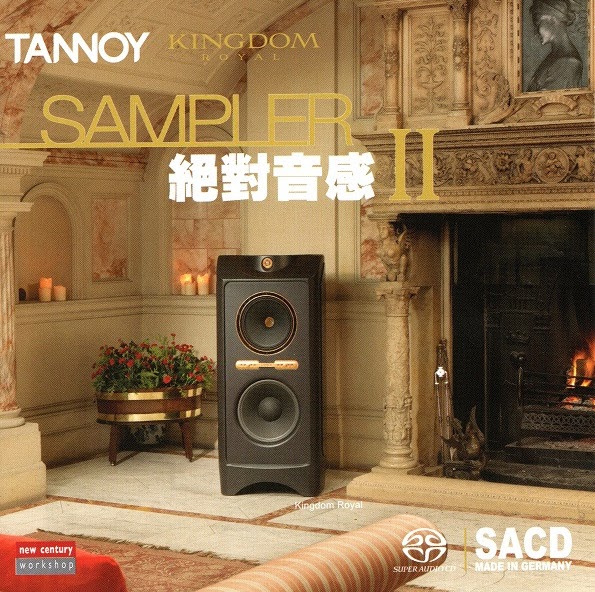
Tannoy
Sampler II
Tannoy Sampler II – When Your Listening Room Becomes a Concert Hall
There is something wonderfully ambitious about a great pair of loudspeakers. Give them an intimate voice or a softly played acoustic guitar and they should be capable of delicacy, subtlety and warmth. Give them a full orchestra a few minutes later and suddenly they are expected to reproduce an entirely different world: enormous scale, explosive dynamics and a soundstage extending far beyond the physical boundaries of two cabinets. Tannoy Sampler II is exactly the kind of audiophile recording that explores those contrasts, turning a listening session into a journey through some of the most demanding sounds a high-end audio system can reproduce.
Associated with the legendary British loudspeaker name Tannoy, this audiophile sampler moves decisively towards classical and orchestral music. Rather than relying on a succession of spectacular effects, the collection uses real instruments, ensembles and acoustic spaces to reveal what an audio system can do. Brass, strings, harp, choir and orchestra each present their own challenge, making Tannoy Sampler II an intriguing reference recording for anyone interested in soundstage, dynamics, tonal balance and the ability of loudspeakers to create a believable sense of scale.
The Concert Hall Opens in Front of You
The journey begins with Purcell’s “Rondeau” from Abdelazer, performed by the Empire Brass Quintet with William Kuhlman. Brass instruments are wonderfully revealing because reproducing them convincingly requires a careful balance between brilliance and body. Too much energy in the upper frequencies and they become hard and aggressive; too little and the excitement disappears. When everything is right, however, you hear not simply a bright metallic sound but the physical character of air moving through an instrument.
From there, the collection quickly expands its ambitions. Paavo Järvi and the Cincinnati Symphony Orchestra take on the dramatic “Death of Tybalt” from Prokofiev’s Romeo and Juliet, while Robert Spano and the Atlanta Symphony Orchestra explore Christopher Theofanidis’ atmospheric Rainbow Body. These are recordings that ask much more from a system than simple frequency extension. An orchestra contains dozens of musicians occupying a large acoustic space, and reproducing that convincingly requires resolution without losing cohesion.
On a well-balanced system, the orchestra shouldn’t become an enormous collection of disconnected instruments. Individual sections remain identifiable, but everything still belongs to the same performance. Strings stretch across the stage, percussion develops depth behind them and brass emerges with power without flattening the entire soundstage.
This is where audiophile orchestral recordings can become addictive. You don’t simply hear more instruments. You begin hearing the hall around them.
Listen to the Space, Not Just the Music
One of the most revealing moments comes with harpist Yolanda Kondonassis performing “Malagueña.” After the scale of an orchestra, the intimacy of a harp forces the listener to adjust. The attack of each string is only the beginning of the sound; what follows—the resonance, harmonic texture and gradual decay—is equally important.
A highly resolving system lets those notes hang naturally in space. Instead of hearing a collection of isolated plucks, you hear the instrument itself developing a physical presence in the room.
That transition from enormous orchestral forces to a more delicate instrument illustrates one of the central pleasures of Tannoy Sampler II. A genuinely capable high-end loudspeaker system shouldn’t have only one impressive trick. Deep bass is exciting, enormous dynamics are exciting and microscopic detail can be fascinating, but musical realism depends on being able to change scale effortlessly.
Sometimes the music needs to fill the room.
Sometimes it needs only a small corner of it.
When the Human Voice Joins the Acoustic
The arrival of Tapestry performing “Propera Amica Mea” from Canticum Canticorum introduces another dimension: the human voice and the acoustic surrounding it. Vocal ensembles are particularly useful for hearing whether a system can separate individual textures while preserving the unity of the performance.
Listen to the reverberation following the voices rather than concentrating solely on the singers themselves. Those tiny reflections contain information about the recording environment. When reproduced correctly, they create depth and atmosphere without needing artificial surround effects.
This is one of the great pleasures of audiophile reference music. The most impressive information isn’t always the loudest information. Sometimes it is hidden in the fraction of a second after the musicians have stopped playing.
Then the Orchestra Lets Go
As the album progresses, scale returns. Gerard Schwarz and the Royal Liverpool Philharmonic Orchestra are followed by Donald Runnicles with the Atlanta Symphony Orchestra and Chorus, before Erich Kunzel and the Cincinnati Pops Orchestra arrive with music from Ben-Hur.
This is where sitting politely and analysing tiny details becomes considerably more difficult.
A large orchestral recording reproduced at a realistic level demands dynamic headroom. Quiet passages need delicacy, but when the orchestra rises the system must respond immediately without compression or hardness. Bass needs weight without becoming slow, percussion needs impact without losing texture and brass must retain its bite without becoming painful.
These qualities have made large-scale recordings popular as audiophile speaker test music for decades. They expose limitations remarkably quickly.
But when a system handles them properly, analysing the equipment becomes the least interesting part of the experience.
The room gets bigger.
From Cincinnati to Rotterdam
One of the enjoyable surprises later in the collection comes from Conrad van Alphen and the Rotterdam Chamber Orchestra with the Allegro vivace from Grieg’s Holberg Suite. After some of the larger-scale performances, the chamber orchestra offers another opportunity to hear how accurately a system reproduces differences in scale.
A chamber ensemble shouldn’t suddenly become a full symphony orchestra simply because the loudspeakers are large. Good reproduction preserves proportion. The performance can still sound expansive and energetic, but the acoustic picture should remain believable.
That may sound obvious, yet it is one of the qualities that separates impressive hi-fi from convincing hi-fi. Bigger isn’t automatically better. The goal is to reproduce what is actually present in the recording.
Boston Baroque under Martin Pearlman continues the exploration with Handel’s ** Music for the Royal Fireworks **, bringing another combination of instrumental texture, speed and acoustic information into the room.
By now, Tannoy Sampler II has taken the system through brass, orchestra, harp, voices, chamber music and baroque repertoire without ever settling into one sonic character.
The Quiet Parts Matter Too
Audiophile demonstrations have a habit of concentrating on dramatic moments. We wait for the enormous drum strike, the deepest bass note or the orchestral crescendo that makes everyone in the room look at the loudspeakers.
Yet the quieter passages can tell you just as much.
Listen to how naturally instruments fade into silence. Notice whether the soundstage remains present when the music becomes soft. Pay attention to whether you can still sense the acoustic environment without increasing the volume.
A truly transparent high-end audio system shouldn’t need to shout to reveal information.
This becomes particularly apparent when moving through the later orchestral selections. The contrast between stillness and power is what creates dynamics in the first place. Without genuine quiet, loud isn’t particularly impressive.
Fifteen Tracks Later
By the time the collection reaches its final stages, with music involving conductors including Benjamin Zander and Paavo Järvi before concluding with Ensemble Galilei, you may have forgotten why you started listening.
Perhaps you wanted to test your loudspeakers. Maybe you were curious about the bass response, stereo imaging or whether moving the speakers slightly further away from the wall had improved the depth of the soundstage. Tannoy Sampler II certainly gives you enough material to investigate all of those things.
But eventually the technical checklist should disappear.
That is when an audiophile reference recording becomes something more valuable than a demonstration disc.
The orchestra expands beyond the loudspeakers. A harp appears delicately in front of you. Brass has weight and energy. Voices reveal the dimensions of the acoustic space, and a quiet passage can make the room seem larger than a spectacular one.
You started the evening listening to your audio system.
Somewhere along the way, the walls moved.
That is the magic a great recording and a great pair of loudspeakers are trying to create. Not simply more bass, more treble or more detail, but the illusion that the listening room is no longer the room you are sitting in.
With Tannoy Sampler II, close your eyes and give the recording enough space to do its work.
If your loudspeakers disappear and a concert hall takes their place, don’t analyse it too much.
Just stay in your seat.
Hi-Fi(ve),
Ronald – Your EarFluencer 🎧


