
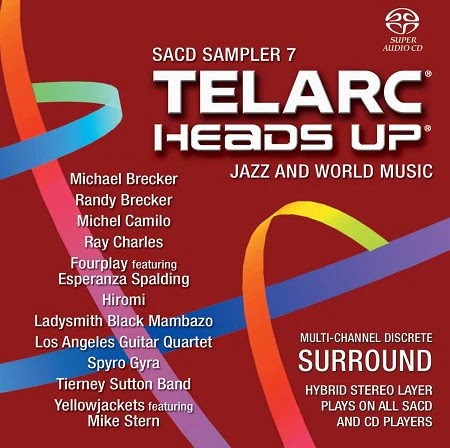
Telarc
Jazz and World Music Sampler 7
Telarc Jazz and World Music Sampler 7 – A Journey Beyond the Boundaries of Audiophile Jazz
Some audiophile albums are designed to show you how beautiful a single voice can sound, or how convincingly an acoustic guitar can appear between two loudspeakers. Telarc Jazz and World Music Sampler 7 has considerably bigger travel plans. From the explosive energy of the Brecker brothers to the unmistakable voice of Ray Charles, from Hiromi’s breathtaking piano playing to the harmonies of Ladysmith Black Mambazo, this is a recording that takes the listener on a journey through jazz, fusion and world music while quietly demonstrating just how exciting a great high-end audio system can be.
Released by Telarc in 2009, the collection brings together eleven recordings from the Telarc and Heads Up catalogues. The musicians alone make the journey irresistible: Michael and Randy Brecker, Ray Charles, Tierney Sutton, Hiromi, the Los Angeles Guitar Quartet, Michel Camilo, Yellowjackets with Mike Stern, Fourplay with Esperanza Spalding, Spyro Gyra and Ladysmith Black Mambazo. It is an extraordinary mixture of styles, but beneath that diversity lies something these recordings share: dynamics, musical energy and the kind of clarity that has made Telarc audiophile recordings favorites among serious listeners.
From the First Note, There Is No Sitting Still
The album doesn’t gently introduce itself. It opens with Michael Brecker and Randy Brecker performing “Some Skunk Funk,” and immediately there is movement everywhere. Brass, bass, drums and keyboards compete for space without losing their individual identities, creating exactly the sort of complex musical picture that can expose the strengths and weaknesses of an audio system.
On a revealing setup, the excitement shouldn’t turn into confusion. Individual instruments remain identifiable even when the arrangement becomes busy, percussion retains its speed and impact, and the soundstage stays open rather than collapsing into a wall of sound. This is where an audiophile jazz recording becomes more than simply a beautifully recorded piece of music. It shows whether your system can keep its composure when several things are happening at once.
Then, almost as if somebody has opened another door, Ray Charles appears with the Count Basie Orchestra performing “Oh, What a Beautiful Morning.” The atmosphere changes completely. The familiar character of Charles’s voice provides a wonderful contrast to the instrumental fireworks that came before it, while the orchestra adds scale and warmth behind him.
It is one of the great pleasures of this sampler: you never remain in the same musical place for very long.
A Song You Thought You Knew
The Tierney Sutton Band follows with “You Are My Sunshine,” but forget the simple song most of us remember. In the hands of Sutton and her musicians, something familiar becomes sophisticated, intimate and surprisingly atmospheric.
This is also the point where you may begin listening differently. Instead of concentrating on sheer dynamics, attention shifts towards the voice and the acoustic space surrounding it. A good system should give Sutton a stable position in the soundstage while preserving the subtle relationships between voice and instruments.
That ability to change perspective is one of the strengths of Telarc Jazz and World Music Sampler 7. It isn’t a collection where every track has been chosen to demonstrate the same audiophile trick. Each recording asks something different of the system and of the listener.
And then Hiromi arrives.
When Hiromi Plays Caravan
Anyone familiar with Hiromi knows that sitting politely in the background isn’t really part of the experience. Her interpretation of “Caravan,” performed with Hiromi’s Sonicbloom, brings extraordinary energy to the album. Piano becomes both melodic and percussive, and rapid changes in intensity give amplifiers and loudspeakers plenty to deal with.
A piano is one of the most revealing instruments in recorded music. The initial strike needs speed, the note itself requires weight and harmonic complexity, and its decay must disappear naturally into the recording space. Get that balance wrong and a piano becomes hard, thin or strangely mechanical. Get it right and you begin to appreciate why high-resolution jazz recordings can be so addictive.
With Hiromi, however, there isn’t much time for technical analysis. The music keeps moving.
That is probably exactly as she intended.
From Japan to Brazil and the Caribbean
After the intensity of “Caravan,” the Los Angeles Guitar Quartet changes the scenery with Antônio Carlos Jobim’s “O Morro Não Tem Vez.” Suddenly the musical landscape becomes lighter and more spacious. Four guitars require precision of a different kind, with each instrument needing its own tonal character and position while still sounding like part of a single ensemble.
Then Michel Camilo takes us somewhere else again with “Hurry Up and Wait.” His rhythmic piano playing brings Latin jazz energy into the journey, making this an excellent track for listening to transient speed, percussion and bass definition. A system that sounded wonderfully warm and relaxed a few tracks earlier now has to demonstrate that it can move.
This is why a varied audiophile reference album can be so useful. One track might flatter a particular system characteristic, but eleven radically different recordings make hiding considerably more difficult.
The Soundstage Gets Crowded
The Yellowjackets, joined by Mike Stern, continue the journey with “Dreams Go,” before Michael Brecker returns with the expansive “Tumbleweed.” These are recordings where instrument separation becomes particularly interesting, but separation shouldn’t mean pulling the musicians apart into isolated hi-fi demonstrations.
Great stereo reproduction does something subtler. It allows each musician to occupy a believable position while preserving the sense that everyone is playing together.
Close your eyes and listen beyond left and right. Is one instrument positioned behind another? Does the percussion have its own acoustic space? Can you follow a bass line without it becoming detached from the rest of the music?
When a high-end audio system gets those relationships right, the soundstage develops depth rather than merely width.
The loudspeakers begin to disappear again.
And Then Esperanza Spalding Appears
One of the most intriguing moments arrives with Fourplay featuring Esperanza Spalding on “Prelude for Lovers.” Here the mood becomes more intimate and the young bassist and vocalist brings another texture to an album that has already travelled through several musical worlds.
After the complexity and energy of the preceding tracks, the change of scale is refreshing. It is also another reminder that audiophile sound isn’t always about spectacle. Sometimes the most impressive thing a system can reproduce is subtlety: the texture of a voice, the body of an instrument or the quiet acoustic information surrounding a performance.
Spyro Gyra’s “Simple Pleasures” then brings back the groove, with the polished fusion sound providing another excellent test of rhythm, bass control and stereo imaging.
By now, however, hopefully you have stopped treating the album as a test.
The Journey Ends in South Africa
The final destination could hardly be further removed from the opening Brecker track.
Ladysmith Black Mambazo closes the collection with “This Is the Way We Do,” and suddenly the most important instrument is once again the human voice—but this time multiplied into the extraordinary vocal harmonies for which the South African group is famous.
Listen to how the voices relate to one another. On a transparent system they shouldn’t merge into one indistinct vocal mass. Individual textures remain audible while the singers combine into something larger than any single voice.
It is a beautiful way to finish an album that has spent more than an hour refusing to stay within one musical boundary.
Eleven Tracks, One Audiophile Adventure
You could use Telarc Jazz and World Music Sampler 7 to evaluate almost every important characteristic of an audio system. The Brecker brothers test speed and separation, Ray Charles brings vocal character and orchestral scale, Tierney Sutton reveals intimacy and imaging, Hiromi challenges dynamics and transient response, while Michel Camilo, Yellowjackets, Fourplay and Spyro Gyra explore rhythm, bass definition and musical timing. Finally, Ladysmith Black Mambazo provides an entirely different test of vocal texture and spatial information.
That makes this collection excellent audiophile reference music for testing speakers, headphones, amplifiers and DACs, but reducing it to a collection of test tracks would miss its greatest strength.
It is simply tremendous fun to listen to.
Perhaps that is what makes the best Telarc recordings so enduring. Exceptional sound quality is always welcome, but technical perfection means very little if the music doesn’t make you want to hear the next track.
With Jazz and World Music Sampler 7, the next track could take you almost anywhere.
So don’t skip ahead. Don’t select only the track you normally use to test your system. Start with the Breckers and let the album travel.
By the time Ladysmith Black Mambazo sings the final notes, your listening room will have crossed jazz clubs, concert stages and continents without moving a single loudspeaker.
And that may be the best demonstration of high-end audio of all.
Hi-Fi(ve),
Ronald – Your EarFluencer 🎧
