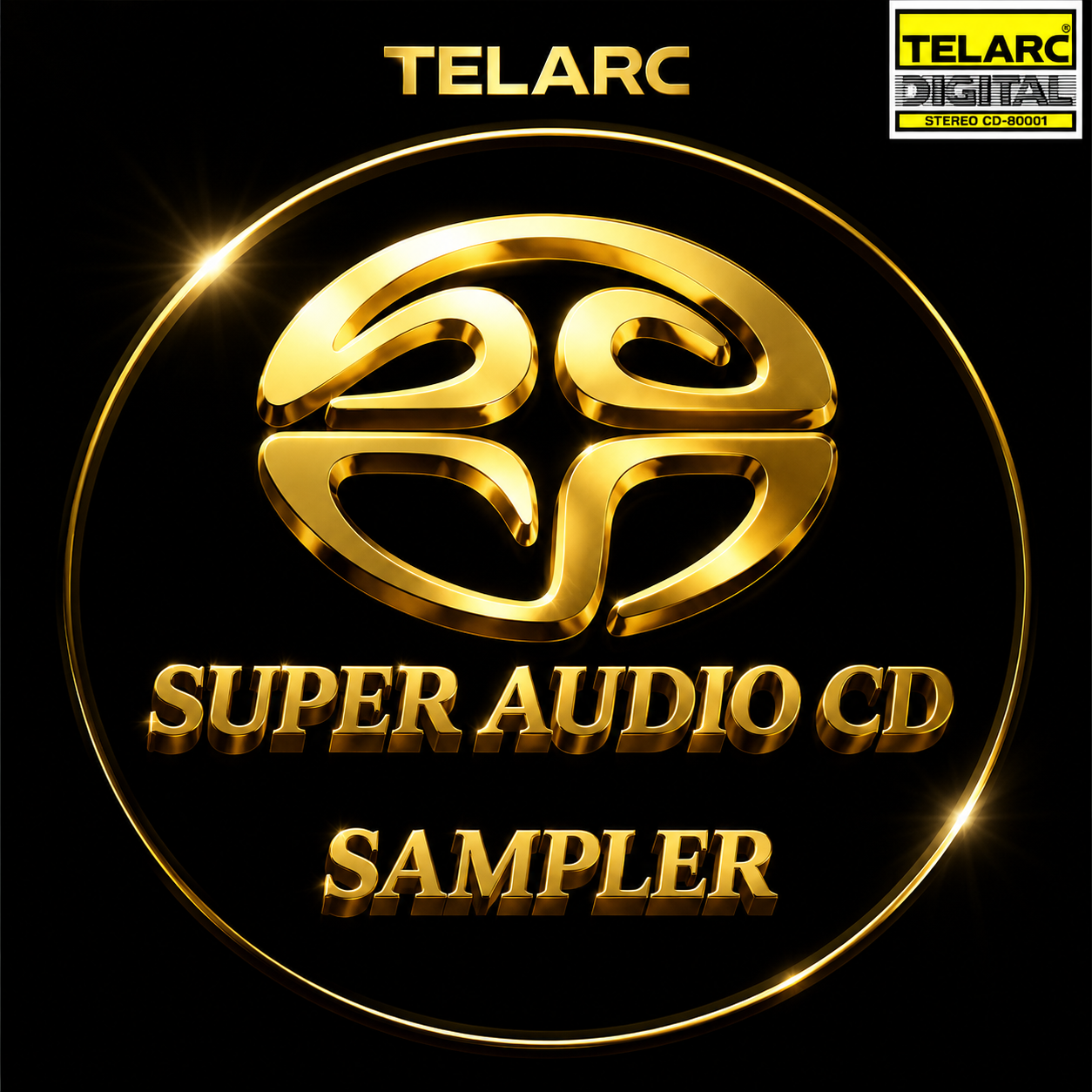
Telarc
Super Audio CD Sampler
Telarc Super Audio CD Sampler – When SACD Opened a New Chapter in Audiophile Sound
At the end of the 1990s, digital audio was about to enter a fascinating new chapter. The compact disc had transformed the way people listened to music, but for serious audiophiles the search for greater resolution, more natural dynamics and a more convincing sense of musical space had never stopped. Then came Super Audio CD, promising a new generation of digital reproduction, and Telarc Super Audio CD Sampler arrived at precisely that moment. Released in 1999 as a showcase for Telarc’s early SACD catalogue, this thirteen-track collection now feels like a musical snapshot of the moment when high-resolution digital audio was beginning to show what it might become.
For Telarc, the arrival of SACD was particularly appropriate. Long before high-resolution audio became part of everyday audiophile vocabulary, Telarc Records had established a reputation for recordings with extraordinary dynamics, natural instrumental timbre and an ability to capture the scale of a performance without making it sound artificially impressive. The new Super Audio CD format offered another way to pursue those qualities, and this sampler brings together jazz, blues, orchestral music, vocals and classical performances in a collection designed to demonstrate far more than simple technical resolution.
The journey begins with Erich Kunzel and the Cincinnati Pops Orchestra performing “Let Yourself Go!”, followed by “September in the Rain” and “Night and Day.” These opening tracks immediately reveal why orchestral recordings can be so effective for evaluating a high-end audio system. There is scale, but there is also subtlety. Individual instrumental sections need their own position within the soundstage while remaining connected to the orchestra as a whole, and dynamic changes should feel effortless rather than compressed. A revealing system allows the acoustic picture to develop behind and between the loudspeakers, giving the orchestra depth instead of simply spreading it across a wide stereo image.
After three Cincinnati Pops performances, Monty Alexander changes the atmosphere completely with “No Woman, No Cry.” The familiar Bob Marley composition enters a different musical world in Alexander’s hands, and that transition demonstrates one of the strengths of the Telarc sampler. It isn’t designed around one particular audiophile sound. Instead, the variety of recordings asks the system to change character with the music. Alexander continues with “So Jah Seh,” bringing rhythmic energy and a very different sense of scale after the orchestral opening.
That variety becomes even more apparent with The Ray Brown Trio featuring Nancy King and Antonio Hart on “The Perfect Blues.” Acoustic bass is one of the great tests of natural low-frequency reproduction because it requires far more than extension. Ray Brown’s instrument should have weight, but also texture, pitch and the unmistakable resonance of strings interacting with a large wooden body. When bass reproduction is right, individual notes remain easy to follow without becoming detached from the rest of the ensemble. The voice and saxophone add their own tonal signatures, making this an excellent example of why well-recorded jazz remains such valuable audiophile reference music.
The collection then brings in another giant of jazz with the Dave Brubeck Quartet performing “Deep Purple.” At more than eight minutes, the track has enough room to develop naturally, allowing piano, bass, drums and the surrounding acoustic space to become part of the listening experience. Piano in particular is notoriously difficult to reproduce convincingly. The initial attack of a note must be fast and precise, but the harmonic body and decay that follow are equally important. Too much emphasis on attack makes the instrument hard and mechanical, while insufficient resolution can rob it of life. A well-balanced high-end system allows those elements to coexist without drawing attention to any one of them.
What follows may be one of the most appealing combinations on the entire sampler: Oscar Peterson, Ray Brown and Milt Jackson performing “Caravan.” Three musicians with unmistakable musical personalities come together in a recording that provides almost everything an audiophile could ask for without ever sounding like a technical demonstration. Peterson’s piano brings speed and dynamics, Brown’s bass provides weight and rhythmic foundation, while Jackson’s vibraphone introduces a completely different set of harmonic textures. The ability to follow each musician individually while still hearing a coherent trio is a far more meaningful test of transparency than simply searching for the smallest possible sound hidden somewhere in the recording.
By this point, Telarc Super Audio CD Sampler has travelled through orchestral arrangements, reggae-influenced jazz, blues and classic jazz trio performances, but the musical landscape changes again with Rudolf Werthen and I Fiamminghi performing Astor Piazzolla’s “No. 1 Street Tango.” The transition into classical and tango repertoire introduces strings and another kind of acoustic space, revealing whether a system can reproduce instrumental texture without making the upper frequencies unnaturally sharp. String recordings are particularly unforgiving in this respect, and a transparent system needs enough resolution to preserve harmonic complexity while maintaining the natural warmth of the instruments.
Erich Kunzel and the Cincinnati Pops Orchestra then return with “Children Will Listen” from Into the Woods and “He Lives in You” from The Lion King. These tracks bring voices and orchestral scale together, providing another opportunity to hear how well the recording preserves depth when many musical elements occupy the same space. Good stereo reproduction shouldn’t simply separate everything into isolated positions. The challenge is to create enough definition that individual parts remain clear while preserving the sense of a unified performance.
The final section takes the sampler even further into classical territory. Erik van Nevel and Currende perform Philippe de Monte’s “Bona est oratio cum ieiunio,” introducing a very different vocal acoustic before Robert Shaw, the Atlanta Symphony Orchestra and Chorus conclude the collection with “Quando corpus morietur” from Dvořák’s Stabat Mater. After the intimate jazz performances earlier in the album, the scale of orchestra and chorus provides a fitting conclusion. Reproducing such a performance convincingly requires dynamics, tonal balance and spatial depth simultaneously, but the quieter information is just as important as the grandest passages. The acoustic decay surrounding the chorus helps define the recording venue, while the relationship between voices and orchestra determines whether the presentation feels genuinely three-dimensional.
Listening to the sampler today also provides an interesting perspective on the history of Super Audio CD and high-resolution audio. In 1999, SACD represented something genuinely new. Developed around DSD technology, the format promised a different approach to digital reproduction and arrived at a time when audiophiles were already debating the limitations and possibilities of conventional digital audio. Telarc was among the labels ideally positioned to demonstrate what the format could offer because its catalogue already contained recordings whose dynamics and spatial information could challenge even excellent playback systems.
More than a quarter of a century later, the technology surrounding digital music has changed dramatically. High-resolution downloads and lossless streaming have made exceptional digital quality far easier to access, while modern DACs offer capabilities that would have seemed extraordinary when the first SACD players appeared. Yet the musical qualities demonstrated by Telarc Super Audio CD Sampler have hardly changed. Natural timbre still matters, dynamic range remains essential, acoustic bass still needs texture rather than merely depth, and a convincing soundstage depends on far more than simply placing sounds to the left and right.
That makes the album surprisingly relevant as audiophile reference music for speakers, headphones, amplifiers and DACs. The Cincinnati Pops recordings can reveal scale and dynamics, Monty Alexander tests timing and rhythmic character, Ray Brown exposes bass definition, Dave Brubeck and Oscar Peterson challenge piano reproduction, while the classical and choral selections explore instrumental texture, soundstage depth and the ability of a system to remain composed during complex passages.
However, treating this collection only as an audiophile test disc would overlook what makes the best Telarc recordings endure. The technology may have been an important reason for creating the sampler, but the musicians are the reason to continue listening to it. Once Oscar Peterson, Ray Brown and Milt Jackson begin playing, discussions about digital formats become considerably less interesting, and when the Atlanta Symphony Orchestra and Chorus fill the final recording with scale and atmosphere, specifications can wait.
Telarc Super Audio CD Sampler therefore represents more than an early demonstration of SACD. It captures a fascinating moment when digital audio was taking another technological step forward while reminding us that the ultimate objective had remained exactly the same. Whether music reaches us from SACD, a modern DAC or a high-resolution streaming service, the goal is still to preserve enough of the original performance that the equipment gradually disappears from our attention.
Start with the Cincinnati Pops, follow Monty Alexander into jazz, spend some time with Ray Brown, Dave Brubeck and Oscar Peterson, and allow the journey to finish with Dvořák. Somewhere during those thirteen tracks, you may hear exactly what Telarc was trying to demonstrate back in 1999.
Not simply a new audio format, but another way of getting closer to the music.
Hi-Fi(ve),
Ronald – Your EarFluencer 🎧


