
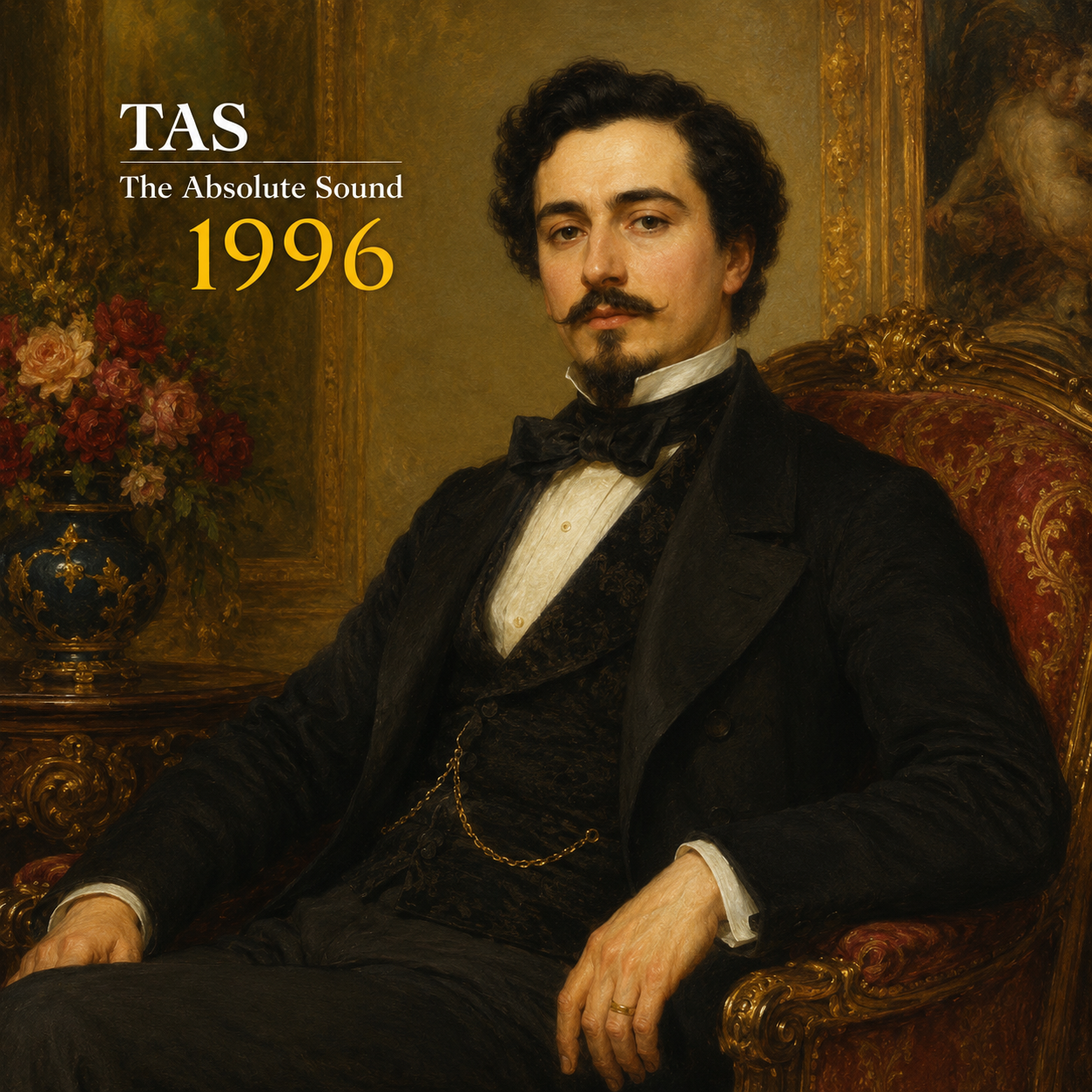
The Absolute Sound
1996
GREAT CHOICE: The Absolute Sound 1996!
Great music deserves to be discovered, enjoyed and shared.
CAN YOU SPARE A CUP OF COFFEE?
Audiophile-Streaming is a personal passion project, built with countless hours of discovering, selecting and sharing exceptional music.
I personally cover, without sponsors, the ongoing costs of hosting, software and subscriptions to keep the music discoveries coming. If you enjoy my work, your support is always appreciated.
A LITTLE THANK YOU IN RETURN
Just one coffee gives you lifetime access to the Coffee Club and all its playlists.
No subscriptions. No recurring fees.
The Absolute Sound 1996, The Remarkable Beginning of a Legendary Audiophile Series
There are albums that simply collect songs, and then there are albums that seem to open a door into another world of listening. The Absolute Sound 1996 belongs unmistakably to the second group. From the moment the music begins, the album feels less like an ordinary compilation and more like an invitation to discover what high fidelity sound can truly mean. It is atmospheric, carefully balanced and deeply musical, offering the kind of listening experience that reminds audiophiles why they first became fascinated by loudspeakers, amplifiers, headphones and beautifully recorded music.
Released as the first chapter in the celebrated TAS series, The Absolute Sound 1996 established a standard that later editions would continue to explore. Its importance is not based only on age or collectability. The album remains relevant because it brings together the qualities that define the best audiophile recordings, including natural vocals, spacious soundstage reproduction, refined instrumental detail and an impressive sense of musical realism. Nearly three decades after its appearance, it still deserves a place among the best audiophile albums for testing speakers and enjoying high quality music.
A Musical Journey Rather Than a Technical Demonstration
The great achievement of The Absolute Sound 1996 is that it never feels like a sterile speaker test disc. The album can reveal the strengths and weaknesses of a high end audio system, yet the music always comes first. Instead of forcing the listener to concentrate on isolated sounds, it creates a continuous musical journey in which voices, instruments and recording spaces gradually reveal themselves.
That sense of flow is important because true high fidelity is not only about hearing more detail. It is about hearing the relationships between sounds. A singer should not appear as a detached image in the centre of the room, but as part of a believable acoustic space. A piano should not be reduced to a series of sharp notes, but should carry weight, resonance and natural decay. Strings should have texture, while percussion should possess both impact and air.
The Absolute Sound 1996 allows these qualities to emerge naturally. On a well balanced stereo system, the album sounds open and unforced, with each recording offering its own atmosphere. Some passages draw the listener closer through intimacy and warmth, while others create a larger, more dramatic presentation. This variety makes the album ideal as both an audiophile reference recording and an enjoyable musical companion.
An Excellent Album for Testing Speakers
For listeners searching for the best music to test speakers, The Absolute Sound 1996 remains a highly rewarding choice. Its carefully recorded vocals and acoustic instruments quickly reveal whether a loudspeaker has a natural tonal balance. If the midrange is coloured, voices may sound too heavy or too thin. If the treble is aggressive, delicate details may become sharp and tiring. If the bass lacks control, the music may lose its rhythm and sense of foundation.
A capable pair of high end speakers should reproduce this album with clarity and ease. The central image should remain stable, instruments should occupy believable positions and the soundstage should extend beyond the physical boundaries of the loudspeakers. The best systems create the impression that the speakers have disappeared entirely, leaving only the performance behind.
This is where The Absolute Sound 1996 becomes especially valuable as a hi fi test album. It does not rely on exaggerated effects to sound impressive. Instead, it rewards systems that are balanced, transparent and musically convincing. A good setup will reveal the album’s detail, but a truly excellent setup will reveal its emotion.
Natural Vocals and Beautiful Midrange Realism
The human voice has always been one of the most reliable tools for evaluating audio equipment, and The Absolute Sound 1996 offers many moments in which vocal realism becomes central to the experience. Through transparent loudspeakers or reference headphones, singers can appear remarkably present, with breath, phrasing and subtle emotion clearly preserved.
The finest vocal recordings on the album demonstrate why audiophile female vocals and acoustic performances remain so popular among serious listeners. A natural voice contains warmth, texture and small variations that are easily lost on ordinary equipment. When reproduced correctly, those details never sound artificial or overemphasised. They simply make the performance feel more human.
This quality gives The Absolute Sound 1996 an intimate character. The listener is not kept at a distance. Instead, the album creates the impression of being close to the musicians, hearing not only the notes but also the space around them. That sense of closeness makes the album particularly effective for testing midrange transparency, vocal clarity and overall tonal accuracy.
A Wide and Convincing Stereo Soundstage
One of the most impressive features of The Absolute Sound 1996 is its ability to create a broad and immersive stereo soundstage. On a carefully positioned pair of speakers, the music can stretch beyond the left and right channels while maintaining a strong and focused centre image. Instruments do not merely sit in a flat line. They appear to occupy different layers of depth, giving the recordings a more realistic and three dimensional character.
This makes the album extremely useful for adjusting speaker placement. Small changes in toe in angle, distance from the rear wall or listening position can influence the presentation dramatically. The voice may become more focused, the bass may tighten and the soundstage may suddenly open.
For audiophiles interested in stereo imaging, room acoustics and speaker setup, The Absolute Sound 1996 offers an excellent reference point. Because the recordings are musically engaging, the process never becomes tiring. Each adjustment brings the listener closer to the ideal balance between precision and naturalness.
A Rewarding Test for Headphones, Amplifiers and DACs
Although The Absolute Sound 1996 is often associated with loudspeaker listening, it is equally effective as a headphone test album. Good audiophile headphones should reproduce the album with smooth treble, clear vocals and a spacious presentation. Open back headphones may emphasise the sense of air and depth, while closed back designs may reveal their strengths in intimacy, low frequency control and focus.
The album is also useful for comparing amplifiers, CD players, network streamers and digital audio converters. A refined DAC may reveal more ambience and tonal texture. A powerful amplifier may provide greater control and dynamic freedom. A superior source component may improve separation without making the music sound cold or analytical.
These differences are often subtle, but The Absolute Sound 1996 makes them easier to recognise because the recordings contain both fine detail and emotional content. The best component is not necessarily the one that produces the brightest sound or the most obvious detail. It is the one that allows the album to sound more natural, more coherent and more involving.
The Historic First Chapter of the TAS Series
As the first edition in the TAS collection, The Absolute Sound 1996 also carries genuine historical importance. It introduced a formula that would become familiar to audiophile listeners around the world, combining carefully chosen music with recording quality capable of demonstrating high end audio equipment.
For collectors, that makes the album an essential early title. For music lovers, however, its value goes far beyond rarity. The Absolute Sound 1996 still succeeds because the musical selections have not lost their ability to communicate. The recordings remain vivid, expressive and technically impressive, even when played through modern audio systems.
That timeless quality separates a genuine audiophile classic from a temporary demonstration disc. Technology changes, formats evolve and listening habits move from compact disc to lossless streaming and high resolution audio, but a beautifully captured performance remains powerful. The Absolute Sound 1996 proves that exceptional recording quality never truly becomes outdated.
Final Verdict
The Absolute Sound 1996 is enthusiastically recommended to anyone who values high quality music, realistic sound reproduction and the emotional power of a carefully recorded performance. It is one of the most significant audiophile compilation albums of its era and remains an excellent choice for testing speakers, headphones, amplifiers, DACs and complete high end audio systems.
Its greatest strength is not simply detail, bass response or stereo imaging, although it performs admirably in all of those areas. Its greatest strength is the way it brings those qualities together in service of the music. The album can reveal a wider soundstage, a more natural voice or a deeper acoustic space, but its real achievement is making the listener want to continue listening.
The Absolute Sound 1996 is therefore much more than the beginning of a famous audiophile series. It is a warm, elegant and beautifully recorded musical experience that continues to reward careful listening. For anyone building a serious audiophile music collection, this first TAS edition is not merely recommended. It is essential

this is the original cover
