
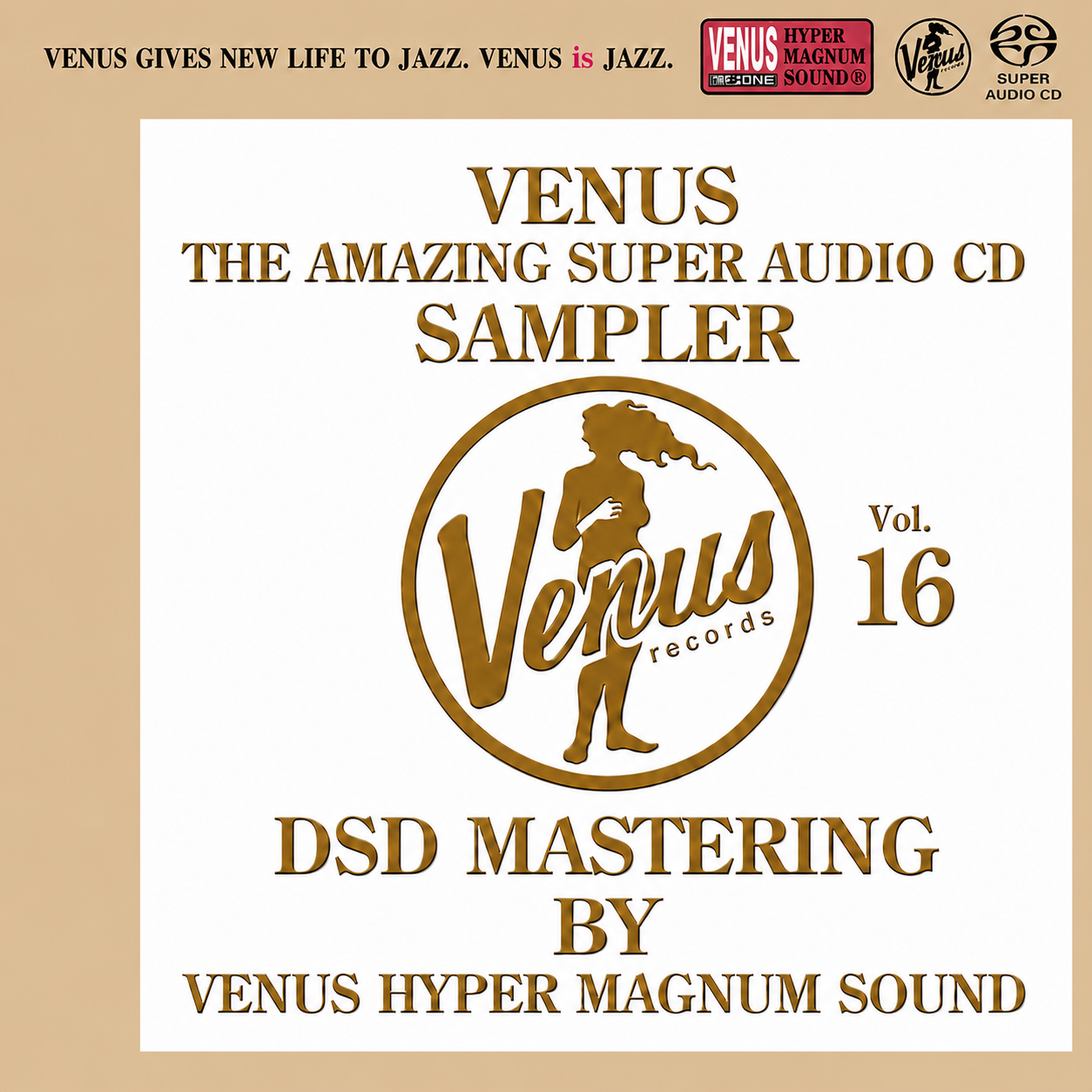
Venus – Amazing Super Audio CD Sampler Vol. 16
Venus – The Amazing Super Audio CD Sampler Vol. 16: Jazz Tradition, Audiophile Sound and the Art of Listening
The opening notes of “My Funny Valentine” arrive without unnecessary drama. Pianist Renato Sellani allows the familiar melody to emerge slowly, surrounded by the quiet pulse of his trio. Every touch of the keyboard feels carefully placed, and every pause seems to hold its own emotional weight. It is an understated beginning, yet it immediately reveals the purpose of Venus – The Amazing Super Audio CD Sampler Vol. 16: this is not simply a collection of jazz recordings, but an invitation to listen more closely.
Released in Japan on October 19, 2016, by Venus Records, the compilation appeared under catalogue number VHGD-181. The single-disc SACD contains 15 tracks and runs for approximately 85 minutes, bringing together piano trios, jazz vocalists, saxophone masters, organ-driven grooves and imaginative reinterpretations of classical and popular music.
By the time this sixteenth volume arrived, the Amazing Super Audio CD Sampler series had become an important showcase for the Venus Records catalogue. The Japanese label had built its reputation around passionate performances, luxurious packaging and a highly recognizable recording aesthetic. Its releases often placed musicians close to the listener, creating a large, immediate sound in which the piano had weight, the double bass had physical presence and the drums appeared with startling impact.
The Amazing Super Audio CD Sampler Vol. 16 captures that identity while refusing to remain within a single corner of jazz. Its sequencing feels less like a technical demonstration and more like a night of musical discovery, moving from intimate ballads to Latin romance, hard bop, vocal jazz, soul-jazz and spiritual improvisation.
Renato Sellani Trio’s “My Funny Valentine” sets the reflective tone. Sellani approaches the Rodgers and Hart standard with patience and restraint, avoiding unnecessary ornamentation. The melody remains recognizable, but it is given enough space to feel personal again. On a revealing high-end audio system, the performance becomes a study in piano tone, room ambience and the subtle interaction between three musicians.
The atmosphere changes with Cyrille Aimée and Brazilian guitarist Diego Figueiredo performing “Dos Gardenias.” Aimée’s agile voice and Figueiredo’s rhythmic guitar create a performance that is light on its feet but emotionally direct. The famous Cuban bolero carries its history of longing and romance, yet the duo presents it with an ease that makes the music feel spontaneous rather than nostalgic.
The contrast between the first two tracks already explains much of the sampler’s appeal. It can move from the measured elegance of an Italian jazz piano trio to an intimate Latin vocal performance without losing its coherence. Venus Records’ sonic character binds the material together, but it is the individuality of the musicians that keeps the album alive.
The Bill Crow Quartet follows with “Bohemia After Dark,” the Oscar Pettiford composition closely associated with the energy of 1950s hard bop. Bassist Bill Crow brings authority and swing to the piece, while the quartet preserves its combination of sophistication and late-night club atmosphere. The recording offers a strong sense of instrumental separation, but the musicians never sound isolated from one another. Instead, they occupy a shared acoustic space, exchanging phrases and rhythmic signals as naturally as conversation.
Then comes one of the compilation’s most unexpected turns. Dr. Lonnie Smith, guitarist John Abercrombie and drummer Marvin “Smitty” Smith transform Jimi Hendrix’s “Voodoo Chile” into a 12-minute organ-trio journey. Recorded in New York in 1994, the performance replaces the original song’s psychedelic blues-rock weight with swirling Hammond organ, exploratory guitar and powerful drumming.
Lonnie Smith does not treat Hendrix as a museum piece. His organ lines growl, shimmer and surge forward, while Abercrombie’s guitar moves between blues expression, jazz abstraction and controlled distortion. Marvin Smith provides the rhythmic engine, driving the performance without limiting its freedom. For audiophile listeners, “Voodoo Chile” is one of the album’s most demanding demonstrations of dynamic range and low-frequency power. More importantly, it is a compelling example of jazz musicians claiming a familiar composition and creating something entirely their own.
Russian vocalist Anna Kolchina restores the late-night mood with “Street of Dreams.” Her cool, carefully controlled delivery fits naturally within the romantic Venus Records tradition. The arrangement surrounds her with warmth while keeping the voice clearly focused at the centre of the soundstage. Kolchina does not overstate the song’s sense of desire. Instead, she allows its emotional character to unfold through phrasing, timing and subtle changes in tone.
John Di Martino’s Romantic Jazz Trio follows with “Mein Herr,” a song originating from the musical Cabaret. In another context, the composition could easily become theatrical or exaggerated. Di Martino and his trio instead reshape it as a sophisticated instrumental jazz performance. The melody retains its dramatic character, but the arrangement introduces harmonic elegance and rhythmic flexibility.
That ability to transform material from outside the conventional jazz-standard repertoire has always been one of the most attractive qualities of Venus Records. Rather than dividing music into rigid categories, the label’s artists frequently explore popular songs, film themes, classical works and Broadway melodies through the language of jazz.
Eddie Higgins Trio’s “Perfidia” offers a perfect example. The Latin standard is treated with the lyrical refinement for which Higgins became celebrated among Japanese jazz collectors. His piano playing sounds effortless, but beneath that elegance lies a precise understanding of melody and swing. Higgins never attempts to overwhelm the composition. He simply finds its emotional centre and lets the trio build around it.
The Claude Williamson Trio continues the piano-trio tradition with “Autumn in New York.” Williamson’s interpretation carries a sense of nostalgia, but it avoids becoming overly sentimental. The familiar melody unfolds over more than seven minutes, giving the musicians time to explore its harmonies while preserving the song’s autumnal atmosphere.
For serious jazz listeners, this is one of the pleasures of Venus – The Amazing Super Audio CD Sampler Vol. 16. The album does not hurry through its selections merely to present as many artists as possible. Several performances are given enough time to breathe, develop and reveal the personality of the musicians.
Vocalist Laird Jackson’s “Mood Indigo” enters with a different emotional colour. The Duke Ellington classic has been interpreted countless times, yet Jackson’s reading finds a balance between blues feeling and elegant restraint. Her voice sits naturally within the arrangement, supported rather than crowded by the accompanying instruments. The result is intimate, smoky and quietly expressive.
The Roma Trio then turns toward Antonio Vivaldi with the first movement of the “Winter” concerto from The Four Seasons. The transformation of a Baroque composition into a jazz-trio performance could easily become a novelty, but the group treats the music seriously. Vivaldi’s dramatic rhythmic figures provide natural material for improvisation, while the trio preserves the tension and forward movement of the original work.
The recording also highlights the technical strengths of the SACD format. The piano attacks are sharply defined, the bass remains controlled and the drums retain both speed and body. Yet the value of the performance extends beyond sound quality. It demonstrates how classical themes can become living material when jazz musicians approach them with imagination instead of excessive reverence.
Pianist Vladimir Shafranov and saxophonist Harry Allen bring the album back to the language of classic standards with “Just One More Chance.” Shafranov’s piano provides a graceful foundation, while Allen’s saxophone carries the melody with a full, conversational tone. Their partnership feels relaxed and natural, reflecting the timeless appeal of musicians who understand that technical skill is most effective when it serves the song.
The Cedar Walton Trio’s “Beautiful Love” adds another major voice from the American jazz tradition. Recorded with bassist Buster Williams and drummer Willie Jones III at Avatar Studios in New York, the performance combines Walton’s harmonic sophistication with the strong rhythmic foundation of one of his later trios.
“Beautiful Love” has long been a favourite vehicle for jazz improvisation, and Walton explores it with the authority of a pianist who understands both its structure and its possibilities. Williams gives the bass line strength and mobility, while Jones responds with crisp, alert drumming. The result is modern mainstream jazz of the highest order: intelligent, swinging and emotionally grounded.
Simone’s interpretation of “Tennessee Waltz” changes the scene once more. Supported by an ensemble that includes pianist John Di Martino, bassist George Mraz, drummer Victor Lewis and saxophonists Houston Person and Aaron Heick, she transforms the country standard into an elegant jazz ballad.
Her performance does not reject the song’s simple, memorable melody. Instead, it respects that simplicity while placing it within a richer harmonic landscape. The warmth of Houston Person’s tenor saxophone complements Simone’s voice, while the rhythm section gives the arrangement a gentle forward motion. It is a recording that feels both familiar and newly discovered.
Kenny Werner Trio’s “If I Should Lose You” provides one of the album’s more expansive piano-trio performances. Werner is known for balancing intellectual curiosity with emotional openness, and his reading of the standard reflects both qualities. The trio moves freely through the composition while maintaining a clear connection to its melody.
As the improvisation develops, the listener hears not simply a soloist accompanied by bass and drums, but three musicians shaping the music together. On a well-positioned stereo system, the performance creates a convincing sense of depth, with the piano, bass and percussion occupying distinct but connected positions within the soundstage.
The compilation ends with the Pharoah Sanders Quartet performing Horace Silver’s “Moon Rays.” Sanders is often associated with the spiritual and avant-garde movements of jazz, but here his tenor saxophone is placed within a beautifully structured ballad. Recorded in Tokyo with pianist William Henderson, bassist Ira Coleman and drummer Joe Farnsworth, the performance lasts more than seven minutes and closes the album with depth, warmth and quiet intensity.
Sanders’ sound remains unmistakable. Even at his most restrained, there is a human cry within his tone, a mixture of vulnerability, strength and spiritual searching. “Moon Rays” does not finish the sampler with spectacle. It ends with reflection, leaving the final notes to fade naturally into silence.
That ending reveals why Venus – The Amazing Super Audio CD Sampler Vol. 16 works as more than an audiophile test disc. Its SACD sound offers clarity, dynamic impact and a vivid sense of instrumental presence, but technology is never the central character. The album succeeds because its 15 selections tell a broader story about jazz itself.
That story includes the romantic piano of Renato Sellani and Eddie Higgins, the vocal individuality of Cyrille Aimée, Anna Kolchina, Laird Jackson and Simone, the rhythmic tradition represented by Bill Crow and Cedar Walton, the adventurous organ sound of Lonnie Smith and the unmistakable spiritual voice of Pharoah Sanders.
The compilation’s extended running time of 1 hour, 25 minutes and 56 seconds allows these different worlds to coexist without feeling compressed. Each performance opens another door into the Venus Records catalogue, giving collectors a reason to search for the original albums from which the selections were drawn.
For newcomers to Japanese audiophile jazz releases, The Amazing Super Audio CD Sampler Vol. 16 offers an accessible introduction to the Venus Records sound. For experienced collectors, it presents a thoughtfully sequenced journey through familiar standards, adventurous arrangements and major jazz personalities.
It is possible to use the album to evaluate a high-end stereo system. The piano recordings expose tonal balance, the vocal tracks reveal imaging and midrange naturalness, “Voodoo Chile” tests scale and dynamics, and the final Pharoah Sanders performance demonstrates how well a system can reproduce the emotional character of a tenor saxophone.
But listening only for technical qualities would miss the deeper achievement of the collection. Venus – The Amazing Super Audio CD Sampler Vol. 16 ultimately reminds the listener that audiophile sound matters most when it brings the music closer. Beneath the polished SACD presentation lies a varied and deeply human jazz programme, one that moves between romance, nostalgia, swing, experimentation and spiritual expression.
When the last breath of “Moon Rays” disappears, the room feels different from the one in which “My Funny Valentine” began. The sampler has travelled through several decades and traditions of jazz, yet it has done so with the intimacy of a single evening. That is the enduring appeal of this Venus Records compilation: it demonstrates exceptional sound, but it leaves the listener remembering the performances.
