
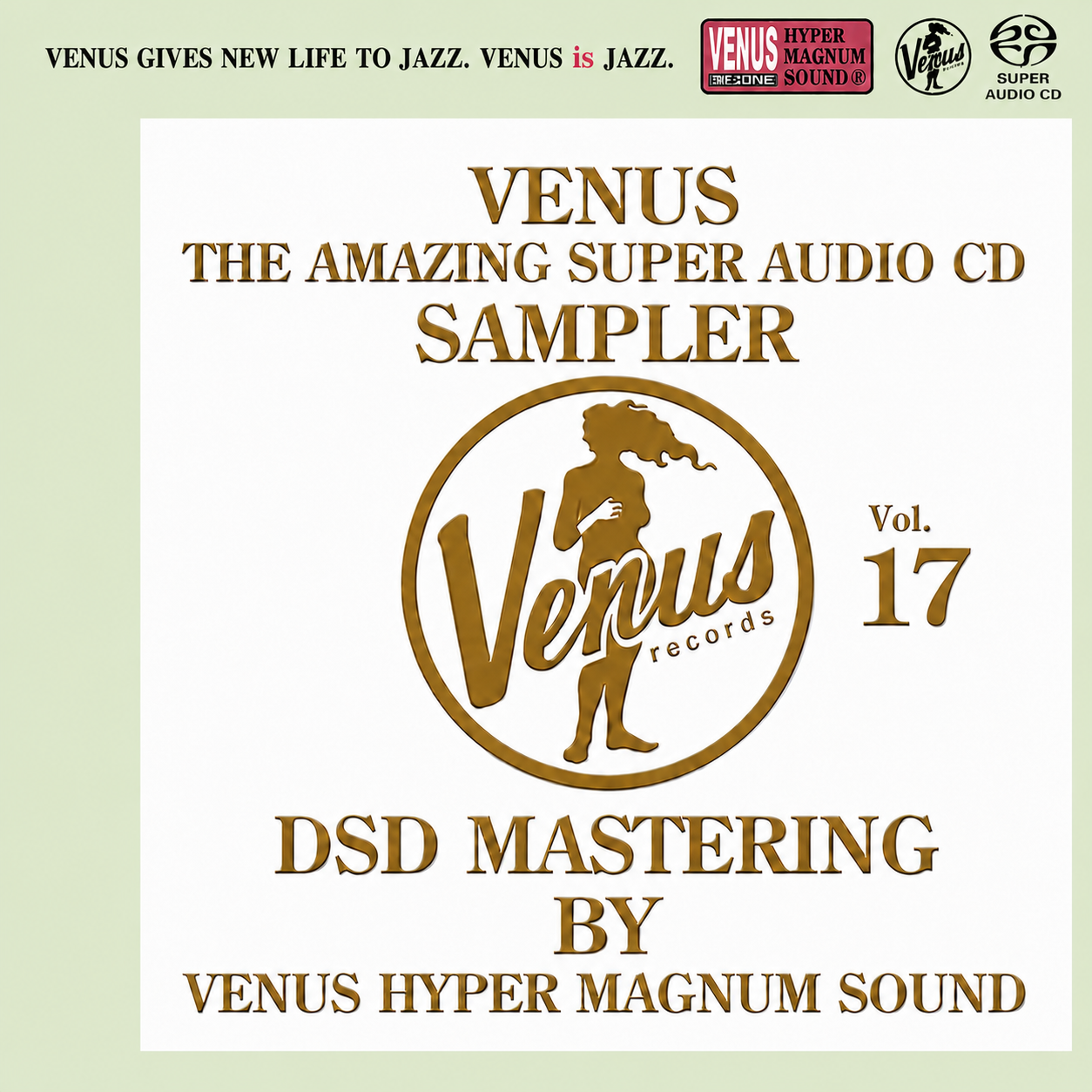
Venus – Amazing Super Audio CD Sampler Vol. 17
Venus – The Amazing Super Audio CD Sampler Vol. 17: Romantic Jazz, Timeless Melodies and Audiophile SACD Sound
The first melody arrives like a scene remembered from an old film. A tenor saxophone begins to sing, the rhythm section settles into a gentle pulse, and “An Affair to Remember” unfolds with the warmth of a conversation that has waited years to be resumed. Performed by the Phil Woods Quintet, the track opens Venus – The Amazing Super Audio CD Sampler Vol. 17 with elegance, emotional clarity and an unmistakable sense of cinematic romance.
That opening is an ideal doorway into the world of Venus Records. Released in Japan on January 18, 2017, under catalogue number VHGD-197, The Amazing Super Audio CD Sampler Vol. 17 is an official 15-track compilation with a running time of approximately 81 minutes. It was issued as a stereo single-layer SACD, meaning that the original physical disc requires a compatible Super Audio CD player and cannot be played in an ordinary CD-only machine.
By the time Volume 17 appeared, the Venus Amazing Super Audio CD Sampler series had developed into far more than a collection of demonstration recordings. Each edition functioned as a guided journey through the Japanese label’s catalogue, introducing listeners to celebrated jazz musicians, polished piano trios, intimate vocalists and sophisticated interpretations of familiar songs. The seventeenth volume continues that tradition with performances by Phil Woods, Simone Kopmajer, Richie Beirach, John Hicks, Dan Nimmer, Tessa Souter, Eric Alexander, Massimo Farao’, Anna Kolchina, Peter Bernstein, Sayaka Tsuruta, Simone and the Romantic Jazz Trio.
The programme is built around recognition. Many of its compositions are already deeply embedded in popular culture: “Moon River,” “Cry Me a River,” “The Shadow of Your Smile,” “I Left My Heart in San Francisco,” “We’ve Only Just Begun” and “The Fool on the Hill.” Yet the purpose of the album is not simply to repeat well-known melodies. Its musicians reshape them through jazz harmony, improvisation and personal expression, revealing emotional details that can disappear when songs become too familiar.
After the Phil Woods Quintet establishes the album’s romantic atmosphere, Austrian singer Simone Kopmajer enters with “Tea for Two.” The Vincent Youmans standard has been performed in countless styles, from Broadway to swing, but Kopmajer gives it a relaxed, intimate character. Her vocal delivery feels conversational rather than theatrical, placing the listener close to the performance. The arrangement moves lightly, allowing the melody to retain its charm without becoming nostalgic decoration.
Richie Beirach’s interpretation of “Moon River” then changes the emotional temperature. The song, written by Henry Mancini and Johnny Mercer, is often associated with sentimental orchestration and Hollywood elegance. In Beirach’s hands, it becomes more reflective. The familiar theme emerges through rich piano harmony, with pauses and subtle shifts giving the music an almost private quality.
This is one of the central strengths of Venus – The Amazing Super Audio CD Sampler Vol. 17. It takes songs that appear simple on the surface and places them in the hands of musicians capable of finding new harmonic and emotional possibilities. “Moon River” is no longer merely a famous film song. It becomes a meditation on memory, distance and longing.
The John Hicks Trio continues the journey with “Cry Me a River.” Hicks was a pianist with a powerful connection to the hard-bop tradition, but he also possessed the sensitivity needed for a ballad of betrayal and regret. The performance does not need a vocalist to communicate the song’s emotional meaning. The piano states the melody with quiet authority, while the bass and drums provide space rather than pressure.
On an audiophile sound system, the track also demonstrates the particular appeal of the Venus Records SACD catalogue. The piano carries body and weight, the bass occupies a clearly defined position, and the drums retain their natural attack and decay. Yet the technical qualities never overwhelm the musical message. The recording draws attention to the interaction between musicians rather than to sound effects created merely to impress.
Dan Nimmer Trio’s “Love Is a Many-Splendored Thing” follows with lyrical confidence. Nimmer belongs to a generation of pianists deeply influenced by the language of classic jazz, and his approach combines respect for melody with rhythmic freshness. The composition’s grand romantic theme is reduced to the direct language of piano, bass and drums, where every phrase must carry its own emotional weight.
Tessa Souter’s “So Many Stars” introduces one of the album’s most atmospheric vocal moments. The song, associated with Sergio Mendes and the Brazilian jazz tradition, has a dreamlike quality that suits Souter’s expressive voice. Her interpretation feels suspended between jazz balladry and Brazilian elegance, with the arrangement creating a soft rhythmic current beneath the melody.
Souter does not force the song’s sense of wonder. Instead, she allows it to emerge through careful phrasing and tonal colour. The track becomes a quiet centrepiece of the compilation, demonstrating how vocal intimacy can be every bit as revealing as instrumental virtuosity.
Eric Alexander Trio’s “We’ve Only Just Begun” offers a striking example of how Venus Records artists transform popular music into sophisticated jazz. Best known through the Carpenters, the composition could easily have been treated as a piece of soft-pop nostalgia. Alexander instead approaches it as a serious melodic vehicle.
His tenor saxophone brings weight and emotional urgency to the tune. The melody remains unmistakable, but the improvisation expands its possibilities, replacing polished pop sentiment with the energy of a small jazz group. It is a reminder that strong songs can survive almost any stylistic transformation when musicians engage with them honestly.
Massimo Farao’ Trio continues the sequence with “I Left My Heart in San Francisco.” The famous ballad is so closely associated with Tony Bennett that any new interpretation risks sounding imitative. Farao’ avoids that problem by returning the piece to its harmonic foundations. Without lyrics, the composition becomes a spacious piano-trio performance, balancing romance with a controlled sense of swing.
The piano is recorded with the full, immediate character associated with many Venus Records productions. Chords have physical presence, while the rhythm section provides a solid foundation beneath the melody. For listeners using the album as an SACD sound-quality demonstration, the track offers a clear test of piano timbre, bass definition and stereo depth.
Anna Kolchina’s performance of “Dark Eyes” brings a different atmosphere. Rooted in a traditional Russian melody, the song has travelled through folk music, gypsy jazz and popular song. Kolchina approaches it with controlled drama, preserving its cultural identity while placing it within a polished jazz arrangement.
Her voice carries a cool, focused quality. Rather than exaggerating the song’s passion, she lets the tension build through timing and phrasing. The performance feels mysterious and elegant, providing a contrast to the warmer American standards heard earlier on the album.
Guitarist Peter Bernstein and his ensemble take on Antônio Carlos Jobim’s “Luiza,” one of the most harmonically beautiful compositions in the Brazilian songwriter’s catalogue. Bernstein’s guitar tone is clear and rounded, moving naturally through Jobim’s sophisticated chord changes.
“Luiza” creates a late-night atmosphere, but it avoids becoming background music. The musicians listen closely to one another, shaping the arrangement through subtle rhythmic decisions and melodic responses. The SACD presentation allows the guitar’s attack, resonance and decay to emerge with clarity, while the group maintains a cohesive acoustic image.
The New York Trio follows with Duke Ellington and Billy Strayhorn’s “Star-Crossed Lovers.” The composition carries the elegance and emotional ambiguity associated with Ellington’s most refined ballads. In a piano-trio setting, its harmonies become especially exposed, allowing the musicians to explore the tension between beauty and sadness.
The performance unfolds with patience. Instead of using the melody merely as a platform for extended improvisation, the trio preserves its narrative shape. Every phrase seems to lead naturally into the next, giving the track the quality of a short story told without words.
Japanese vocalist Sayaka Tsuruta appears with the Dan Nimmer Trio for “The Shadow of Your Smile.” The song, originally written for the film The Sandpiper, became a jazz standard because of its graceful melody and bittersweet harmonic movement. Tsuruta sings it with restraint, supported by Nimmer’s elegant piano accompaniment.
Her vocal presence is clear and intimate, while the trio avoids crowding the arrangement. The result is a performance that feels carefully balanced but never artificial. It is also an effective example of the Venus Records approach to vocal jazz: the singer remains central, but the instrumental accompaniment is given enough definition and space to become an equal part of the emotional landscape.
The Konrad Paszkudzki Trio brings a lighter swing to “Cabin in the Sky.” Paszkudzki is known for his connection to traditional jazz-piano language, and the performance reflects an understanding of melody, rhythm and classic trio interplay. The tune moves with natural ease, offering a welcome change of pace after several reflective ballads.
There is elegance in the playing, but also a sense of enjoyment. The trio does not treat the standard as a historical artefact. It sounds alive, direct and connected to the present moment. That balance between tradition and freshness is one of the qualities that makes the track particularly effective within the sampler’s sequence.
Simone’s “Don’t Let Me Be Lonely Tonight” returns the album to contemporary popular songwriting. Written by James Taylor, the song already contains elements of soul, jazz and blues, making it a natural choice for reinterpretation. Simone’s performance emphasizes its vulnerability without turning it into melodrama.
Her voice remains close and emotionally direct, while the arrangement surrounds her with warmth. The recording captures small details of breath and articulation, but the listener’s attention remains focused on the song’s plea for temporary comfort. It is one of the most human moments on the album.
The journey concludes with John Di Martino’s Romantic Jazz Trio performing “The Fool on the Hill.” The Beatles composition is instantly recognizable, yet the trio removes it from the world of psychedelic pop and places it within a sophisticated jazz setting.
Di Martino approaches the melody with affection rather than irony. The tune’s sense of isolation and quiet observation remains intact, but its harmonies are expanded and its rhythm becomes more flexible. The performance serves as a graceful final chapter, bringing together the album’s central ideas: familiar music, imaginative arrangement and refined acoustic sound.
When the final notes fade, Venus – The Amazing Super Audio CD Sampler Vol. 17 has travelled across several musical landscapes. It has moved from Broadway standards to Hollywood themes, Brazilian compositions, Russian tradition, American popular song and the music of the Beatles. The full selection comprises “An Affair to Remember,” “Tea for Two,” “Moon River,” “Cry Me a River,” “Love Is a Many-Splendored Thing,” “So Many Stars,” “We’ve Only Just Begun,” “I Left My Heart in San Francisco,” “Dark Eyes,” “Luiza,” “Star-Crossed Lovers,” “The Shadow of Your Smile,” “Cabin in the Sky,” “Don’t Let Me Be Lonely Tonight” and “The Fool on the Hill.”
Despite that variety, the compilation never feels disconnected. Its unity comes from the Venus Records aesthetic: close, present recording; warm instrumental tone; romantic repertoire; and musicians who treat melody as the heart of jazz rather than as something to be discarded after the opening chorus.
As an audiophile jazz SACD, the album offers numerous opportunities to evaluate a high-end stereo system. The vocal selections reveal midrange purity and centre imaging. The piano trios expose tonal balance and transient accuracy. The saxophone performances test whether a system can reproduce both the body and edge of a horn without becoming harsh. The guitar tracks reveal fine detail, resonance and acoustic space.
Yet reducing The Amazing Super Audio CD Sampler Vol. 17 to a technical test would miss its real achievement. The album works because it can be enjoyed without thinking about equipment at all. The sound quality matters because it helps the listener feel the musicians’ presence, not because it calls constant attention to the recording process.
For collectors of Japanese SACD releases, the album is an attractive entry in the long-running Venus sampler series. For listeners discovering Venus Records for the first time, it offers a broad introduction to the label’s romantic jazz style. For fans of vocal jazz, piano trios and imaginative interpretations of standards, it provides more than 80 minutes of carefully selected music.
The title may describe it as a sampler, but the experience is more complete than that word suggests. Venus – The Amazing Super Audio CD Sampler Vol. 17 plays like an evening of stories told through familiar melodies. Some speak of romance, others of distance, loneliness, memory or hope. Together, they create a portrait of jazz as a living language—one capable of turning songs everyone knows into performances that feel newly discovered.
