
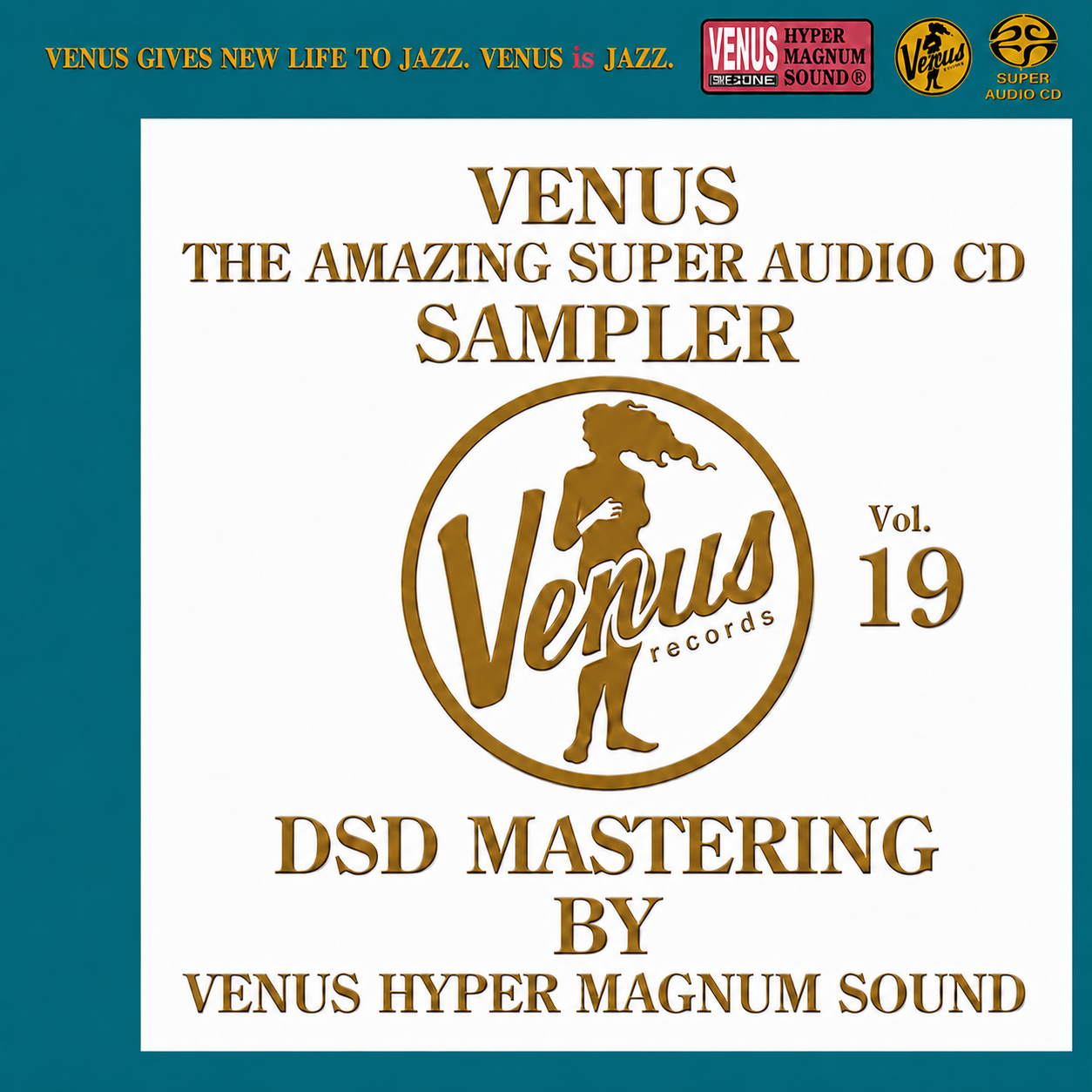
Venus – Amazing Super Audio CD Sampler Vol. 19
Venus – The Amazing Super Audio CD Sampler Vol. 19: Classic Jazz Reborn in Spectacular SACD Sound
The first guitar chords emerge with the confidence of a musician who has no need to hurry. Joe Beck begins “Ruby” by allowing the melody to settle naturally into the room, his warm electric-guitar tone supported by bass and drums that seem close enough to touch. The performance is polished but never distant, romantic without becoming sentimental. Within a few moments, Venus – The Amazing Super Audio CD Sampler Vol. 19 has established its purpose: to make familiar jazz sound immediate, physical and alive again.
Released in Japan by Venus Records on June 21, 2017, under catalogue number VHGD-229, the nineteenth volume in the label’s acclaimed audiophile sampler series gathers 15 representative tracks from albums numbered VHGD-213 through VHGD-228. Venus Records described it as an extended SACD programme with a total running time of approximately 84 minutes, designed to showcase both the musical variety of its catalogue and the vivid sound associated with its high-resolution releases.
Yet describing The Amazing Super Audio CD Sampler Vol. 19 merely as a demonstration disc would be misleading. The album is constructed more like a journey through jazz history. Its programme moves from elegant guitar and piano trios to hard bop, Brazilian lyricism, organ jazz, bebop, opera and deeply reflective ballads. The names involved include Joe Beck, John Di Martino, Claude Williamson, Hank Jones, Steve Kuhn, Eddie Higgins, Lonnie Smith, John Abercrombie, Harold Mabern, Francesco Cafiso, Massimo Farao’, Enrico Rava and several other musicians whose individual styles give the compilation its remarkable range.
Joe Beck Trio’s “Ruby” is an inspired opening choice. The melody, written by Heinz Roemheld, carries the elegance of classic cinema, but Beck avoids treating it as a nostalgic ornament. His guitar tone is round and expressive, every note shaped with restraint. There is no need for unnecessary speed or technical display. The beauty lies in the spaces between the phrases and in the relaxed conversation taking place among guitar, bass and drums.
For audiophile listeners, “Ruby” immediately reveals the character of the Venus Records sound. The guitar appears firmly positioned within the stereo image, the bass has weight and definition, and the cymbals retain their metallic shimmer without becoming harsh. The presentation is intimate and full-bodied, yet the recording’s technical qualities remain secondary to Beck’s ability to tell a story through melody.
The mood shifts sharply with John Di Martino’s Romantic Jazz Trio performing Thelonious Monk’s “Epistrophy.” Monk’s composition is angular, repetitive and rhythmically unpredictable, a piece built from musical shapes that appear almost deliberately awkward. Di Martino and his trio do not attempt to smooth away those unusual qualities. Instead, they place them within a more polished, harmonically rich framework.
The result is a fascinating meeting between two musical worlds. Monk’s original theme retains its stubborn personality, but the Romantic Jazz Trio brings clarity and elegance to its dissonant turns. Piano chords land with force, bass lines move beneath them with precision, and the drums respond to the tune’s fragmented rhythm. It is jazz tradition approached with respect but not fear.
Claude Williamson Trio’s “Robbin’s Nest” then opens the door to a more relaxed swing. The composition, associated with Illinois Jacquet and Sir Charles Thompson, has the atmosphere of a late-night club where the musicians know the material so well that they can play with it freely.
Williamson’s piano carries the language of classic bebop and West Coast jazz. His touch is crisp, his melodic lines clear and his timing effortless. The trio does not attempt to modernize the tune through radical reharmonization. Instead, it trusts the strength of the melody and the enduring pleasure of swing.
That confidence runs throughout Venus – The Amazing Super Audio CD Sampler Vol. 19. The album frequently returns to standards and well-known jazz compositions, but the musicians never sound trapped by history. They treat the repertoire as a living language in which personality remains more important than novelty.
The fourth selection, “I Remember Clifford,” brings together the ensemble One for All for Benny Golson’s famous tribute to trumpeter Clifford Brown. Few jazz ballads carry such an immediate sense of loss. Golson wrote the composition after Brown’s death in a car accident, and its melody has since become one of the most moving memorials in jazz.
One for All approaches the piece with controlled emotion. The musicians resist the temptation to exaggerate its sadness, allowing the melody itself to carry the weight of remembrance. Horns blend with warmth, the rhythm section remains understated, and the arrangement unfolds with dignity.
The recording gives every instrument a clear place without breaking the ensemble into isolated pieces. This is especially important in a ballad such as “I Remember Clifford,” where the emotional impact depends on musicians breathing and phrasing together. The performance is technically beautiful, but its deepest power comes from restraint.
The presence of pianist Hank Jones on “Body and Soul” gives the fifth track a special historical significance. Here Jones appears with saxophonist Satoru Oda and the Great Jazz Quintet, interpreting one of the most enduring standards in the jazz repertoire. The official Venus listing identifies the performance as “Body and Soul” by Satolu Oda and the Hank Jones Great Jazz Quintet.
Hank Jones belonged to a generation of musicians for whom sophistication never required excessive complexity. His playing was graceful, balanced and deeply rooted in swing. On “Body and Soul,” he supports the melody with harmonic colours that feel inevitable, even when they are subtle and unexpected.
The saxophone carries the tune with a rich, vocal quality. Every phrase seems connected to the song’s history, yet the performance never feels ceremonial. It remains a spontaneous jazz interpretation, shaped in the moment by musicians listening closely to one another.
Steve Kuhn Trio’s “Charade” introduces the cinematic world of Henry Mancini. The composition is instantly memorable, but Kuhn reveals darker possibilities beneath its elegant surface. His piano playing moves between lyrical delicacy and harmonic tension, transforming the film theme into a sophisticated modern-jazz performance.
Kuhn has always possessed the ability to make familiar melodies feel slightly mysterious. He does not destroy their structure or hide them beneath layers of abstraction. Instead, he changes the light around them. On “Charade,” the melody appears, disappears and returns with a different emotional character.
The SACD sound captures the full resonance of the piano, from the initial hammer attack to the long decay of sustained chords. The bass remains firm beneath the instrument, while the drums create movement through brushes, cymbals and carefully placed accents. It is a performance that rewards both technical listening and emotional attention.
Eddie Higgins Trio follows with Antônio Carlos Jobim’s “Falando de Amor,” also known as “Speaking of Love.” Higgins was one of the central figures in the Venus Records catalogue, admired particularly in Japan for his lyrical piano style and elegant treatment of standards.
His interpretation of Jobim avoids the clichés that can appear when jazz musicians approach Brazilian music superficially. The rhythm is gentle and understated, while the melody unfolds with natural grace. Higgins understands that Jobim’s music does not need to be overloaded with decoration. Its sophistication already exists within the harmony.
The trio creates a calm, intimate atmosphere. The piano sounds warm and rounded, the bass moves with quiet assurance, and the drums maintain the Brazilian pulse without becoming mechanically precise. “Falando de Amor” is one of the album’s most romantic moments, but its emotion is expressed through simplicity.
That serenity is interrupted by “Naima,” performed by the trio of organist Lonnie Smith, guitarist John Abercrombie and drummer Marvin “Smitty” Smith. John Coltrane’s composition is one of the most spiritual ballads in modern jazz, built around harmonies that seem to float rather than resolve.
Lonnie Smith’s Hammond organ gives “Naima” an entirely different physical presence. Instead of the delicate transparency often associated with the tune, the organ produces a broad, breathing foundation. Chords swell and recede, filling the space with colour.
Abercrombie’s guitar moves above that foundation with an exploratory tone. His lines are melodic but never predictable, sometimes touching Coltrane’s theme directly and sometimes drifting into more abstract territory. The drummer provides both structure and freedom, allowing the performance to develop gradually.
For listeners testing an audiophile stereo system, this track presents a demanding combination of deep organ frequencies, electric-guitar texture and dynamic percussion. Yet its lasting impression is spiritual rather than technical. The musicians approach “Naima” as a place for contemplation, preserving the composition’s atmosphere while making it entirely their own.
Harold Mabern’s “Stolen Moments” brings the programme back toward the muscular language of hard bop. Oliver Nelson’s composition is defined by its memorable minor-key theme, one that immediately creates tension and mystery.
Mabern was a pianist with a powerful rhythmic attack and a deep connection to blues and gospel. His interpretation gives the piece weight from the opening bars. Chords arrive with authority, while the rhythm section drives the tune forward without making it feel rushed.
“Stolen Moments” also demonstrates the difference between speed and momentum. The performance does not need to move at an extreme tempo to create intensity. Its energy comes from harmonic pressure, rhythmic placement and the musicians’ shared understanding of the groove.
Francesco Cafiso Quartet’s “Seven Steps to Heaven” then increases the velocity. Written by Victor Feldman and famously associated with Miles Davis, the composition has become a test of bebop agility. Its fast-moving harmonies demand technical precision, but the greatest performances also retain a sense of play.
Cafiso brings youthful energy to the tune. His saxophone lines move rapidly but remain articulate, shaped into coherent musical statements rather than displays of speed. The quartet responds with equal sharpness, pushing the rhythm while maintaining control.
The recording allows the listener to hear the physical effort behind the performance: the saxophone’s breath and reed, the drummer’s rapid cymbal patterns, the bass keeping pace beneath the harmony. It is one of the album’s most energetic selections and a reminder that the Venus Records catalogue was never limited to romantic ballads.
Massimo Farao’ Trio’s “Moanin’” continues the hard-bop atmosphere. Bobby Timmons’ composition is one of the defining themes of the soul-jazz era, built on a call-and-response figure with roots in church music and the blues.
Farao’ approaches the tune directly. The famous opening motif is given the weight it deserves, and the trio settles into a deep groove. His piano attack is strong and percussive, yet there is also flexibility in his phrasing.
The bass and drums provide more than accompaniment. They answer the piano, reinforce its accents and help build the performance into a collective statement. “Moanin’” is familiar, but the trio plays it with enough conviction to prevent it from becoming routine.
The atmosphere becomes lighter with Konrad Paszkudzki Trio’s “Pocketful of Miracles.” The Jimmy Van Heusen composition carries the optimism and melodic charm of classic American songwriting. Paszkudzki, a pianist deeply connected to the swing tradition, treats it with elegance and rhythmic lift.
The track feels like sunlight entering after several darker, blues-based performances. The piano dances across the melody, while the bass and drums maintain a buoyant pulse. There is sophistication in the arrangement, but also an obvious sense of enjoyment.
Paszkudzki does not attempt to make the song heavier than it is. He accepts its optimism and allows it to become a graceful jazz vehicle. Within the album’s narrative, “Pocketful of Miracles” provides a moment of release.
The most unexpected chapter arrives with Italian trumpeter Enrico Rava performing “Un bel dì, vedremo” from Giacomo Puccini’s opera Madama Butterfly. The inclusion of an operatic aria might appear unusual on a jazz SACD sampler, yet it reflects the international and stylistically open character of the Venus catalogue. The official track sequence identifies Rava’s performance as the thirteenth selection.
Rava does not treat Puccini’s melody as an object to be preserved behind glass. His trumpet enters with a fragile, almost human tone, carrying the aria’s mixture of hope and approaching tragedy. The operatic theme remains recognizable, but jazz phrasing changes its emotional perspective.
The performance feels spacious and reflective. Notes are allowed to hang in the air, with silence becoming part of the arrangement. Rava’s ability to suggest vulnerability without losing control makes the track one of the album’s emotional high points.
“Solamente una vez,” performed by saxophonist Gianni Basso and pianist Renato Sellani, continues the European and Latin atmosphere. Written by Mexican composer Agustín Lara, the song is known in English as “You Belong to My Heart.”
Basso’s saxophone carries the melody with warmth and old-world romance. Sellani’s piano supports him with understated elegance, creating a conversation between two experienced musicians who understand that a ballad requires patience.
Nothing is overstated. The musicians allow the melody to unfold at its own pace, and the emotional effect comes from the natural rise and fall of the phrases. The recording places both instruments close to the listener, creating the feeling of a private performance after the audience has gone home.
The album ends with “Blame It on My Youth” by the Spirits Trio. Oscar Levant’s composition has long been associated with regret, vulnerability and the painful recognition of mistakes made in the name of love. It is an appropriate final track for a compilation that has travelled through romance, memory, spiritual searching and musical history.
The trio approaches the ballad slowly. The melody appears without decoration, carrying the emotional weight of its title. Piano, bass and drums remain closely connected, responding to one another with subtle shifts in timing and dynamics.
There is no dramatic conclusion. Instead, the performance gradually settles into silence. After the speed of “Seven Steps to Heaven,” the gospel force of “Moanin’” and the harmonic mystery of “Naima,” the final ballad feels like a quiet reflection on everything that has come before.
The complete programme of Venus – The Amazing Super Audio CD Sampler Vol. 19 includes “Ruby,” “Epistrophy,” “Robbin’s Nest,” “I Remember Clifford,” “Body and Soul,” “Charade,” “Falando de Amor,” “Naima,” “Stolen Moments,” “Seven Steps to Heaven,” “Moanin’,” “Pocketful of Miracles,” “Un bel dì, vedremo,” “Solamente una vez” and “Blame It on My Youth.”
Together, these 15 performances reveal the breadth of the Venus Records jazz catalogue. There are piano trios shaped by swing and romantic lyricism, horn-led groups rooted in hard bop, guitar and organ performances with a modern electric edge, and European interpretations that connect jazz to opera and Latin song.
As an audiophile SACD, Volume 19 provides a varied test for any high-end audio system. Joe Beck’s guitar reveals tonal colour and imaging. The piano trios test weight, attack and harmonic richness. “Naima” challenges the system’s ability to reproduce deep organ sound without losing definition. The horn recordings expose harshness or unnatural brightness, while the quieter ballads reveal whether low-level detail and room ambience remain audible.
But the collection’s real success lies in the way those technical qualities gradually disappear from the listener’s attention. A well-recorded album should not constantly remind the audience that it is well recorded. It should make the equipment vanish and allow the music to occupy the room.
That is precisely what The Amazing Super Audio CD Sampler Vol. 19 achieves at its best. Its sound is vivid, warm and immediate, but the performances remain the focus. The listener remembers Hank Jones’ elegance, Harold Mabern’s authority, Enrico Rava’s fragile trumpet and the spiritual atmosphere created by Lonnie Smith and John Abercrombie.
For collectors of Japanese SACD releases, the album represents another important chapter in the long-running Venus sampler series. For newcomers, it offers an accessible route into a catalogue that includes American jazz legends, European masters and musicians from a younger generation.
It also demonstrates why the word “sampler” can be deceptive. This is not a sequence of disconnected fragments assembled only to promote other albums. Its 84-minute programme has its own rhythm and emotional architecture. It begins with the romantic glow of “Ruby,” moves through bebop, ballads, Brazilian music, hard bop and opera, and closes with the quiet regret of “Blame It on My Youth.”
When the final piano chord fades, the journey feels complete. The album has crossed countries, generations and musical traditions without losing its identity. Every selection carries the recognizable Venus Records commitment to melody, emotional immediacy and audiophile sound.
Venus – The Amazing Super Audio CD Sampler Vol. 19 ultimately tells a story about the durability of jazz. Old standards remain capable of surprise. Familiar compositions can acquire new personalities. Opera can meet improvisation, Brazilian melody can sit beside hard bop, and a song heard a hundred times can suddenly feel newly discovered.
The SACD technology brings the listener closer to the musicians, but technology is not the destination. It is simply the doorway. Beyond it lies an 84-minute jazz evening filled with elegance, energy, memory and soul—a reminder that great sound matters most when it helps great music become fully human.
