
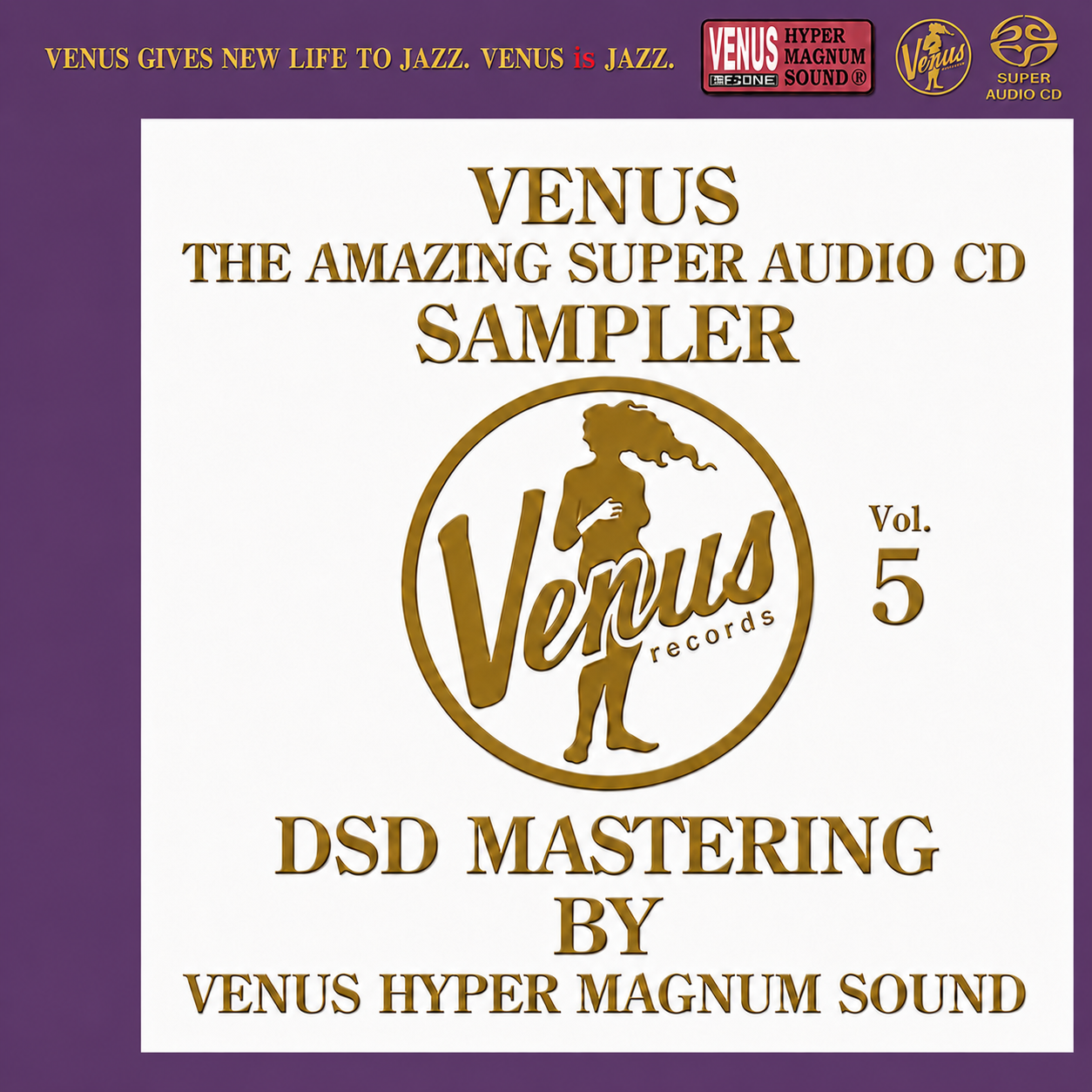
Venus – Amazing Super Audio CD Sampler Vol. 05
Venus – The Amazing Super Audio CD Sampler Vol. 5: A Journey Through the Golden Sound of Audiophile Jazz
The story begins with percussion, brass and a rhythm that refuses to sit still. Eric Alexander’s tenor saxophone enters “Mambo Inn” with confidence, immediately turning the listening room into a crowded late-night jazz club. The instruments feel close enough to touch, yet each musician retains a clearly defined place in the performance. It is an energetic opening to Venus – The Amazing Super Audio CD Sampler Vol. 5, an album created not only to showcase the Venus Records catalogue but also to demonstrate how vivid and emotionally involving a carefully produced audiophile jazz recording can be.
Released in Japan on May 20, 2015, under catalogue number VHGD-79, the fifth volume in the Venus SACD sampler series contains 15 performances with a total running time of approximately 86 minutes. Venus Records selected representative tracks from albums numbered between VHGD-63 and VHGD-80, creating a broad survey of the label’s piano trios, saxophone quartets, vocal jazz sessions and romantic interpretations of classic standards. (venusrecord.com)
This is a single-layer Super Audio CD rather than a hybrid SACD, which means it requires a compatible SACD player and cannot be played in an ordinary CD machine. That technical limitation makes the release a specialist item, but it also identifies its intended audience. The Amazing Super Audio CD Sampler Vol. 5 was made for listeners who care about the shape of a piano note, the texture of a saxophone reed, the resonance of an acoustic bass and the silence surrounding each instrument. (elusivedisc.com)
After the Latin momentum of “Mambo Inn,” the Vladimir Shafranov Trio moves into Benny Golson’s “Whisper Not.” The change in atmosphere is immediate. Where the opening track arrives with rhythmic heat, Shafranov creates a more restrained and elegant scene. The piano leads with clarity, while bass and drums maintain a relaxed but purposeful pulse. It is the first indication that this Japanese audiophile SACD is not arranged merely as a collection of impressive recordings. The programme moves like a story, shifting between energy, reflection, romance and nostalgia.
The third chapter takes an unexpected turn. Aaron Heick and the Romantic Jazz Trio reinterpret Carlos Santana’s “Europe,” carrying the famous melody away from its rock setting and into an intimate acoustic jazz environment. The composition’s dramatic shape remains intact, but the instrumentation gives it a different emotional weight. Instead of guitar sustain and electric intensity, the listener hears a lyrical saxophone voice supported by the measured movement of a jazz trio. It is a transformation that reflects the Venus Records philosophy: familiar music is given new life through elegant arrangements and close, full-bodied recording.
One For All follows with Oliver Nelson’s “Stolen Moments,” bringing ensemble sophistication and hard-bop authority into the sequence. The performance introduces a broader musical conversation, with melodic lines passing between the players while the rhythm section maintains the composition’s quietly insistent motion. On a revealing high-end audio system, the track becomes more than a test of stereo imaging. It shows how naturally the musicians respond to one another and how much tension can exist inside an apparently controlled arrangement. (venusrecord.com)
The mood softens when the Ken Peplowski Tenor Sax Quartet begins “When You Wish Upon a Star.” A melody associated with childhood wonder becomes a late-night jazz ballad, played without sentimentality but with unmistakable warmth. Peplowski allows the tune to unfold patiently, giving each phrase enough room to linger. It is the kind of performance that explains the enduring appeal of Venus Records SACD releases. The recording quality draws attention to breath, tone and acoustic space, but the technical detail never distracts from the emotional centre of the song.
Harold Mabern’s trio then enters with “Blue Bossa.” Kenny Dorham’s composition has long been a favourite among jazz musicians, combining a memorable theme with a rhythmic structure that invites improvisation. Mabern approaches it with a strong, grounded piano sound, restoring movement after the dreamlike calm of the previous track. The bass provides weight without becoming heavy, while the drums give the music forward momentum. For listeners searching for reference-quality piano-trio recordings, this performance demonstrates timing, tonal balance and the physical impact of an acoustic rhythm section.
Sir Roland Hanna’s interpretation of John Lewis’s “Django” brings another change of light. The composition was written as a tribute to guitarist Django Reinhardt, but here its melancholy theme becomes the centre of a refined piano-trio performance. Hanna does not overstate the emotion. His playing is dignified and spacious, allowing the melody to retain its quiet sadness. The track feels like a pause in the journey, a moment when the room grows darker and the conversation becomes more personal.
That intimate atmosphere continues with Nicki Parrott and Ken Peplowski performing “In the Wee Small Hours of the Morning.” Parrott’s voice and Peplowski’s instrumental lines create a scene of urban solitude, the hour after midnight when familiar streets appear strangely empty. The performance is concise, lasting just under three minutes, yet it forms one of the album’s clearest emotional images. It is vocal jazz presented without unnecessary decoration, relying on phrasing, tone and the unspoken space between singer and accompanist. (Klangheimat)
The New York Trio changes the temperature with Cole Porter’s “My Heart Belongs to Daddy.” Without a vocalist to deliver Porter’s playful lyrics, the musicians turn the song into an elegant instrumental conversation. The melody remains recognisable, but the trio explores its harmonic possibilities with the polished confidence associated with the Venus Records piano-trio catalogue.
Nicki Parrott returns for another Cole Porter composition, “Too Darn Hot,” but this time the restraint of the earlier ballad is replaced by wit and rhythmic vitality. Her performance brings personality to the middle of the programme, preventing the compilation from becoming a procession of solemn audiophile showpieces. Parrott understands that classic vocal jazz depends as much on attitude as it does on technical control, and her delivery gives the song a lively theatrical edge.
The Roma Trio follows with “Love Is a Many-Splendored Thing,” turning the famous film melody into a romantic piano-trio statement. The performance fits naturally within the Venus Records aesthetic, where well-known themes are polished rather than dismantled. The musicians preserve the tune’s sweeping emotional character while giving it the intimacy of a small-group session. It is lush without becoming excessive, melodic without losing its jazz identity.
Charles McPherson’s quartet then performs “I’ll Never Stop Loving You,” bringing alto saxophone lyricism to one of the collection’s longest tracks. The official Venus listing also associates the performance with pianist Steve Kuhn, and the result feels like a conversation between two strong melodic voices. McPherson’s saxophone can sound direct and urgent, yet here it serves the ballad with patience. The interpretation develops gradually, moving beyond the theme without losing sight of its emotional meaning. (venusrecord.com)
Ken Peplowski returns on clarinet for “The Shadow of Your Smile.” His appearance earlier in the programme centred on tenor saxophone, but the clarinet introduces a lighter and more delicate colour. The familiar movie theme floats above the rhythm section, its romantic quality balanced by Peplowski’s precise control. The track also provides an effective demonstration of high-resolution audio, revealing subtle changes in breath, articulation and instrumental texture.
Then comes “Besame Mucho,” performed by the Barney Wilen Quintet. The famous Latin standard has been recorded countless times, but Wilen approaches it with the cool elegance that defined much of his work. The rhythm carries the song forward without rushing, while the saxophone gives the melody a smoky, European character. At nearly seven minutes, the musicians have time to move beyond the tune’s familiar surface and create something more atmospheric. It is not merely a romantic standard placed near the end of a compilation; it feels like the last substantial scene before the closing credits.
Those credits arrive with the Vladimir Shafranov Trio’s “Midnight in Moscow.” The traditional melody brings the album full circle, returning to the pianist who appeared near the beginning with “Whisper Not.” This time the mood is reflective and faintly cinematic. The title suggests a city after dark, but the performance also feels like the conclusion of a long listening session, when the final notes remain suspended in the room and silence slowly returns.
The consistent character of the album comes from producer and engineer Tetsuo Hara, who produced, mixed and mastered the compilation using the Venus Hyper Magnum Sound Direct Mix approach. His recordings are often recognised for their immediacy, strong instrumental presence and richly defined stereo image. On The Amazing Super Audio CD Sampler Vol. 5, that production style connects artists and sessions that might otherwise sound unrelated. A Latin-jazz quartet, a romantic piano trio, a vocal performance and a clarinet ballad all appear to inhabit the same luxurious musical world. (venusrecord.com)
As an audiophile jazz compilation, the album succeeds because it never behaves like a cold technical demonstration. It can certainly be used to evaluate loudspeaker placement, saxophone tone, piano weight, bass definition, percussion transients and stereo depth, but those qualities emerge naturally from the performances. The listener is not asked to admire sound effects. Instead, the high-resolution SACD format reveals the human details inside the music.
For collectors searching for a Japanese SACD, a Venus Records compilation, an audiophile jazz sampler or a reference album for a high-end stereo system, Venus – The Amazing Super Audio CD Sampler Vol. 5 offers an unusually varied programme. Eric Alexander, Vladimir Shafranov, Aaron Heick, One For All, Ken Peplowski, Harold Mabern, Sir Roland Hanna, Nicki Parrott, the New York Trio, the Roma Trio, Charles McPherson and Barney Wilen create a journey that moves from Afro-Cuban heat to romantic ballads and midnight reflection. (sieveking-sound.de)
Yet the album’s lasting appeal is not found in its specifications or collector value. It lies in the way the music develops across 15 carefully chosen performances. The journey begins in the crowded excitement of “Mambo Inn,” travels through whispered conversations, cinematic melodies, Cole Porter sophistication and Latin romance, and finally ends under the distant lights of “Midnight in Moscow.” By the time the last piano chord disappears, The Amazing Super Audio CD Sampler Vol. 5 has demonstrated something more important than audiophile sound quality. It has shown how superior recording can bring the listener closer to the emotional life of jazz.
