
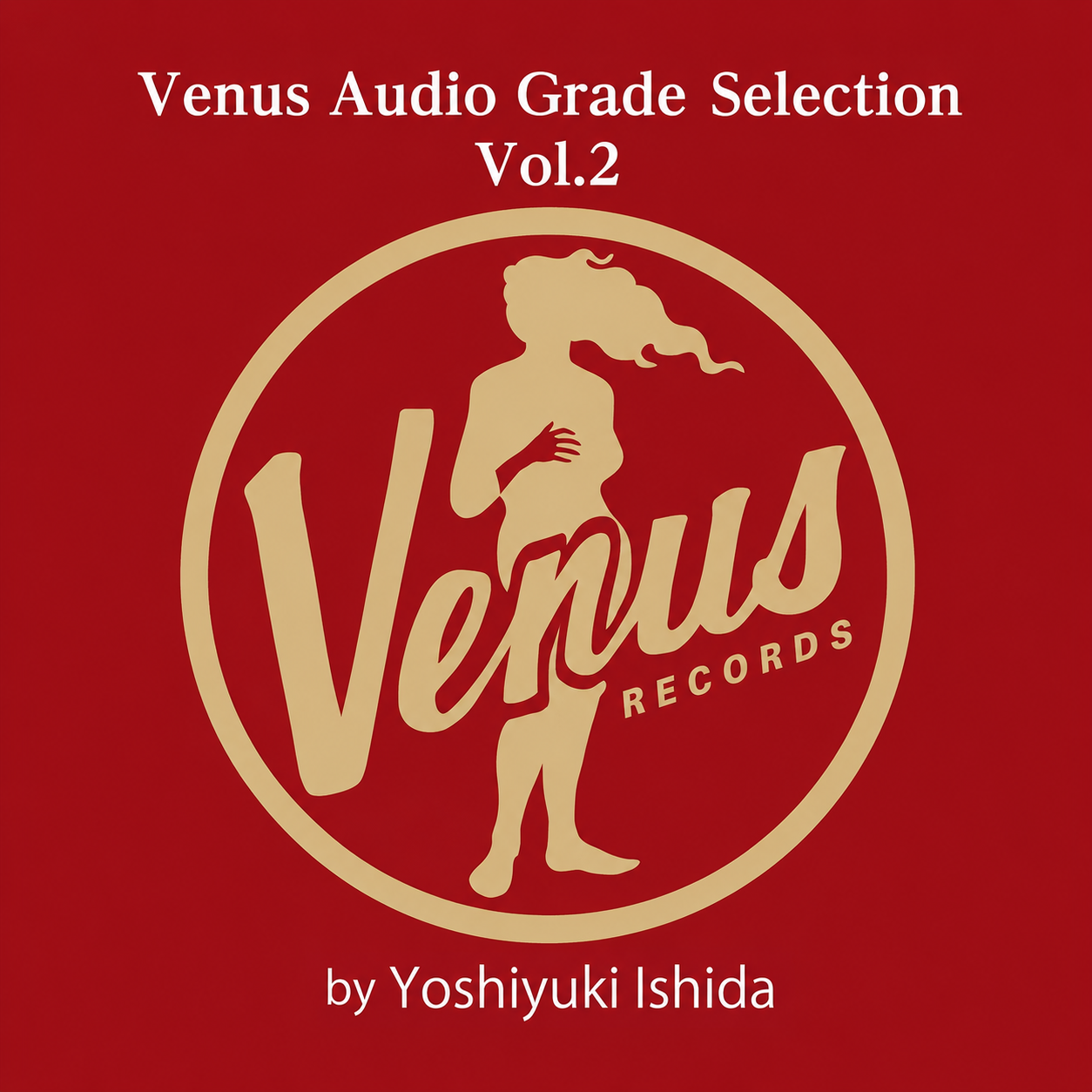
Venus Audio Grade Selection Vol. 2
GREAT CHOICE: Venus Audio Grade Selection Vol. 2!
Great music deserves to be discovered, enjoyed and shared.
CAN YOU SPARE A CUP OF COFFEE?
Audiophile-Streaming is a personal passion project, built with countless hours of discovering, selecting and sharing exceptional music.
I personally cover, without sponsors, the ongoing costs of hosting, software and subscriptions to keep the music discoveries coming. If you enjoy my work, your support is always appreciated.
A LITTLE THANK YOU IN RETURN
Just one coffee gives you lifetime access to the Coffee Club and all its playlists.
No subscriptions. No recurring fees.
Venus Audio Grade Selection Vol. 2 by Yoshiyuki Ishida: Jazz Chosen for the Pleasure of Sound
A great audiophile recording does more than reproduce music accurately. It creates an event inside the listening room. The piano gains physical weight, the breath behind a saxophone becomes audible, and the space between musicians acquires its own atmosphere. On Venus Audio Grade Selection Vol. 2 by Yoshiyuki Ishida, those qualities are not accidental. They are the reason the album exists.
Curated by Japanese audio critic Yoshiyuki Ishida, this ten-track Venus Records compilation approaches jazz from two inseparable directions. Every selection must work as music, but it must also reward serious listening through a revealing audio system. Ishida described good music and good recording quality as the essential foundations of his choices. For him, listening to beautifully reproduced sound could offer the same cleansing satisfaction as an exceptional meal or an encounter with a great work of art. When that sound was joined by jazz, the pleasure became even greater.
That philosophy makes Venus Audio Grade Selection Vol. 2 different from the average audiophile sampler. It is not a collection of isolated sonic effects assembled to impress visitors during a loudspeaker demonstration. There are no artificially exaggerated explosions, trains crossing the room or percussion instruments recorded merely to show off transient speed. Instead, Ishida turns to complete jazz performances in which recording quality supports emotional communication.
The album was issued as a hybrid SACD under catalogue number VHGD-10022, bringing ten carefully selected Venus Records performances together on one disc. A high-resolution digital edition followed on August 27, 2025, with a total running time of just over 61 minutes and playback offered in 24-bit/48kHz stereo.
The story begins with “Those Were the Days,” performed by saxophonist Jerry Weldon with the Massimo Faraò Trio. The familiar melody carries an immediate sense of memory, but the performance does not treat nostalgia as something fragile. Weldon’s tenor saxophone enters with authority, standing firmly in front of the rhythm section while retaining the warmth and humanity of a singing voice.
For an audiophile listener, the track establishes the terms of the album almost immediately. The saxophone must sound full without becoming swollen, and its brighter overtones must remain alive without turning hard. Behind Weldon, the piano, bass and drums need enough separation to be identified clearly, yet the musicians must continue to feel like one working ensemble. The recording succeeds when the listener stops thinking about stereo imaging and begins following the musical conversation.
It is an appropriate beginning because Ishida did not select these performances solely for transparency or technical perfection. He searched for recordings with freshness, clearly defined instrumental outlines and a convincing balance between direct sound and surrounding resonance. He also deliberately avoided repeating material used for an earlier Venus Records anniversary collection, first choosing the performing groups and then identifying the most sonically rewarding track from each album.
Barbara Carroll follows with “But Beautiful,” and the room changes. Where Weldon’s opening performance speaks with the broad voice of the tenor saxophone, the Barbara Carroll Trio offers intimacy, elegance and restraint. Jimmy Van Heusen’s standard has always lived between hope and resignation, and Carroll allows that emotional uncertainty to remain unresolved.
The piano is one of the most difficult instruments for a recording and playback system to reproduce convincingly. Its frequency range is enormous, its attack can become brittle, and its body can easily turn thick or indistinct. On “But Beautiful,” the instrument must possess both firmness and delicacy. The notes need a clear beginning, but they also need enough harmonic bloom to sound like struck strings resonating inside a wooden body rather than digital points appearing between the loudspeakers.
Carroll’s performance never becomes a sterile piano demonstration. The recording quality serves her timing, her touch and her refusal to overcrowd the melody. Silence matters here. The brief spaces between phrases give the listener time to hear the sound decay naturally, creating the impression that the music continues to breathe even when no one is playing.
The third selection, “Django,” places Sir Roland Hanna at the centre of another piano trio. John Lewis wrote the composition as a tribute to guitarist Django Reinhardt, and its dignified melody has become one of modern jazz’s most enduring memorials. Hanna approaches it with gravity but without heaviness, preserving the formal beauty of the piece while giving it a personal rhythmic life.
Through a high-quality audio system, the track becomes a study in scale. The piano should appear large enough to feel physically credible but not so large that it occupies the entire front wall. The bass must provide depth without losing its individual notes, while the drums should add shape and momentum rather than floating as disconnected details at the edges of the soundstage.
Hanna’s “Django” also clarifies the deeper purpose of an audio-grade jazz selection. Technical resolution is valuable because it reveals human decisions. A slight hesitation, a firmer left-hand accent or a change in dynamic level can alter the emotional direction of a phrase. Better sound is not simply more information. At its best, it allows the listener to understand the performance more completely.
With the Richie Beirach Trio’s “Scenes from Childhood, Op. 15, No. 1,” the album crosses from the jazz standard repertoire into the world of Robert Schumann. Classical material has often provided jazz pianists with harmonic and melodic possibilities, but Beirach’s interpretation is not an exercise in decoration. He draws out the composition’s reflective character and places it within the freedom of trio interaction.
The recording asks for tonal subtlety. Piano harmonics must remain distinct, particularly as notes overlap and decay. The bass should emerge from the same acoustic world rather than appearing as an added low-frequency layer. The drummer’s lightest movements must be audible without becoming disproportionately prominent.
This is the kind of performance that exposes weaknesses in an audio system without sounding like a test track. An excessively bright system may make the piano attack tiring. Too much warmth may blur the inner lines and reduce the clarity of Beirach’s voicings. When the balance is right, however, the performance feels suspended in space, with classical memory and jazz spontaneity occupying the same moment.
Barney Wilen’s “Besame Mucho” brings a different atmosphere. The famous Consuelo Velázquez melody has passed through popular song, Latin music and countless jazz interpretations, yet Wilen approaches it with the patience of a storyteller. His saxophone does not rush toward the familiar theme. It circles the melody, allowing romance and melancholy to remain closely connected.
The Venus Records sound has often been associated with physical presence, and “Besame Mucho” illustrates why. Wilen’s instrument arrives with body and proximity. The listener can sense the energy of the air column and the changing pressure behind each phrase. Yet the best moments are not merely impressive. They are vulnerable. The closeness of the recording makes the performance feel less like a public statement and more like a confession offered after midnight.
Ken Peplowski’s Gypsy Jazz Band continues the journey with “Nuages,” Django Reinhardt’s atmospheric masterpiece. The title means “clouds,” and the music seems to drift with the same combination of movement and stillness. Peplowski’s clarinet brings a smooth, woody colour to the melody, while the surrounding ensemble preserves the rhythmic elegance associated with gypsy jazz.
Here the audiophile value lies in texture. Clarinet, acoustic guitars and bass each occupy a different tonal region, but their overtones overlap constantly. A good system must keep those colours identifiable without breaking the ensemble into isolated pieces. The guitars need speed and rhythmic definition, yet they should retain the resonance of wood and strings. The clarinet must remain rounded even as it rises into its brighter register.
The result is one of the compilation’s most visually suggestive performances. The music seems to create its own landscape: a grey European sky, a quiet boulevard and clouds moving slowly above buildings that have witnessed several generations pass beneath them.
“Miss Bo,” performed by Italian saxophonist Gianni Basso with pianist Renato Sellani, brings the album into a more relaxed and conversational setting. Basso’s tone is rich and unforced, while Sellani answers with the lyrical economy that made him such a distinctive presence in European jazz.
Nothing in the performance appears hurried. The musicians allow the tune to unfold at its own pace, trusting tone and phrasing rather than dramatic gestures. This restraint makes the recording particularly revealing. Without dense arrangements to hide behind, every change in touch becomes important. The listener hears not only the melody but also the relationship between two mature musicians who understand how much can be communicated without raising their voices.
Simone’s “Ghost in This House” then places a human voice at the centre of the collection. After several instrumental performances, the arrival of a singer changes the listener’s scale of attention. Breath, consonants and small variations in vocal texture become the focus, while the accompaniment forms an intimate emotional frame.
The song carries the atmosphere of an abandoned relationship, but Simone avoids exaggerated sorrow. Her performance is controlled, allowing the words and melodic line to create their own tension. On a transparent system, the voice should appear stable and natural, with enough presence to feel immediate but not so much that it becomes unnaturally large.
Vocal recordings are among the quickest ways to judge tonal credibility because listeners know instinctively how a human voice should sound. Excessive brightness makes breath and sibilance distracting. Too much lower-midrange energy can make the singer seem chesty and confined. “Ghost in This House” demands balance, and that balance allows its emotional quietness to become more powerful.
The Vladimir Shafranov Trio follows with Kenny Dorham’s “Scandia Skies.” Shafranov has long been admired for a piano style that combines rhythmic certainty with melodic warmth, and the selection restores forward movement after Simone’s reflective ballad.
The trio’s performance feels open and buoyant. Piano lines travel across the rhythm section with clarity, while bass and drums maintain a sense of motion beneath them. The recording is useful for judging pace and coherence: whether the system allows the listener to follow each musician without losing the larger swing of the group.
That question is more important than spectacular detail. A system may produce an impressive cymbal or a sharply defined bass note, but if the rhythmic relationship between the musicians becomes difficult to feel, the essential meaning of the performance has been lost. “Scandia Skies” reminds the listener that timing is not merely an equipment specification. It is the pulse that turns separate sounds into jazz.
The album closes with “Tin Tin Deo” by trumpeter Cesare Mecca, expanding the collection’s scale through Afro-Cuban rhythm and brass energy. Written by Dizzy Gillespie, Chano Pozo and Gil Fuller, the piece carries a percussion-driven momentum that offers a striking contrast to the intimate piano trios and ballads heard earlier.
Mecca’s trumpet rises above a busy rhythmic foundation, demanding both dynamic freedom and control from the playback system. The instrument should sound brilliant and forceful without becoming piercing. Percussion must remain fast and layered, while the lower frequencies need enough definition to prevent the music from collapsing into a single block of energy.
As a closing statement, “Tin Tin Deo” is decisive. The album does not fade into contemplation. It finishes with colour, movement and the communal force of rhythm. What began with the nostalgic melody of “Those Were the Days” ends in Afro-Cuban celebration.
Together, the ten selections form a remarkably broad journey. Jerry Weldon provides muscular tenor saxophone, Barbara Carroll, Roland Hanna and Richie Beirach explore three different approaches to the piano trio, Barney Wilen brings romantic intensity, and Ken Peplowski revisits the gypsy jazz tradition. Gianni Basso and Renato Sellani offer Italian lyricism, Simone introduces vocal intimacy, Vladimir Shafranov restores Nordic-tinged swing, and Cesare Mecca closes the programme with Latin fire. The official high-resolution release contains these ten performances in that sequence and runs for 1 hour, 1 minute and 34 seconds.
The compilation was also prepared as a limited-edition 180-gram double LP in the Venus Masterpiece LP Collection. The vinyl version rearranged the tracks across four sides and was presented in a gatefold jacket with an obi strip. It was mixed and mastered by Venus Records founder and producer Tetsuo Hara using the label’s Venus Hyper Magnum Sound Direct Mix Stereo approach.
The vinyl sequence begins with “Django,” “Ghost in This House” and “Scenes from Childhood,” giving the analogue edition a different narrative shape from the SACD and digital programme. “Those Were the Days” and “Besame Mucho” occupy the second side, while “Tin Tin Deo” and “Scandia Skies” form the third. “But Beautiful,” “Miss Bo” and “Nuages” create a more intimate final side.
Yet format is not the central story of Venus Audio Grade Selection Vol. 2 by Yoshiyuki Ishida. Whether heard through SACD, high-resolution streaming or heavyweight vinyl, the album argues that serious audio listening should remain inseparable from musical involvement.
Ishida’s idea of “audio appreciation” is not passive. He describes listening to jazz at a sufficient volume in front of loudspeakers as an act of direct engagement rather than background entertainment. The listener confronts the music, tasting the sound itself alongside the meaning of the composition.
That principle can be heard across the compilation. The album invites attention to instrumental outlines, microphone distance, tonal freshness, room resonance and dynamic contrast, but these qualities are never presented as ends in themselves. They deepen the character of the musicians.
The body of Jerry Weldon’s saxophone matters because it strengthens the emotion in his phrasing. The natural decay of Barbara Carroll’s piano matters because it preserves the tenderness of “But Beautiful.” The texture of Simone’s voice matters because it brings the song’s loneliness closer. The attack of the percussion in “Tin Tin Deo” matters because rhythm should be felt physically as well as understood intellectually.
This is what distinguishes the finest audiophile jazz albums from technical demonstrations. They do not ask the listener to admire sound instead of music. They make it impossible to separate the two.
Venus Audio Grade Selection Vol. 2 by Yoshiyuki Ishida ultimately becomes a portrait of listening as an active pleasure. It begins in memory, moves through beauty, European lyricism, classical reflection, romantic melancholy and intimate song, then emerges into open swing and Afro-Cuban celebration.
When the final trumpet phrase disappears, the listener is left with more than a catalogue of excellent Venus Records recordings. The album has demonstrated what high-fidelity sound is supposed to achieve. It should not draw attention permanently toward loudspeakers, amplifiers or formats. It should allow those things to disappear, leaving musicians, instruments and emotion standing in the room.
That is the real audio grade by which this collection should be judged, and on that scale, Yoshiyuki Ishida’s selection succeeds beautifully.
