
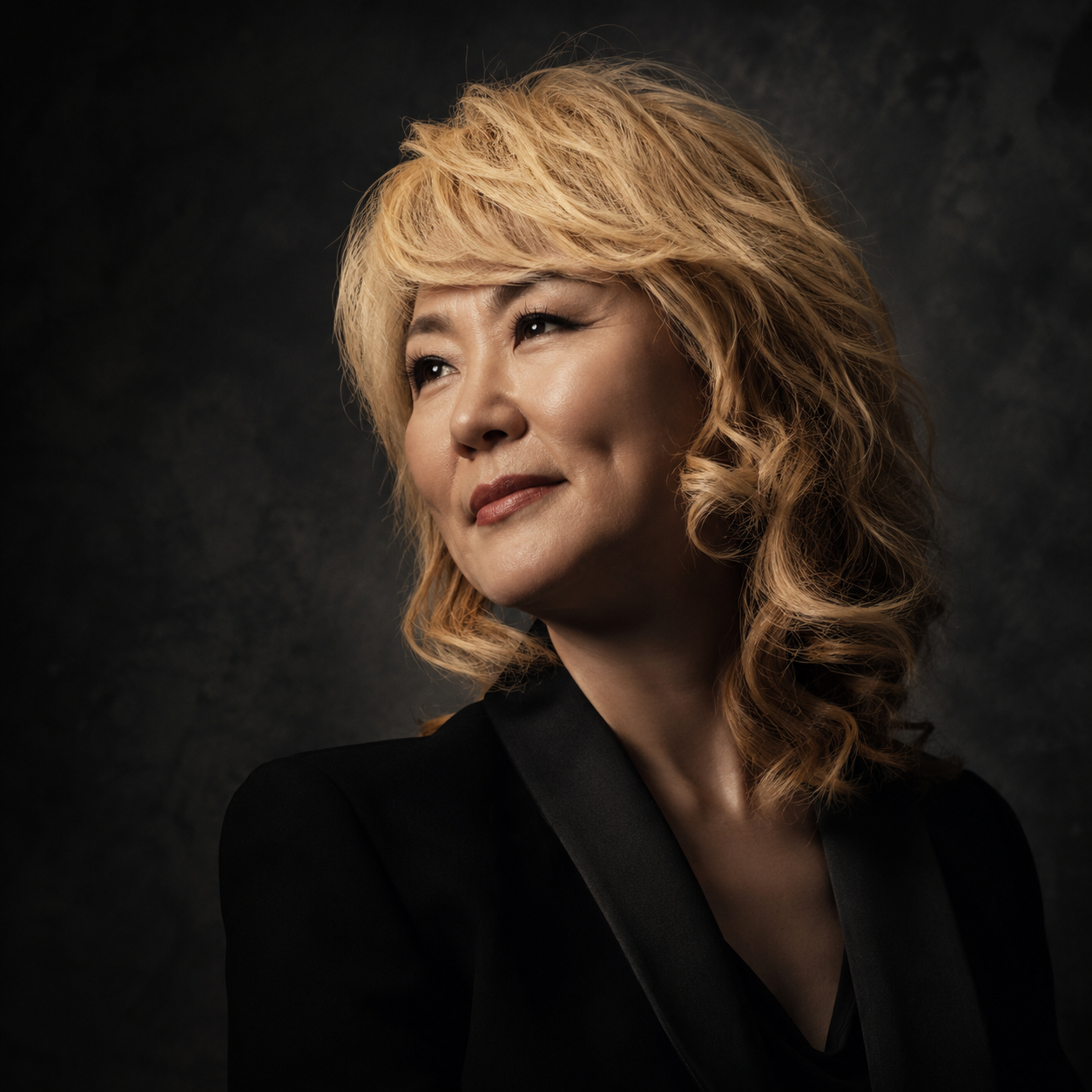
Youn Sun Nah
GREAT CHOICE: Youn Sun Nah!
Great music deserves to be discovered, enjoyed and shared.
CAN YOU SPARE A CUP OF COFFEE?
Audiophile-Streaming is a personal passion project, built with countless hours of discovering, selecting and sharing exceptional music.
I personally cover, without sponsors, the ongoing costs of hosting, software and subscriptions to keep the music discoveries coming. If you enjoy my work, your support is always appreciated.
A LITTLE THANK YOU IN RETURN
Just one coffee gives you lifetime access to the Coffee Club and all its playlists.
No subscriptions. No recurring fees.
Youn Sun Nah is one of the great modern voices for anyone who believes hi-fi should reveal emotion, not just sound. She is a South Korean jazz vocalist, songwriter and performer whose music moves with astonishing freedom between jazz, chanson, folk, pop, improvisation and art-song atmosphere. Her official biography describes her as one of contemporary jazz’s most admired vocalists, praised for moving naturally between dramatic expression, abstract improvisation and folk-like simplicity.
What makes Youn Sun Nah so special for audiophiles is the sheer physical presence of her voice. She can whisper with almost microscopic control, then open into a full, fearless vocal line without losing elegance. On a serious system, her recordings become a test of everything that matters: vocal texture, micro-dynamics, silence, room ambience, transient detail and emotional realism. You do not only hear notes; you hear breath, distance, tension and release. That is why her music is so rewarding on high-end audio. It has space. It has contrast. It has life.
Her story begins in Seoul, South Korea. She started with piano as a child, later sang gospel with the Korean Symphony Orchestra, and then moved to Paris in the 1990s to study jazz and chanson. That European chapter shaped her into a truly international artist: Korean in origin, French in artistic development, and global in musical language. She became known not by copying American jazz singers, but by creating her own vocal identity, one that treats the voice as both melody and instrument.
Her important albums form a beautiful path through modern vocal jazz. Voyage introduced many international listeners to her refined ECM-like spaciousness. Same Girl became one of her breakthrough recordings and includes her unforgettable interpretation of “My Favorite Things,” a track that shows her ability to transform familiar material into something sharp, intimate and new. Lento is another essential album, full of deep atmosphere, emotional patience and gorgeous ensemble playing. She Moves On moved her closer to American song traditions, while Immersion gave her sound a more modern, cinematic production. Waking World from 2022 was especially important because it was her first album made entirely from her own songwriting, showing her not only as an interpreter but as a complete creative author.
Her 2024 album Elles is also a major statement, built around songs associated with women artists and interpreted through her unmistakable vocal world. Her official discography now also lists Lost Pieces, released by Warner Music Arts / Nplug in 2026, with songs including “Shell of Me,” “Where’d You Hide?,” “Lost Pieces,” “A Map of Pain,” “I Can’t Sleep” and “My Home.”
The positives are enormous. First, Youn Sun Nah has one of the most expressive voices in contemporary jazz: technically controlled but never cold. Second, she is fearless with repertoire, moving from standards to folk songs, pop songs and original compositions without losing identity. Third, her recordings often have excellent spaciousness, making them ideal for judging vocal imaging and emotional presence. Fourth, she knows how to use silence, and that is rare. Many singers fill every moment; Youn Sun Nah lets the room speak.
For the hi-fi listener, the strongest starting points are Same Girl, Lento, Voyage, Immersion, Waking World and Elles. If you want pure vocal magic and acoustic intimacy, start with Same Girl and Lento. If you want a more modern, polished production with strong atmosphere, choose Immersion. If you want to hear her as a songwriter, Waking World and Lost Pieces are essential. There is no reliable evidence that her key catalogue is native DSD, so I would not present it as DSD material. The honest audiophile advice is to seek out the best available lossless or hi-res editions on platforms such as Qobuz, Tidal, Apple Music or physical CD/vinyl, depending on the album.
Youn Sun Nah should be heard because she reminds us that great vocal music is not about perfection alone. It is about risk, air, colour, silence and soul. A good hi-fi system does not make her music impressive; it simply removes the curtain. And once that curtain is gone, you hear one of the most distinctive, emotionally intelligent and sonically fascinating voices in modern jazz.
