
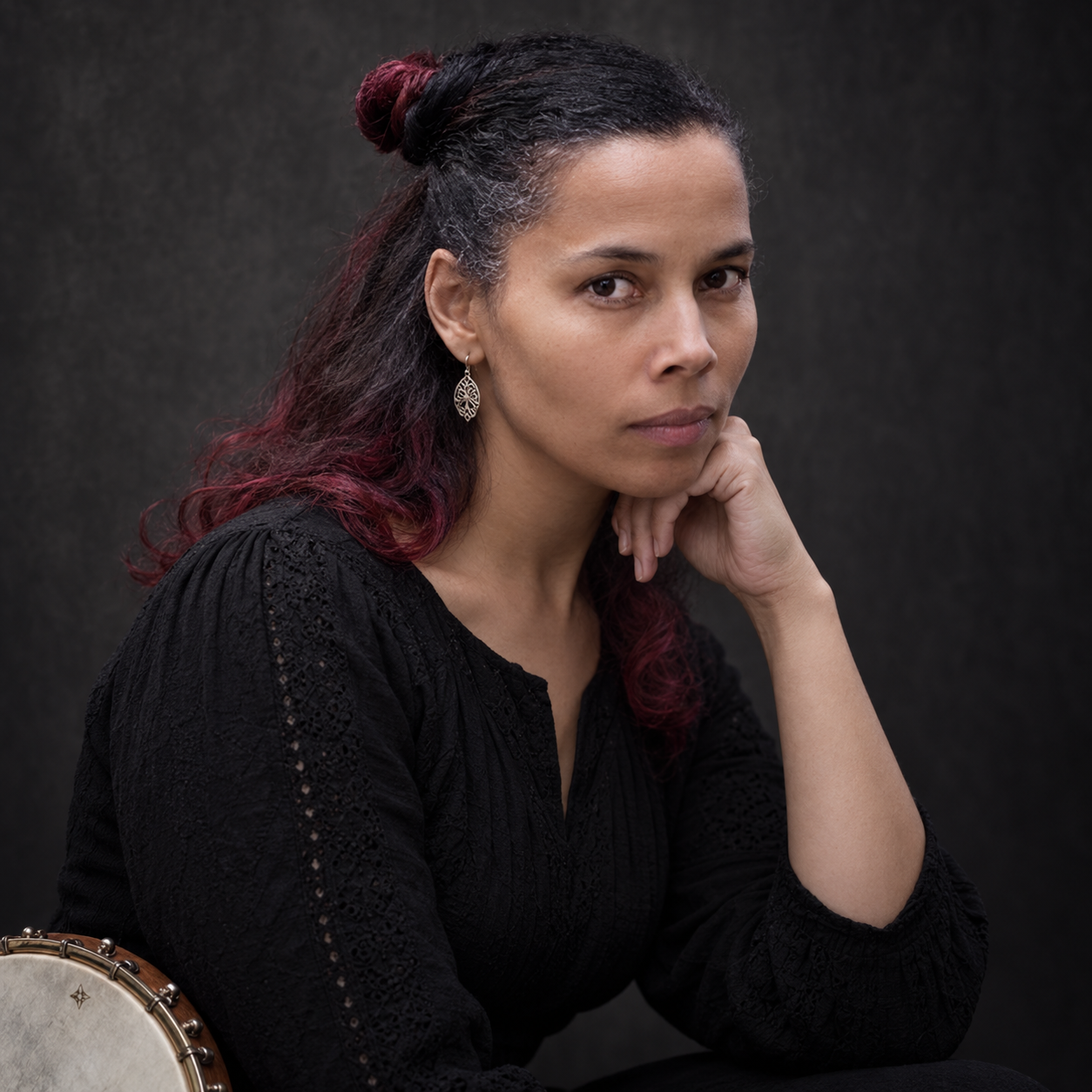
Rhiannon Giddens
GREAT CHOICE: Rhiannon Giddens!
Great music deserves to be discovered, enjoyed and shared.
CAN YOU SPARE A CUP OF COFFEE?
Audiophile-Streaming is a personal passion project, built with countless hours of discovering, selecting and sharing exceptional music.
I personally cover, without sponsors, the ongoing costs of hosting, software and subscriptions to keep the music discoveries coming. If you enjoy my work, your support is always appreciated.
A LITTLE THANK YOU IN RETURN
Just one coffee gives you lifetime access to the Coffee Club and all its playlists.
No subscriptions. No recurring fees.
The banjo has a much more interesting history than many people realise, and Rhiannon Giddens is one of the musicians who made me appreciate that history in a completely different way. Her music challenges the idea that American folk, country and bluegrass developed within separate musical communities. She brings those traditions together without making them sound like an educational exercise. What appeals to me is the combination of a powerful, flexible voice, excellent musicianship and a genuine understanding of where the songs come from. She can sing an old folk ballad with remarkable restraint and then deliver a gospel or blues performance with an entirely different kind of energy. I hear an artist who respects tradition but has no intention of being restricted by it.
Born Rhiannon Giddens on February 21, 1977, in Greensboro, North Carolina, she grew up in a region with deep musical connections to the American South. She studied opera at the Oberlin Conservatory of Music in Ohio, giving her a formal vocal background that would later become one of her most recognisable strengths. However, her musical interests extended well beyond classical singing. Traditional folk music, old-time string bands, blues, gospel and Celtic music gradually became important parts of her musical identity. She developed her abilities as a banjo and fiddle player while exploring the historical connections between these styles. I find that combination particularly interesting because her classical training gives her control, while her approach to traditional music gives her performances freedom and character.
Rediscovering the Roots of American Music
An important turning point came in 2005, when Giddens helped establish the Carolina Chocolate Drops with Dom Flemons and Justin Robinson. The group became known for exploring African American string-band traditions, drawing inspiration from older musicians, including North Carolina fiddler Joe Thompson. Their work challenged the widespread assumption that early American banjo and string-band music belonged almost exclusively to white performers. The banjo itself has African and African American roots, something that had become less widely recognised as the instrument became associated with bluegrass and country music. Rather than simply explaining this history, the Carolina Chocolate Drops demonstrated it through lively performances, traditional arrangements and considerable instrumental skill. Their 2010 album Genuine Negro Jig, released by Nonesuch Records, won the Grammy Award for Best Traditional Folk Album in 2011 and introduced their approach to a much wider audience.
I particularly enjoy the way Giddens approaches rhythm in this early material. Her banjo playing has a direct, percussive character, while her fiddle work connects naturally with the movement of the melodies. The performances often have a slightly rough, spontaneous quality that suits the material extremely well. Nothing feels overly polished or carefully arranged to impress the listener. Instead, the musicians sound involved with one another, responding to changes in timing and emphasis as the music develops. It is an important part of understanding Giddens because that sense of musical conversation remains present in her later recordings, even when the arrangements become considerably more sophisticated.
Her move towards a solo career allowed her to explore a broader collection of influences. An important connection was producer T Bone Burnett, who recognised her ability to interpret songs from different musical traditions. Their collaboration resulted in her debut solo album, Tomorrow Is My Turn, released by Nonesuch Records on February 10, 2015. The album includes material associated with artists such as Nina Simone, Dolly Parton, Patsy Cline, Odetta and Elizabeth Cotten. What I appreciate about this selection is that Giddens does not treat the songs as opportunities to imitate their original performers. She takes the musical character of each composition seriously while allowing her own voice and interpretation to determine the result.
Tomorrow Is My Turn remains one of my favourite introductions to her singing. On “Waterboy”, her voice moves between controlled phrasing and forceful expression without losing clarity. There is considerable strength in her lower and middle registers, but she can also open up the sound when a passage demands more intensity. The title track reveals another side of her musical personality, with a measured delivery that allows the melody and words to develop naturally. Burnett’s production gives the instrumental arrangements enough space to support her voice without competing with it. I particularly like the way the acoustic instruments retain their individual character, making it easy to follow the guitar, fiddle and bass while the vocal performance remains central.
For listeners interested in vocal realism and midrange transparency, this album offers some genuinely rewarding moments. On a revealing pair of speakers or headphones, the differences between her quieter phrases and stronger vocal passages become especially interesting. Her voice has body and texture, and the changes in emphasis are more important to the performance than spectacular recording effects. The arrangements also demonstrate how effective acoustic music can be when the instruments are clearly distinguishable without sounding disconnected. I would not describe every track as an audiophile demonstration recording, but I certainly consider it an album that rewards attentive listening.
From Interpretation to Personal Songwriting
Her second solo album, Freedom Highway, released in 2017, marked another important development. Recorded with multi-instrumentalist and co-producer Dirk Powell in Louisiana, the album placed greater emphasis on Giddens as a songwriter. Its material draws on historical accounts of slavery, African American experiences and the civil rights movement, alongside more personal themes. The recording approach is also noticeably different from her solo debut. Much of the album was recorded during an intensive eight-day period, giving the performances a directness that I find particularly convincing. Instead of carefully presenting a collection of interpretations, Giddens sounds increasingly interested in telling stories through music she has helped create herself.
“At the Purchaser’s Option” is an especially strong example. Inspired by a nineteenth-century advertisement offering an enslaved woman for sale, the song confronts a disturbing historical reality without turning the arrangement into a dramatic spectacle. The steady rhythm, banjo and vocal delivery provide much of its emotional weight. I admire the restraint because the subject is already powerful enough without unnecessary musical emphasis. Giddens sings with authority, but she also leaves room for the listener to consider what the words mean. It demonstrates an important quality in her work: she understands that intensity does not always require increased volume or elaborate arrangements.
The title track, drawn from the Staple Singers’ civil rights repertoire, connects the album’s historical subjects with a broader tradition of hope and determination. Giddens handles that connection convincingly because her interest in musical history is not separate from her interest in the people who created it. Her interpretations are informed by research, but they remain performances rather than lectures. I also appreciate that Freedom Highway feels less concerned with presenting a perfectly smooth musical surface. The vocal textures, rhythmic movement and instrumental interplay often have an immediate, human quality. Compared with Tomorrow Is My Turn, I hear a more personal artistic statement and a musician increasingly confident in her own songwriting.
That interest in overlooked historical perspectives continued with Our Native Daughters, a collaboration with Amythyst Kiah, Leyla McCalla and Allison Russell. Their 2019 album, Songs of Our Native Daughters, was released by Smithsonian Folkways and co-produced by Giddens and Dirk Powell. The project uses historical accounts and original compositions to explore the experiences of Black women, particularly those whose stories were neglected or misrepresented. I consider it one of the clearest examples of how Giddens combines musical creativity with historical understanding. The four musicians bring different voices and instrumental approaches to the material, creating a collective sound that feels purposeful without sacrificing individuality. Their use of banjos, acoustic strings and vocal harmonies also reinforces the musical traditions at the heart of the project.
A Wider Musical World
Giddens has continued expanding her musical interests through collaborations with Italian multi-instrumentalist Francesco Turrisi. Their recordings there is no Other in 2019 and They’re Calling Me Home in 2021 explore connections between musical traditions that developed on different sides of the Atlantic. These projects make sense when considered alongside her earlier work because she has always been interested in the movement of music between cultures. I enjoy hearing how different instrumental textures and rhythmic ideas can exist together without one tradition dominating the other. Her willingness to work outside familiar arrangements prevents her music from becoming predictable, although I sometimes find that the quieter, more experimental material requires more patience than her immediately engaging folk and gospel performances. That is not necessarily a weakness, but it does make some recordings better suited to concentrated listening.
Her creative range also extends into classical composition and opera. Working with composer Michael Abels, she created Omar, an opera based on the life of Omar Ibn Said, a West African Muslim scholar who was enslaved in the United States. The work premiered at Spoleto Festival USA in 2022 and received the 2023 Pulitzer Prize for Music. This achievement brought together several aspects of her career, including classical training, historical research, composition and her commitment to telling stories that deserve greater attention. She also became Artistic Director of the Silkroad Ensemble in 2020, following the example established by its founder, Yo-Yo Ma, of bringing musicians from different cultural backgrounds together. These activities show how far her career has developed beyond the traditional expectations of a folk singer.
Her 2023 album You’re the One offers another interesting perspective on that development. Produced by Jack Splash and released through Nonesuch Records, it was her first solo album consisting entirely of original songs. The music incorporates elements of folk, blues, jazz, gospel, soul and popular music, supported by a larger ensemble that includes a horn section. I enjoy the more relaxed, rhythmically lively character of these recordings because it reminds me that Giddens is not interested only in difficult historical subjects. There is room for warmth, humour and straightforward musical enjoyment in her work. The larger arrangements sometimes make her voice less exposed than on the acoustic recordings, but they also demonstrate how comfortably she can operate outside the traditional folk setting.
That openness continued with the Silkroad Ensemble’s American Railroad in 2024 and What Did the Blackbird Say to the Crow, her 2025 collaboration with former Carolina Chocolate Drops colleague Justin Robinson. The latter project is particularly interesting because it reconnects her with North Carolina fiddle and banjo traditions, bringing her musical journey back to some of its earliest influences. Rather than abandoning traditional music as her career expanded, she has continued to investigate it alongside her work in composition and contemporary songwriting. I respect that consistency. Her musical interests have become broader, but the curiosity behind them has remained remarkably clear.
For anyone discovering Rhiannon Giddens, I would begin with Tomorrow Is My Turn to appreciate the versatility and control of her voice, then move to Freedom Highway to understand her songwriting and artistic priorities. From there, Songs of Our Native Daughters provides valuable context for her historical interests, while You’re the One reveals a more contemporary and playful side. What makes her important is not simply her ability to move between folk, classical, blues and gospel music, but her contribution to a more complete understanding of American musical history. She has helped bring neglected traditions and musicians back into the conversation while developing a recognisable musical identity of her own. For me, her strongest performances are those where her voice, instrumental knowledge and understanding of the material come together without unnecessary decoration. The quality that ultimately defines Rhiannon Giddens for me is her ability to communicate conviction through remarkably natural, expressive phrasing.
HiFi’ve, Ronald – Your EarFluencer
