
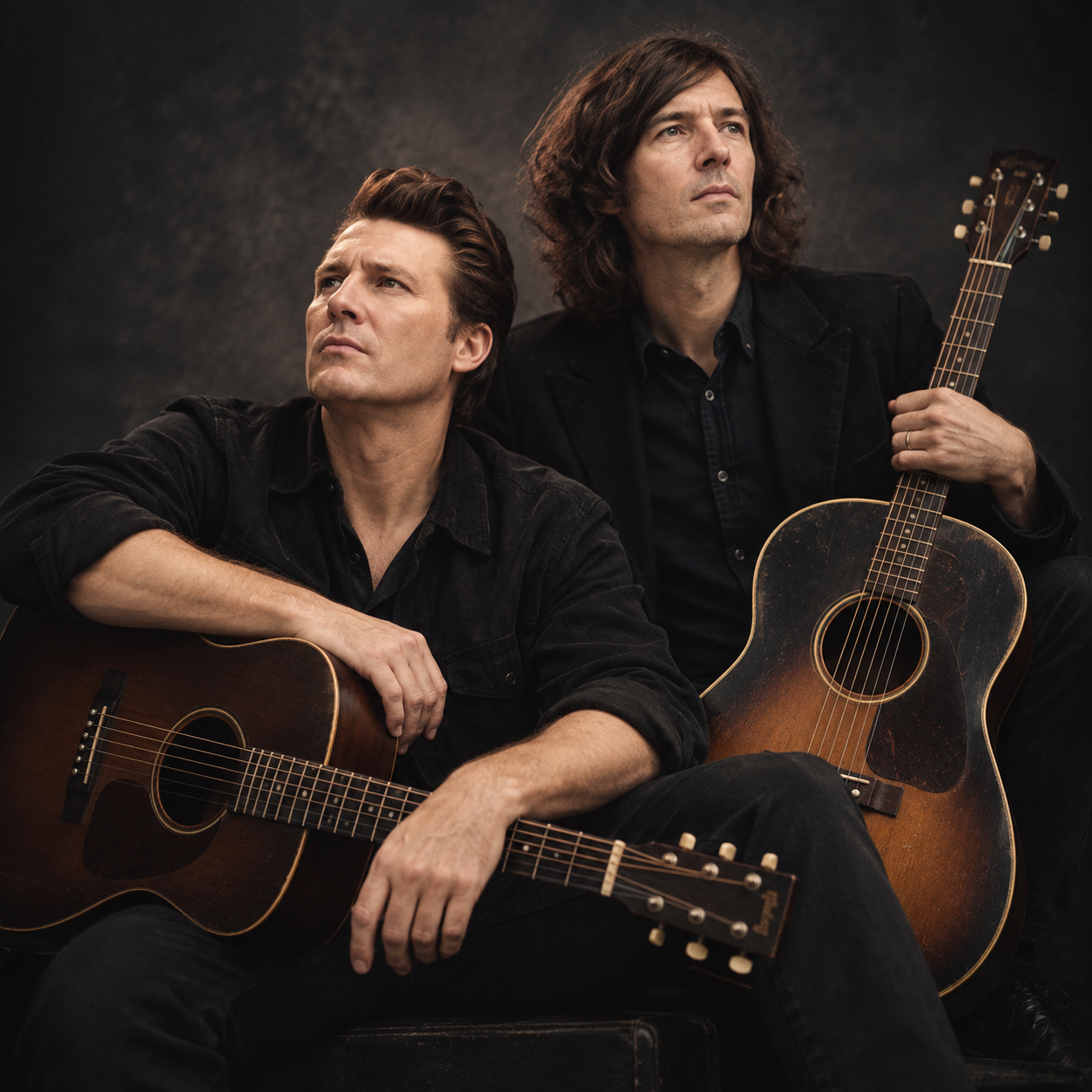
The Milk Carton Kids
GREAT CHOICE: The Milk Carton Kids!
Great music deserves to be discovered, enjoyed and shared.
CAN YOU SPARE A CUP OF COFFEE?
Audiophile-Streaming is a personal passion project, built with countless hours of discovering, selecting and sharing exceptional music.
I personally cover, without sponsors, the ongoing costs of hosting, software and subscriptions to keep the music discoveries coming. If you enjoy my work, your support is always appreciated.
A LITTLE THANK YOU IN RETURN
Just one coffee gives you lifetime access to the Coffee Club and all its playlists.
No subscriptions. No recurring fees.
The way Kenneth Pattengale and Joey Ryan sing together is the reason Milk Carton Kids immediately made sense to me. Their voices do not simply sit in harmony, with one clearly leading and the other decorating the melody. They often seem to create a third voice between them, while the two acoustic guitars perform a similar trick underneath. Pattengale tends to supply the more intricate movement and melodic detail, while Ryan gives the songs their rhythmic foundation, and the result can sound remarkably complete for only two people. That combination of restraint, precision and emotional understatement has become their identity, but their career shows that they have never been quite as stylistically narrow as the basic two-men-with-acoustic-guitars description suggests.
The Milk Carton Kids grew out of the Los Angeles singer-songwriter scene. Kenneth Pattengale and Joey Ryan had both been working as solo musicians when they met through performances at the Hotel Cafe around the end of 2009. They began playing together seriously in 2011 and soon decided the combination was stronger than continuing their separate careers. Both men were born in 1982; Pattengale was born on April 6, 1982, in Pasadena, California. Ryan has spoken about growing up with Bob Dylan, Joni Mitchell, Simon & Garfunkel and Neil Young as important musical reference points, and I can certainly hear that tradition in the duo, although their best work never feels like an exercise in recreating the 1960s folk revival.
Their instruments are an important part of that personality. Ryan became closely associated with a 1951 Gibson J-45, while Pattengale has played a 1954 Martin 0-15. The contrast is useful. Ryan’s guitar can provide a steady, woody foundation while Pattengale moves around it with fingerpicked lines, fills and small melodic answers. On a revealing system I enjoy following the guitars independently because they rarely duplicate each other. The real pleasure, though, is hearing how naturally those parts fit around the vocals rather than showing off technique for its own sake.
Finding the sound
Their first studio album under the Milk Carton Kids name, Prologue, was recorded in North Hollywood during a five-day break in touring in April 2011 and released on July 19 of that year. The setup was beautifully simple: four microphones, two guitars and two voices. The album was offered as a free download, which helped the duo reach an audience well beyond the clubs where they had been working. More importantly, the recording caught them at the point where two individual singer-songwriters were becoming an actual group.
For me, Prologue remains one of the clearest ways to understand them. “Michigan” is a particularly good starting point because almost everything essential is already there: patient pacing, very little instrumental clutter, close vocal harmony and guitar parts that leave room around every phrase. I like the fact that the arrangement does not tell me how to feel with extra layers of production. The emotion comes from timing, harmony and the slight differences between the two voices. Through transparent speakers or headphones, the small movements of the strings and the way the voices occupy almost the same central space become part of the performance rather than audiophile decoration.
The real breakthrough came with The Ash & Clay, released by ANTI- on March 26, 2013. Signing with ANTI- gave the duo a wider platform without requiring them to abandon the stripped-back character that had attracted listeners in the first place. The album was recorded in Culver City and later received a Grammy nomination for Best Folk Album. It also showed that the Milk Carton Kids could make their minimalist format sustain an entire record without everything becoming interchangeable.
I especially like “Snake Eyes” because the guitar playing is so active without disturbing the calm surface of the song. Pattengale can put a surprising amount of information into a short guitar phrase, but Ryan’s rhythm playing keeps it anchored and the singing prevents the instrumental detail from becoming the main event. That balance is one of the duo’s great strengths. There are moments when their deliberate understatement can feel almost too controlled if I listen to several similar songs in succession, but at their best that discipline creates tension rather than blandness. They make me listen harder because they refuse to shout for attention.
Monterey followed in May 2015 and was recorded during 2014. By then the duo had become considerably better known, had won Group of the Year at the 2014 Americana Music Awards and had appeared in Another Day/Another Time, the concert documentary connected with the Coen brothers and producer T Bone Burnett. “The City of Our Lady” from Monterey subsequently received a Grammy nomination for Best American Roots Performance. What interests me about this period is how confident Pattengale and Ryan had become inside their self-imposed limits. They could use silence, tiny changes in guitar dynamics and almost whispered harmony as structural elements instead of simply filling every available space.
Opening the arrangement
A significant change arrived with All the Things That I Did and All the Things That I Didn’t Do in 2018. Produced by Joe Henry and engineered by Ryan Freeland, it was recorded at the House of Blues Studio in Nashville in October 2017 and became the first Milk Carton Kids studio album built around a full supporting band. The musicians included Brittany Haas, Paul Kowert, Dennis Crouch, Jay Bellerose, Pat Sansone, Russ Pahl and others. Rather than replacing the duo’s character, the larger instrumentation allowed them to explore how much space could exist around those two familiar voices.
“One More for the Road” is the track I would use to demonstrate why that expansion mattered. At more than ten minutes, it moves far beyond the compact acoustic-folk song and allows the arrangement to stretch into territory touching folk, jazz and psychedelia. I hear it less as the Milk Carton Kids abandoning simplicity than as them testing whether their sense of restraint still works on a larger canvas. It does. The additional instruments deepen the atmosphere, while the voices and guitars remain recognisably at the centre.
They eventually moved back toward a more concentrated version of themselves. I Only See the Moon, released in May 2023 through Far Cry Records and distributed by Thirty Tigers, was produced by Pattengale and earned the duo another Grammy nomination, this time for Best Contemporary Folk Album. The title track shows how much they had learned from both approaches. The arrangement has more dimension than the earliest records, including strings, but it still depends on intimacy and careful placement rather than scale. I particularly enjoy the vocal realism here: the harmony sounds close and human, while the surrounding instruments give it depth without pushing the singers forward unnaturally.
Their story has continued rather than settling into preservation mode. Lost Cause Lover Fool, released on April 24, 2026 on Far Cry Records and marketed and distributed by Thirty Tigers, finds Pattengale and Ryan fifteen years into the partnership and still interested in small details rather than dramatic reinvention. “Blue Water” opens the album with gently handled banjo and the kind of unhurried singing that has always suited them. The production feels comfortable with space, and I hear two musicians who no longer seem concerned about proving how much can be achieved with only two guitars. They can add a texture when it serves the song and leave it out when it does not.
What keeps Milk Carton Kids interesting to me is not simply the beauty of their harmonies. Plenty of performers can sing closely together. Pattengale and Ryan understand how voices, guitar lines, pauses and dynamics can operate as parts of the same conversation, and over the years they have learned how to widen that conversation without losing its character. Prologue captures the moment the partnership discovered itself, The Ash & Clay shows the classic duo form becoming fully confident, and All the Things That I Did and All the Things That I Didn’t Do proves that the sound could survive a much larger arrangement. Later albums such as I Only See the Moon and Lost Cause Lover Fool show two musicians who now know exactly which parts of that original formula are essential. For me, the quality that explains them best is their sense of musical balance: neither voice, neither guitar and neither personality needs to dominate for the song to feel complete.
HiFi’ve, Ronald – Your EarFluencer
