
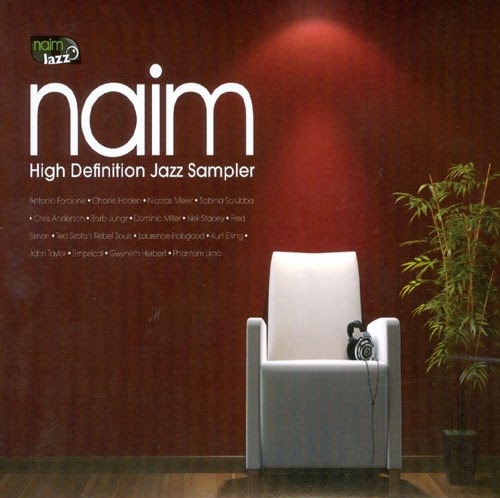
Naim
High Definition
Jazz Sampler
GREAT CHOICE: Naim High Definition Jazz Sampler!
Great music deserves to be discovered, enjoyed and shared.
CAN YOU SPARE A CUP OF COFFEE?
Audiophile-Streaming is a personal passion project, built with countless hours of discovering, selecting and sharing exceptional music.
I personally cover, without sponsors, the ongoing costs of hosting, software and subscriptions to keep the music discoveries coming. If you enjoy my work, your support is always appreciated.
A LITTLE THANK YOU IN RETURN
Just one coffee gives you lifetime access to the Coffee Club and all its playlists.
No subscriptions. No recurring fees.
Naim High Definition Jazz Sampler: Great Jazz, Natural Sound and the Pleasure of Listening
A good jazz compilation should do more than collect attractive recordings. It should introduce musicians with different personalities, show how they approach their instruments and give the listener a reason to explore their music further. That is exactly what makes Naim High Definition Jazz Sampler interesting to me. Released in 2010, this collection from Naim brings together established jazz musicians, inventive guitarists, distinctive vocalists and smaller ensembles that deserve attention. Instead of concentrating on one particular style, it offers thirteen tracks on the main audio CD and seven additional high-resolution selections on a bonus data disc. For anyone interested in audiophile music, it is an opportunity to enjoy excellent performances while discovering what a carefully produced recording can reveal.
Naim is a familiar name among high-end audio enthusiasts, primarily through its British hi-fi equipment. However, the company also developed a recording label with its own musical identity. Founded by Julian Vereker, Naim Audio became closely associated with the idea that good equipment should serve the music rather than distract from it. Its recording activities followed a similar philosophy, building a catalogue that included jazz, classical, acoustic and other styles. The label worked with musicians whose performances benefited from clarity, natural dynamics and careful recording. I appreciate that approach because the best audiophile recordings are not necessarily the loudest or most spectacular. They are recordings that allow me to understand what the musicians are doing.
Different Musicians, Different Personalities
The compilation begins with “October in Ankara” by guitarist Nicolas Meier, an artist whose music brings together jazz improvisation and influences from Turkish and Middle Eastern musical traditions. Meier was born in Switzerland and later established himself in the British jazz scene. His work with different acoustic guitar styles gives his music a character that is recognisable without relying on familiar jazz guitar clichés. His album Silence Talks, released by Naim in 2008, is an important part of his relationship with the label. “October in Ankara” provides an appealing introduction to the rhythmic and melodic interests that distinguish his playing. I particularly enjoy the way his guitar lines can move between delicate detail and more rhythmically active passages. There is plenty to follow without the music becoming unnecessarily complicated.
Another musician who gives this collection much of its personality is Italian guitarist Antonio Forcione. Born in Italy, Forcione developed an international career through his highly individual approach to acoustic guitar. His performances combine jazz, Mediterranean influences, rhythmic experimentation and an unusually expressive use of the instrument. He often treats the guitar as more than a source of melody, using its body, strings and natural resonance to develop a complete musical performance. That makes him particularly interesting on revealing speakers or headphones, where subtle changes in attack and playing technique become easier to appreciate.
Forcione appears several times on this sampler, including a version of Paul Desmond’s famous composition “Take Five” with vocalist Sabina Sciubba. The original became widely known through the Dave Brubeck Quartet, but the combination of Forcione and Sciubba brings a different personality to the composition. The familiar five-beat rhythm remains an essential part of its character, while the interaction between guitar and voice offers a fresh perspective. I like hearing a well-known piece approached without simply copying its most famous recording. Sciubba’s distinctive vocal delivery adds another layer of interest, and the arrangement gives the listener room to concentrate on phrasing and timing.
Forcione also appears with guitarist Neil Stacey on “Talking Hands”, credited to their Acoustic Mania collaboration. Here, the attraction is the conversation between two acoustic guitars. Both musicians have considerable technical ability, but what interests me most is how they respond to each other. The rhythm develops naturally, and the different guitar parts create movement without requiring a large ensemble. On a transparent system, the separation between the instruments can make it easier to follow the exchange of musical ideas. It is a recording I would suggest to someone who enjoys acoustic guitar and wants to understand why timing and articulation matter as much as speed.
Charlie Haden and the Importance of Space
For me, one of the strongest musical connections running through this collection is the presence of American double bassist Charlie Haden. Born Charles Edward Haden on August 6, 1937, in Shenandoah, Iowa, he grew up in a musical family and began performing as a child. He later became one of the most important bassists in modern jazz, particularly through his work with Ornette Coleman and his own Liberation Music Orchestra. Haden died on July 11, 2014, in Los Angeles, California, leaving a body of work that influenced generations of jazz musicians.
Haden’s musical personality was remarkable because he could communicate so much with relatively few notes. He understood the importance of melody and silence, and his bass lines often had a direct emotional quality without becoming sentimental. His playing did not depend on filling every available space. Instead, he listened carefully and gave other musicians the freedom to develop their own ideas. That quality makes his recordings especially rewarding for me, because there is always something happening in the relationship between the musicians, even during the quietest passages.
On this sampler, Haden performs “The Things We Did Last Summer” with pianist Chris Anderson. Anderson, born in Chicago in 1926, was a highly respected jazz pianist whose harmonic understanding influenced musicians including Herbie Hancock. His career was not defined by widespread commercial recognition, but his playing earned considerable admiration among fellow musicians. The partnership with Haden brings together two artists who understood the value of restraint. I enjoy listening to the relationship between the piano and double bass, especially the way musical phrases are allowed to develop without unnecessary decoration. It is the kind of performance where midrange transparency and natural instrumental timbre can make a real difference.
Another important selection is “If”, performed by Charlie Haden and Antonio Forcione. The piece comes from their album Heartplay, released by Naim in 2006. The album is particularly interesting because it places two musicians from different backgrounds in a close musical partnership. Haden’s deep, melodic bass playing provides a foundation for Forcione’s expressive acoustic guitar, but neither musician dominates the performance. The attraction lies in their ability to listen, respond and leave space for one another.
I consider Heartplay an excellent starting point for anyone who wants to explore the quieter side of acoustic jazz. The combination of double bass and guitar makes it relatively easy to concentrate on individual instruments, but the real pleasure comes from understanding how the musicians work together. A recording like “If” can also be useful reference music because the instruments have different tonal characteristics. The lower register of the bass, the attack of the guitar strings and the decay of the notes all contribute to the performance. Good equipment should make these details understandable without exaggerating them.
Haden appears again with British pianist John Taylor on “Bittersweet”. Taylor, born in Manchester in 1942, became a respected figure in European jazz through his sophisticated piano playing and collaborations with musicians including Kenny Wheeler and Norma Winstone. His partnership with Haden produced the album Nightfall, another recording worth exploring for listeners who appreciate intimate jazz performances. Taylor’s touch was different from Anderson’s, but both pianists shared an ability to make complex musical ideas sound natural. I value this kind of playing because it never feels as though the musician is trying to prove something.
Voices, Familiar Songs and Audiophile Listening
The vocal performances on Naim High Definition Jazz Sampler offer another perspective on the label’s catalogue. British singer Barb Jungr contributes “I’m a Believer”, a song written by Neil Diamond and made famous by the Monkees. Jungr has developed a career around highly personal interpretations of existing songs, frequently exploring material associated with artists such as Bob Dylan, Leonard Cohen and Jacques Brel. Rather than treating a familiar composition as something that must remain unchanged, she looks for a way to communicate its meaning through her own musical personality.
That approach makes “I’m a Believer” particularly interesting. A song most listeners associate with bright, energetic pop music can take on a different character when approached by a singer with Jungr’s interpretive instincts. I enjoy artists who are prepared to reconsider familiar material instead of reproducing the original arrangement. Vocal recordings are also excellent for evaluating a hi-fi system because the human voice is something we understand instinctively. If the midrange sounds unnatural or the recording becomes overly aggressive, it can be distracting. With a convincing presentation, attention moves away from the equipment and towards the singer’s phrasing.
Another familiar composition is Sting’s “Shape of My Heart”, performed here by guitarists Dominic Miller and Neil Stacey. Miller was born in Buenos Aires, Argentina, in 1960 and became widely known through his long collaboration with Sting. He co-wrote “Shape of My Heart” with Sting, and the song appeared on Sting’s 1993 album Ten Summoner’s Tales. Miller and Stacey’s instrumental interpretation is included on their Naim album New Dawn, released in 2001.
I have always appreciated the melodic quality of “Shape of My Heart”. The guitar figure is immediately recognisable, but it also has enough musical substance to work without the original vocal. In an instrumental arrangement, the listener can concentrate on the relationship between the guitar parts and the small variations that give the performance its character. Miller has a controlled, melodic touch that contrasts nicely with more rhythmically adventurous players such as Forcione. This is one of the things I enjoy about the compilation: it demonstrates that acoustic guitar music can have very different personalities.
The collection also includes “First Song”, performed by pianist Laurence Hobgood with Charlie Haden and vocalist Kurt Elling. The recording comes from Hobgood’s 2009 Naim album When the Heart Dances, which features collaborations with Haden and Elling. Hobgood and Elling developed a longstanding musical partnership, with Hobgood playing an important role in the arrangements and musical direction of Elling’s work. Their approach combines the flexibility of jazz improvisation with considerable attention to melody and lyrics.
“First Song” is an especially rewarding selection because the musicians understand how to support one another. Elling has a rich and recognisable voice, while Hobgood’s piano playing provides harmonic colour without competing for attention. Haden’s bass contributes the melodic sensitivity that characterises so much of his work. For me, the most interesting aspect is the balance between individual expression and ensemble playing. A good stereo presentation should help the listener follow each contribution while preserving the feeling of a unified performance.
The sampler is not limited to quiet, intimate recordings. Ted Sirota’s Rebel Souls bring a more rhythmically assertive side of jazz through “Geronimo’s Free”, while the Neil Stacey Group, Fred Simon and other performers add further variety. That range matters because it prevents the collection from becoming a demonstration of only one kind of audiophile sound. Different instruments and arrangements place different demands on the recording and on the playback system. Some selections invite close attention to fine details, while others are more about rhythmic energy and the interaction of a complete ensemble.
There is also an interesting technical aspect to this release. In addition to the thirteen-track audio CD, the original edition includes a bonus data disc containing seven FLAC selections in 24-bit resolution, with sample rates including 44.1, 48 and 96 kHz. These include performances by Barb Jungr, Charlie Haden and Antonio Forcione, Laurence Hobgood with Haden and Elling, Empirical, Gwyneth Herbert and Phantom Limb. The data disc is intended for compatible computer-based or digital music playback rather than a conventional CD player.
I find the high-resolution material interesting, but I would not suggest that a higher sample rate automatically guarantees a better musical experience. Recording quality depends on the original performance, microphones, recording environment, engineering and mastering. A carefully produced standard-resolution recording can easily be more enjoyable than a poorly produced high-resolution one. The additional formats can be useful for listeners who want to explore their DACs and high-end audio systems, but the musicians should remain the main attraction. That is where I believe Naim’s approach makes sense.
What ultimately makes this compilation valuable is the quality and variety of its musical encounters. Nicolas Meier demonstrates how different musical traditions can influence modern jazz guitar, Antonio Forcione shows the expressive possibilities of the acoustic instrument, and Charlie Haden reminds us that a simple bass line can communicate more than a technically complicated solo. The recordings by Barb Jungr, Dominic Miller, Laurence Hobgood and Kurt Elling add distinctive interpretations, familiar melodies and vocal performances that broaden the listening experience. I would recommend starting with “If”, “Take Five” or “First Song”, then exploring the original albums and artists that interest you most. Naim High Definition Jazz Sampler is enjoyable as an audiophile recording collection, but its greater value is the opportunity to hear musicians whose playing is based on listening, understanding and responding to one another. For me, the quality that best defines this collection is natural musical expression.