
SoundProLab
Sonic’s Mad
Audiophile Sampler
GREAT CHOICE: SoundProLab Sonic’s Mad Audiophile Sampler!
Great music deserves to be discovered, enjoyed and shared.
CAN YOU SPARE A CUP OF COFFEE?
Audiophile-Streaming is a personal passion project, built with countless hours of discovering, selecting and sharing exceptional music.
I personally cover, without sponsors, the ongoing costs of hosting, software and subscriptions to keep the music discoveries coming. If you enjoy my work, your support is always appreciated.
A LITTLE THANK YOU IN RETURN
Just one coffee gives you lifetime access to the Coffee Club and all its playlists.
No subscriptions. No recurring fees.
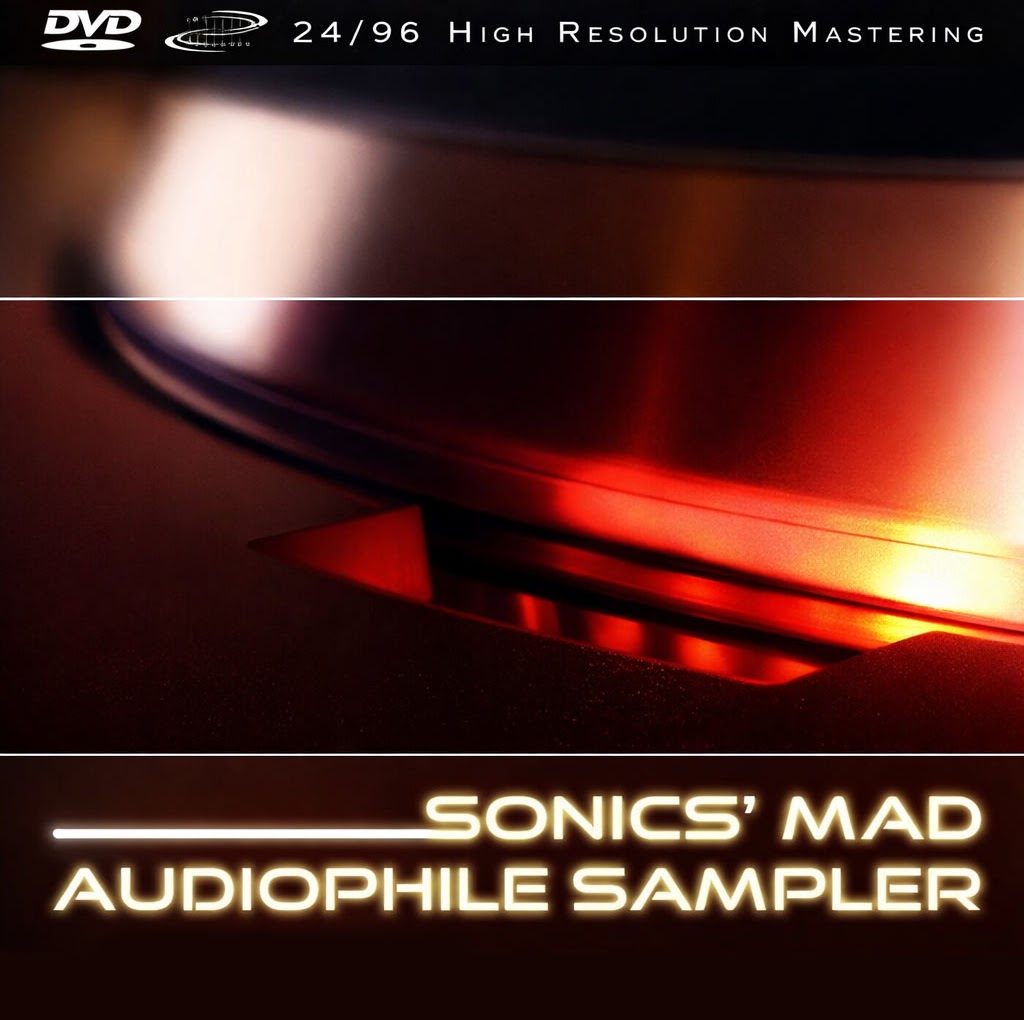
SoundProLab Sonic’s Mad Audiophile Sampler is not the kind of compilation I would normally expect from an audiophile collection. Instead of concentrating on acoustic guitars, intimate jazz recordings and carefully produced female vocals, this 2007 sampler brings together Whitney Houston, Madonna, Quincy Jones, Jacintha, ABBA and even music from Star Wars. That is quite a combination, and it immediately caught my attention. The collection is also known as Sonics’ Mad Audiophile Sampler, a title that suits its unusual selection rather well. What interests me most is the idea behind it: using very different kinds of music to explore how recordings behave on a good stereo system, without limiting the listening experience to traditional audiophile favourites.
The compilation contains recordings from several decades and moves between pop, jazz, classical music, film scores and electronic sounds. It includes contributions from artists and composers such as Elton John, Janet Jackson, Tori Amos, John Williams and Jerry Goldsmith. The musical variety is one of its strongest qualities, although it also means that the listening experience is less consistent than on a conventional album. The original recordings were created in different studios, for different purposes and under different production conditions. I actually appreciate that distinction because it gives me a much broader impression of recording styles than a collection built entirely around one particular audiophile sound.
From Whitney Houston to Quincy Jones
Whitney Houston’s “Love Will Save the Day” is an interesting choice for this compilation. Originally released on her 1987 debut album’s follow-up, Whitney, the song combines her powerful voice with a lively pop arrangement and a strong dance rhythm. I like the way Houston moves between controlled singing and more forceful passages without losing the character of her voice. The rhythm section keeps the music moving, while the keyboards and backing vocals give the arrangement its unmistakable late-eighties personality. For me, the important thing is not whether every detail can be heard separately, but whether the whole performance still feels energetic and convincing. A good presentation should allow Houston to remain the centre of attention without making the accompanying instruments sound weak or disconnected.
Quincy Jones takes the compilation in a completely different direction with “Soul Bossa Nova”. First released on his 1962 album Big Band Bossa Nova, this instrumental has a playful rhythm, bright brass arrangements and an instantly recognisable melody. Jones was already an accomplished arranger and bandleader by this point, and the recording shows how much personality he could bring to a relatively short piece of music. I particularly enjoy the interaction between the brass, percussion and the underlying rhythmic pulse. There is plenty happening, but the arrangement never becomes unnecessarily complicated. This is also a useful recording for appreciating how instruments occupy their own positions within a busy ensemble. The musical timing matters much more to me than spectacular sound effects, and “Soul Bossa Nova” succeeds because everything works together so naturally.
One of the more intimate selections is Jacintha’s interpretation of “The Look of Love”. The Singaporean jazz singer is well known among audiophile listeners for her relaxed vocal delivery and carefully produced recordings, particularly those released through Groove Note Records. Her approach to this Burt Bacharach and Hal David composition is very different from Houston’s energetic pop performance. Jacintha gives the words room to breathe, allowing the melody and phrasing to develop without unnecessary vocal decoration. I enjoy that restraint because it makes the performance feel personal rather than calculated. Her soft delivery also encourages me to listen closely to the relationship between the voice and the accompanying instruments, rather than focusing on volume or dramatic changes.
An Unusual Mix of Musical Styles
The classical and orchestral selections give Sonic’s Mad Audiophile Sampler another dimension. Robert Shaw appears with performances of music by Francis Poulenc and Igor Stravinsky, including the second movement of Poulenc’s Gloria and the opening section of Stravinsky’s Symphony of Psalms. These works require a very different kind of attention from the listener. Instead of following a prominent lead singer or a familiar pop rhythm, I find myself concentrating on the balance between the choir, instrumental accompaniment and the overall musical structure. Choral music is especially interesting because individual voices must combine into a convincing ensemble while retaining enough definition to make the different vocal parts understandable.
The compilation also includes John Williams’ “The Imperial March”, one of the most recognisable pieces from the Star Wars films. Williams originally composed it for The Empire Strikes Back, released in 1980, and its strong brass writing and unmistakable rhythmic character make it a natural contrast to the more intimate selections. I have always enjoyed film music that works independently of the images, and this composition certainly qualifies. The repeated rhythmic figure creates tension, while the brass gives the music its authority. It is the kind of piece where musical impact depends on convincing timing, weight and dynamic contrast rather than simply playing everything as loudly as possible.
Another unexpected inclusion is ABBA’s “Lay All Your Love on Me”, originally from the group’s 1980 album Super Trouper. Its layered vocals, synthesizers and carefully organised production are a reminder that sophisticated studio recording is not limited to jazz or classical music. I enjoy how ABBA could combine strong melodies with arrangements that remain interesting underneath the surface. The recording has a dense, deliberately constructed character, and that is part of its identity. I would not want every layer artificially separated just to make the sound appear more detailed. What matters is that the rhythm remains firm, the vocals retain their character and the arrangement makes musical sense.
What Makes This an Interesting Audiophile Sampler?
One of the unusual aspects of this release is the presence of short interludes credited to composers including Jerry Goldsmith, Gary Rydstrom and Joel McNeely. These contributions interrupt the more familiar sequence of complete songs and give the compilation something of a demonstration-disc structure. I can understand why some listeners might prefer a more continuous musical programme. Personally, I think the changing styles are part of the attraction, particularly when the collection is used for focused listening rather than as background music. It is not necessarily a compilation I would play from beginning to end during a relaxed evening, but individual selections offer plenty to appreciate.
The sampler is also offered in a 24-bit/96kHz high-resolution version, although that specification alone does not establish how the original recordings were produced or whether every source was mastered at that resolution. I think that distinction is important. A higher-resolution file cannot create musical information that was never present in the original recording, and it certainly cannot make every production sound identical. What I value here is the opportunity to compare different recording approaches. The open, rhythmically engaging character of “Soul Bossa Nova”, the polished pop production of Whitney Houston and the more restrained vocal presentation of Jacintha each ask something different of a playback system.
For listeners who enjoy evaluating speakers or headphones, these differences can be particularly informative. A system that presents Jacintha’s voice convincingly may still struggle to keep Houston’s fuller arrangement balanced, while a recording with strong orchestral passages can reveal another side of its dynamic behaviour. Stereo imaging and soundstage are interesting, but I prefer to consider them in relation to how the music was originally recorded and mixed. A deliberately layered studio production should not be expected to create the same sense of space as an acoustic ensemble. Treating every track as a demonstration of maximum width or depth misses the point of the music itself.
There is also an important limitation to remember. Because this is a compilation of previously released recordings, differences in mastering, recording age and production style can have a considerable influence on what we hear. I would therefore hesitate to use it as a definitive reference for judging the absolute performance of any audio component. It is much more useful as a varied collection that encourages careful listening and reveals how differently music can be presented. That makes it interesting for experienced audiophiles, but also accessible to people who simply want to discover why certain recordings sound so distinctive.
For me, SoundProLab Sonic’s Mad Audiophile Sampler succeeds because it refuses to treat audiophile listening as a separate musical genre. Its 2007 selection brings together familiar popular music, jazz interpretations, classical performances and film scores, with enough contrast to keep the listening experience interesting. I particularly value the combination of Quincy Jones’ rhythmic precision, Jacintha’s understated vocal interpretation and Whitney Houston’s expressive pop performance. They represent very different recording traditions, yet each has something worthwhile to offer. The compilation may not have the consistency of a carefully sequenced artist album, and that is perfectly acceptable. Its greatest strength is showing how much variety there is in recorded music and how rewarding it can be to listen closely to the individual choices made by musicians, arrangers and producers.