
The Sound of Jazz
GREAT CHOICE: The Sound of Jazz!
Great music deserves to be discovered, enjoyed and shared.
CAN YOU SPARE A CUP OF COFFEE?
Audiophile-Streaming is a personal passion project, built with countless hours of discovering, selecting and sharing exceptional music.
I personally cover, without sponsors, the ongoing costs of hosting, software and subscriptions to keep the music discoveries coming. If you enjoy my work, your support is always appreciated.
A LITTLE THANK YOU IN RETURN
Just one coffee gives you lifetime access to the Coffee Club and all its playlists.
No subscriptions. No recurring fees.
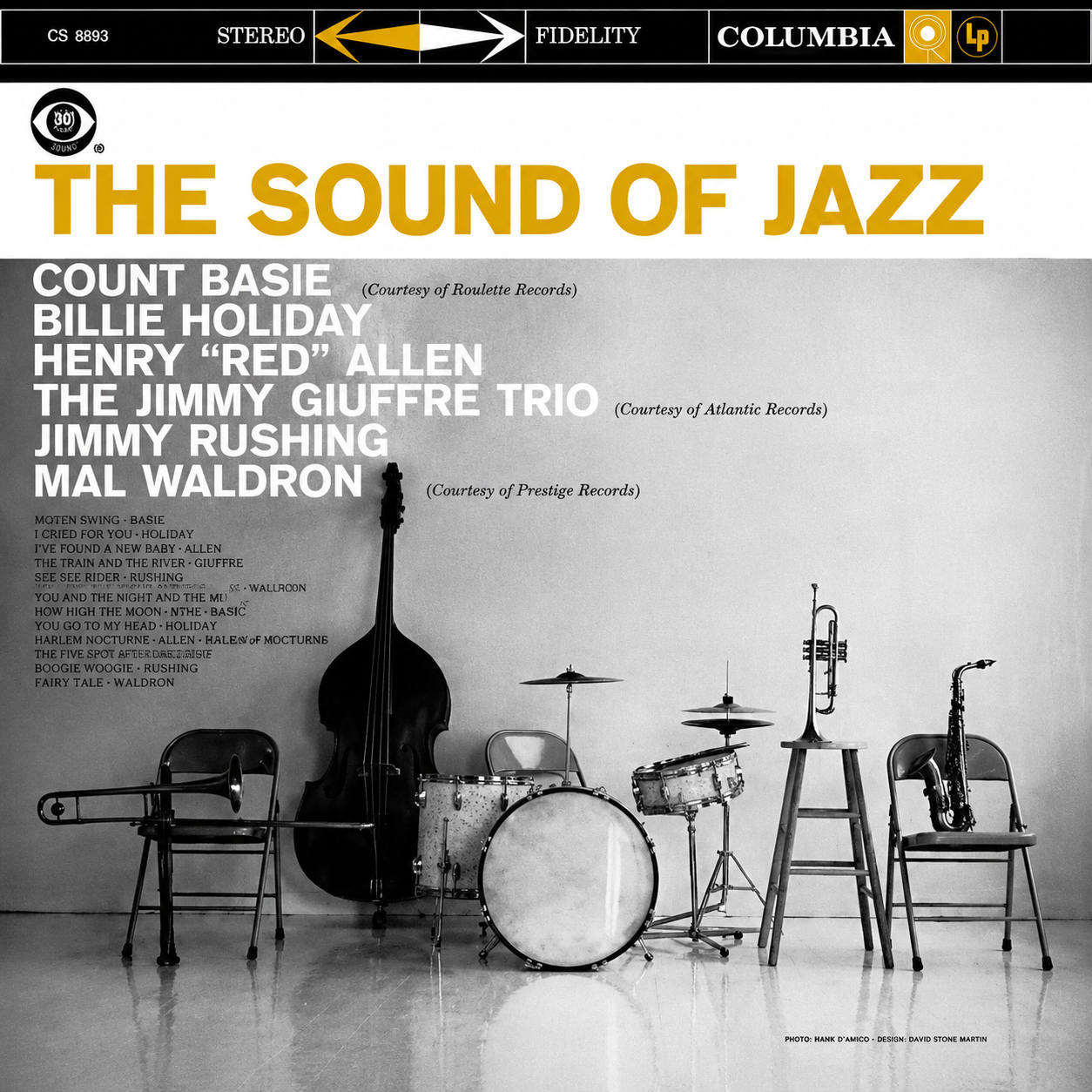
The first thing that makes The Sound of Jazz special to me is the extraordinary collection of musicians playing together. Billie Holiday, Count Basie, Lester Young, Coleman Hawkins, Ben Webster and Jimmy Rushing are just some of the names involved. These are musicians who helped shape jazz, and hearing them in such a relaxed setting is a real pleasure. Originally released by Columbia Records in 1958 and later reissued by Analogue Productions, this album brings together different generations and styles of jazz without making the music feel like a historical demonstration. I hear experienced players listening to one another, responding naturally and enjoying the freedom of playing together. That is exactly the kind of musical interaction I appreciate.
There is also an interesting story behind this recording. On December 8, 1957, CBS broadcast The Sound of Jazz as part of its television series The Seven Lively Arts. Produced by Robert Herridge, with jazz critics Nat Hentoff and Whitney Balliett serving as musical consultants, the programme brought together many leading jazz musicians for a remarkable live television event. The album, however, is not the actual television soundtrack. Columbia recorded a separate session shortly before the broadcast, at its famous 30th Street Studio in New York, and released those performances the following year. That distinction matters because the musicians and performances are not identical to those seen on television. For me, the album deserves to be appreciated as a recording in its own right, rather than simply as a document of the broadcast.
Billie Holiday and the Art of Musical Conversation
The performance that interests me most is “Fine and Mellow”, featuring Billie Holiday with a remarkable group of musicians that includes Lester Young, Coleman Hawkins, Ben Webster, Doc Cheatham and pianist Mal Waldron. Holiday wrote the song herself, and its simple blues structure provides plenty of room for personal expression. By this stage of her career, her voice had lost some of its earlier strength, but her timing and ability to communicate emotion remained unmistakable. I find that her slightly rough delivery makes the performance more convincing rather than less. She never needs to raise her voice to hold my attention, and the instrumental responses give the song its conversational character.
The relationship between Holiday and Lester Young adds another dimension to the music. They had shared a long musical history, and their appearance together during the television broadcast became one of its most famous moments. The album performance is separate from that televised encounter, but it still allows me to hear their individual musical personalities within an exceptional ensemble. I particularly enjoy the contrast between the different tenor saxophone voices. Hawkins has a strong, confident approach, Webster brings his characteristic warmth, and Young plays with a lighter, more economical sense of phrasing. Listening carefully to those differences is one of the great pleasures of this recording. The musicians have their own identities, yet nobody seems interested in dominating the performance.
Another favourite of mine is “I Left My Baby”, with Jimmy Rushing and the Count Basie All-Stars. Rushing was one of the great blues singers associated with Basie’s orchestra, and this performance shows why his partnership with the band worked so well. His voice has authority, but there is also a relaxed feeling in the way he delivers the lyrics. Basie’s piano playing is wonderfully economical, giving the other musicians plenty of room while keeping the rhythm moving. What I enjoy most is the sense of control. The arrangement never feels unnecessarily busy, and the musicians understand exactly when to play and when to leave space. That restraint makes the stronger instrumental passages even more effective.
Different Generations, Different Approaches
The album becomes particularly interesting when the music moves away from the larger ensembles. “The Train and the River”, performed by the Jimmy Giuffre Trio with guitarist Jim Hall and bassist Jim Atlas, offers a completely different approach. Instead of the driving swing associated with Basie, I hear a more open arrangement built around subtle interaction between three musicians. Giuffre’s melodic lines have an unusual conversational quality, while Hall’s guitar provides delicate harmonic support without demanding attention. The bass plays an important role in maintaining the structure and movement of the piece. I like this performance because it demonstrates how much can happen with relatively few instruments.
This contrast is one of the album’s greatest strengths, although it also means that the musical character changes considerably between tracks. The traditional jazz energy of Henry “Red” Allen’s All-Stars on “Wild Man Blues” and “Rosetta” is very different from Giuffre’s more restrained approach. Personally, I enjoy that variety because it demonstrates how many different musical ideas existed within jazz during the same period. There is plenty of lively ensemble playing, but also room for intimate performances and more individual expression. I would not describe The Sound of Jazz as an album with one consistent mood, and listeners expecting that might find the changes surprising. For me, however, those differences are essential to its appeal.
What Analogue Productions Brings to the Recording
From an audiophile perspective, the Analogue Productions reissue is particularly interesting because the original recording already had excellent musical foundations. Irving Townsend produced the Columbia album, and the recording was made during a period when engineers were becoming increasingly skilled at capturing ensembles with a believable sense of space. The later Analogue Productions editions were mastered by Ryan K. Smith at Sterling Sound using the original three-track tape. The label has offered the album in several premium formats, including vinyl editions and a hybrid SACD with a three-channel presentation. The vinyl reissues were pressed at Quality Record Pressings, with particular attention given to preserving the information contained in the original recording.
What matters to me is how this recording presents the relationship between the musicians. On “Fine and Mellow”, the saxophones have noticeably different tonal characters, and Holiday’s voice remains the emotional centre of the performance. The brass instruments sound direct and energetic, while the rhythm section supports the soloists without becoming a distracting mass of sound. There is a convincing sense of instrumental separation, but I never feel that the musicians have been artificially pulled apart simply to demonstrate stereo imaging. Instead, the recording allows me to follow individual contributions while still hearing the ensemble as a complete musical unit. That balance is more important to me than an exaggerated soundstage.
There are also interesting details in the quieter performances. The guitar on “The Train and the River” benefits from a clear midrange, allowing its delicate attacks and natural decay to remain audible alongside Giuffre’s instrument. With the larger Basie ensemble, the contrast between the steady rhythm section and the stronger brass passages gives the music its dynamic character. I find this more revealing than simply listening for deep bass or spectacular high frequencies. A good recording should allow me to understand how musicians interact, especially when several instruments occupy similar frequency ranges. The original recording technology naturally has limitations compared with modern productions, but those limitations do not prevent the music from communicating clearly.
I also appreciate that Analogue Productions has treated this recording as an important musical document rather than merely another demonstration record. The original Columbia album was already historically significant, and the reissue makes its performances available in carefully mastered editions. For listeners who enjoy reference music, it offers useful examples of vocal realism, acoustic instrumental timbre and the dynamic behaviour of a jazz ensemble. Yet I would never choose this album simply to test speakers or headphones. The performances themselves are far too interesting to reduce to that purpose. Once I start concentrating on Holiday’s phrasing, Giuffre’s unusual arrangements or the effortless swing of the Basie musicians, the technical side becomes secondary.
For me, The Sound of Jazz is most valuable because it captures several generations of outstanding musicians sharing their different approaches to the same musical tradition. The 1957 recording session, the original 1958 Columbia release and the later Analogue Productions reissues all contribute to its importance, but the real achievement belongs to the performers. Billie Holiday’s deeply personal singing, Jimmy Rushing’s natural authority and the subtle interaction within the Jimmy Giuffre Trio give me three very different reasons to appreciate this album. I also enjoy hearing musicians such as Coleman Hawkins, Ben Webster and Lester Young expressing their individual styles without losing their connection to the ensemble. What I value most is the freedom and mutual understanding in these performances. They remind me that some of the finest moments in jazz happen when exceptional musicians simply listen to one another and know exactly what to play.