
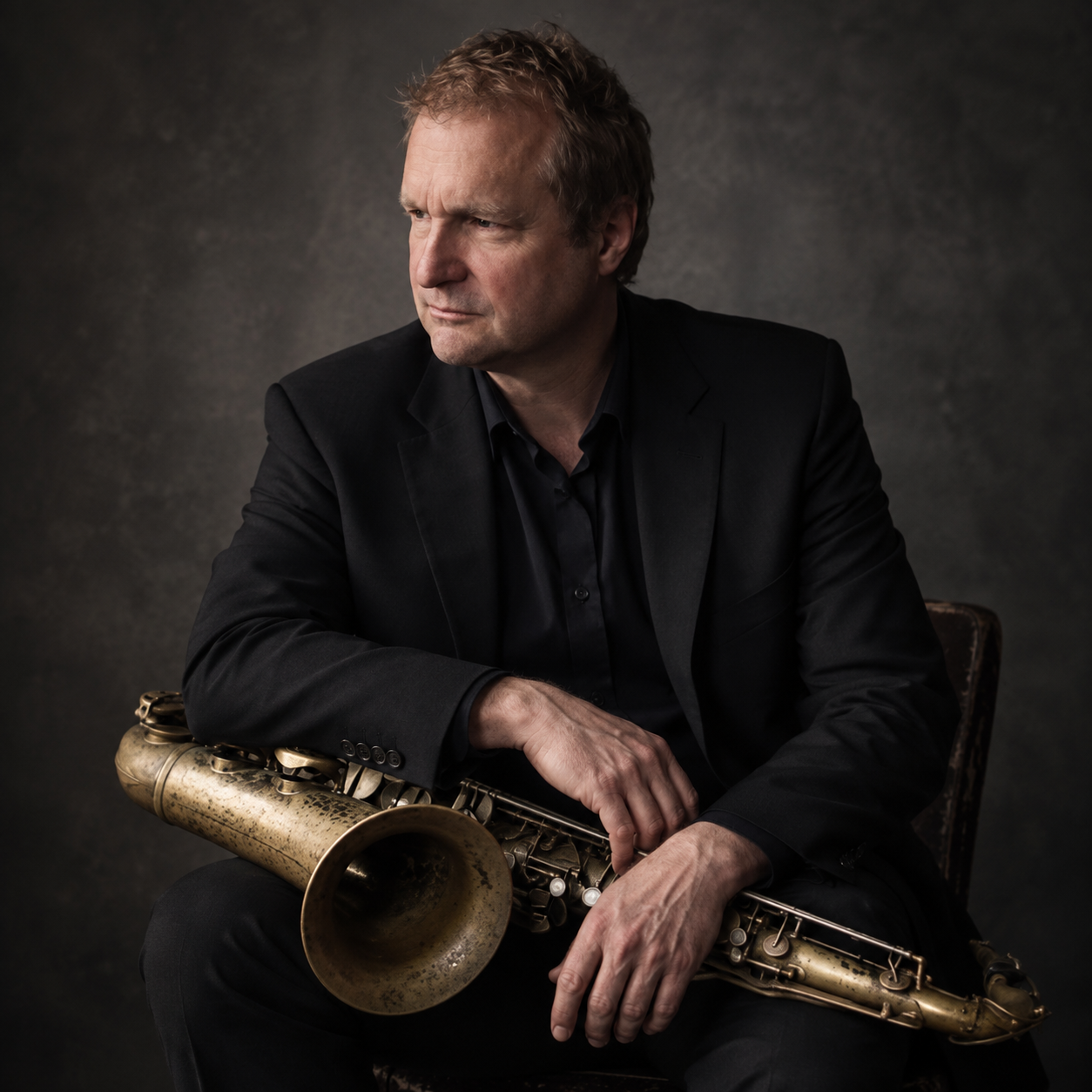
Rich Perry
GREAT CHOICE: Rich Perry!
Great music deserves to be discovered, enjoyed and shared.
CAN YOU SPARE A CUP OF COFFEE?
Audiophile-Streaming is a personal passion project, built with countless hours of discovering, selecting and sharing exceptional music.
I personally cover, without sponsors, the ongoing costs of hosting, software and subscriptions to keep the music discoveries coming. If you enjoy my work, your support is always appreciated.
A LITTLE THANK YOU IN RETURN
Just one coffee gives you lifetime access to the Coffee Club and all its playlists.
No subscriptions. No recurring fees.
Rich Perry has spent much of his musical life playing in some of New York’s finest jazz orchestras, yet his own recordings reveal a quieter and more personal side of his talent. He is a tenor saxophonist who understands that playing more notes does not necessarily make the music more interesting. His sound is warm, slightly dry and immediately recognisable, with a relaxed approach that allows melodies to develop naturally. I particularly appreciate the way he combines complicated musical ideas with playing that remains accessible and enjoyable. His recordings offer plenty for experienced jazz listeners, but they also have qualities that make them rewarding on a good high-end audio system.
Born on July 22, 1955, in Cleveland, Ohio, Rich Perry developed an interest in jazz during his high school years, partly through records introduced to him by his band director. He briefly attended Bowling Green State University before beginning his professional career, touring with the Glenn Miller Orchestra in 1975. He moved to New York City in 1976, and a year later joined the celebrated Thad Jones/Mel Lewis Orchestra. That appointment was an important turning point, placing him alongside musicians such as Pepper Adams, Rufus Reid and pianist Harold Danko. Playing in such an accomplished ensemble required discipline, careful listening and an understanding of how individual musical ideas fit into a larger arrangement. I believe those experiences help explain why Perry’s playing sounds so controlled, even during his most adventurous improvisations.
When Thad Jones left the orchestra in 1978, Perry continued working with Mel Lewis and remained associated with the ensemble that eventually became the Vanguard Jazz Orchestra. He also became a founding member of the Maria Schneider Orchestra in the early 1990s, contributing his distinctive tenor sound to music that explores a different approach to large-ensemble jazz. Over the years, his collaborations have included Chet Baker, Lee Konitz, Paul Bley, George Mraz, Fred Hersch and many other respected musicians. Working in these different environments allowed him to develop an individual style without losing his connection to traditional jazz. His playing sometimes reminds me of the thoughtful harmonic approach associated with Warne Marsh, while his willingness to explore beyond familiar chord patterns suggests an interest in John Coltrane’s later work. Nevertheless, Perry has developed a musical personality that is very much his own.
Finding His Own Voice
Perry’s first album as a leader, To Start Again, appeared on the Danish SteepleChase label in 1993, beginning a recording relationship that would become central to his career. The quartet featured Harold Danko on piano, Scott Colley on bass and Jeff Hirshfield on drums, musicians who understood how to support a soloist without restricting his freedom. The album contains compositions by Thad Jones, Maria Schneider and Antonio Carlos Jobim, alongside music by Danko and Perry himself. I find the interpretation of Schneider’s My Lament particularly interesting because it demonstrates Perry’s ability to explore a melody without losing its emotional character. His saxophone lines move in unexpected directions, but they never sound like technical exercises. The interaction between piano, bass and drums gives the music an open, conversational quality, making this album an excellent introduction to his early work as a bandleader.
What I enjoy about To Start Again is the balance between individual expression and the sound of the entire quartet. Perry does not dominate every moment, and the other musicians have room to develop their own ideas. Danko’s piano playing is especially important, answering the saxophone with carefully chosen chords and phrases. The double bass provides a clear rhythmic foundation, while the drums can move between gentle support and more active conversation. For audiophile listening, these relationships are just as interesting as the saxophone itself. I prefer to hear the instruments as four musicians responding to one another rather than concentrating only on the detail or presence of the lead instrument.
The partnership with SteepleChase continued through albums such as Beautiful Love, Left Alone, Rhapsody and the live recordings made at New York’s Kitano jazz club. His long collaboration with Harold Danko became particularly important, with both musicians appearing on each other’s recordings over several decades. This consistency allowed Perry to explore familiar jazz standards in considerable depth while gradually developing more of his own compositions. His approach to rhythm became increasingly flexible, with phrases that sometimes seem to move independently of the underlying beat. I enjoy that quality because the music can sound relaxed while remaining harmonically and rhythmically demanding. It is not always instantly predictable, and that is part of its attraction.
A More Personal Musical Direction
Other Matters, released in 2019, represents another important development because the entire album consists of Perry’s own compositions. Here he works with pianist Gary Versace, bassist Jay Anderson and drummer John Riley, a quartet that would continue recording together on subsequent albums. Perry explored ideas associated with John Coltrane’s later music, particularly the possibility of beginning with a simple composition and allowing an improvisation to move beyond its original harmonic structure. The result is adventurous modern jazz, but without the constant intensity sometimes associated with that approach. On pieces such as Transparency and the title track, I appreciate the freedom of the musical conversation and the space left between phrases. Versace’s piano contributes considerably to that atmosphere, while Anderson and Riley provide a rhythmic foundation that remains flexible rather than rigid.
I find Other Matters slightly more demanding than Perry’s earlier recordings of familiar standards. The melodies are less immediately recognisable, and the improvisations sometimes require more patience to follow. However, that freedom also allows me to appreciate how carefully the musicians listen to one another. Small changes in rhythm, short piano responses and the natural rise and fall of the saxophone become increasingly interesting. On revealing speakers or headphones, I pay particular attention to the separation between the instruments and the way the bass and drums establish movement without overwhelming the melody. This is the kind of jazz recording where musical interaction matters much more to me than spectacular sound effects.
Perry continued developing this approach on Happy Destiny in 2021, Everything Happens in 2022 and Progression in 2023. His 2025 album Dream, again recorded for SteepleChase with Versace, Anderson and Riley, shows another side of his musical interests. The programme combines original compositions with pieces by Charlie Parker, Wayne Shorter, Horace Silver and Duke Ellington. I particularly like the choice of Shorter’s Juju alongside Silver’s Peace and Ellington’s Sophisticated Lady, because these compositions provide very different opportunities for interpretation. Perry treats established material as something to explore rather than simply reproduce, allowing his own phrasing and harmonic choices to shape the performances. His original compositions, including Oneirology and Something Soft, sit comfortably alongside these jazz classics, demonstrating how naturally his own musical language has developed.
Why Rich Perry Deserves More Attention
For me, Perry’s greatest strength is his understanding of musical space and timing. His tenor saxophone has a rounded, slightly grainy character, and he frequently allows individual notes to carry the expression instead of filling every available moment. There is considerable technical ability behind his playing, but it rarely becomes the main attraction. His melodic lines can take unexpected turns, and occasionally I need a second or third listen before I fully appreciate where he is going. That makes his music more rewarding than recordings that reveal everything immediately. I would not describe him as the ideal choice for someone looking for aggressive, high-energy saxophone playing throughout an entire album, but listeners who appreciate subtle musical development will find plenty to enjoy.
From an audiophile perspective, I consider Perry’s small-group recordings particularly useful for evaluating the natural character of acoustic instruments. A tenor saxophone can easily become too sharp or forward on a poorly balanced system, while a piano can lose its body and warmth. His quartet recordings encourage me to listen to midrange transparency, the relationship between the instruments and the small dynamic changes that give a performance its character. Good stereo imaging helps make the individual musicians easier to follow, but I never want the equipment to become more interesting than the music. Whether listening through speakers or headphones, the most important quality is the sense of musicians playing together and reacting naturally.
Beyond his recordings, Perry’s lasting contribution includes his decades with the Vanguard Jazz Orchestra and the Maria Schneider Orchestra, as well as his teaching at institutions including William Paterson University and New York University. His influence is not built around commercial hits or dramatic changes of musical direction, but around a consistent commitment to developing his own sound and helping younger musicians understand jazz improvisation. For someone discovering his music, I would begin with To Start Again to hear the foundations of his quartet playing, followed by Other Matters for his more personal compositions and Dream for the mature balance between tradition and exploration. Together, these albums show a musician who has continued learning and refining his ideas throughout a long career. I value Rich Perry because he combines deep musical knowledge with genuine sensitivity, without feeling the need to demonstrate everything he knows. More than his technical ability, impressive collaborations or extensive discography, it is his patient, melodic phrasing that makes him such a distinctive tenor saxophonist.