
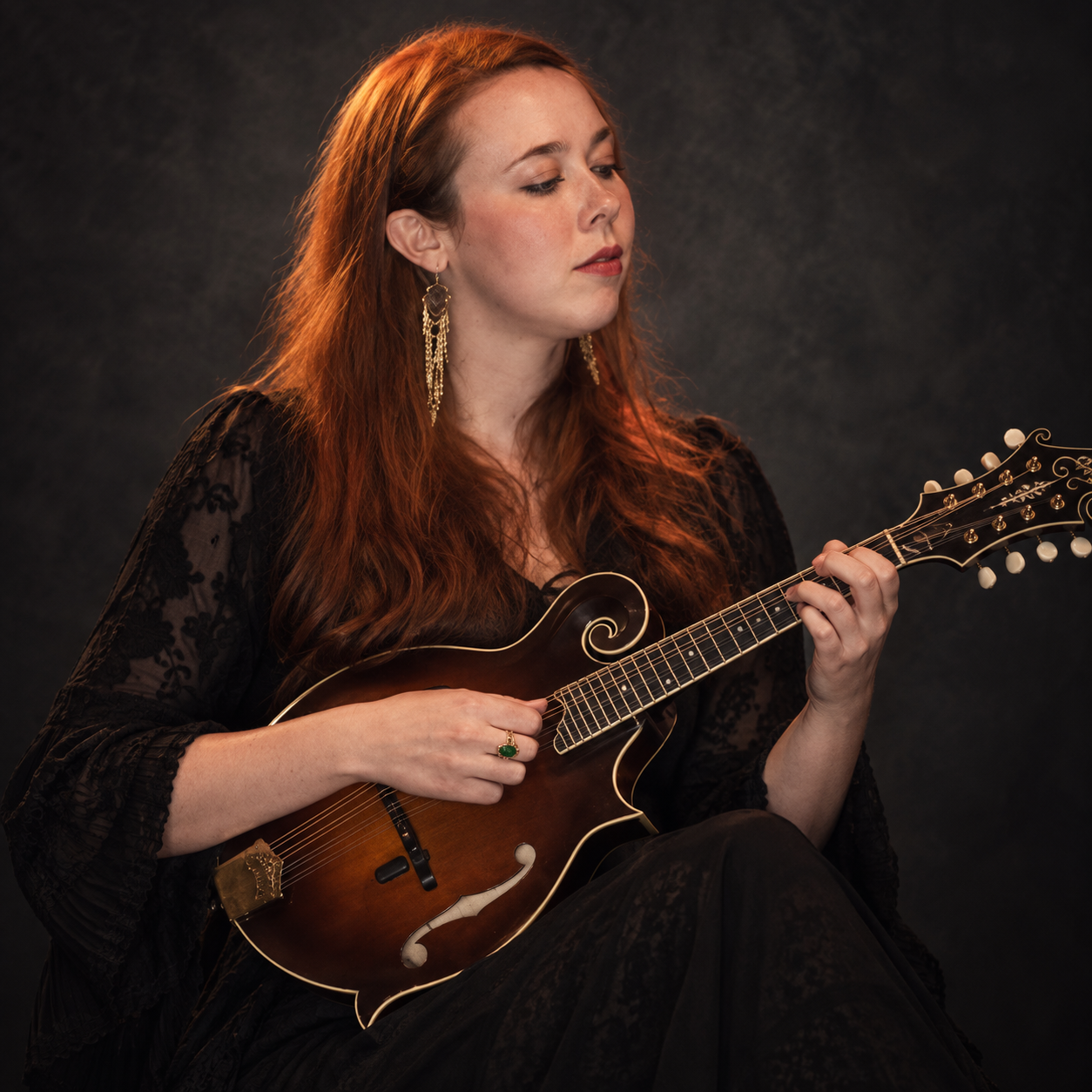
Sarah Jarosz
GREAT CHOICE: Sarah Jarosz!
Great music deserves to be discovered, enjoyed and shared.
CAN YOU SPARE A CUP OF COFFEE?
Audiophile-Streaming is a personal passion project, built with countless hours of discovering, selecting and sharing exceptional music.
I personally cover, without sponsors, the ongoing costs of hosting, software and subscriptions to keep the music discoveries coming. If you enjoy my work, your support is always appreciated.
A LITTLE THANK YOU IN RETURN
Just one coffee gives you lifetime access to the Coffee Club and all its playlists.
No subscriptions. No recurring fees.
At sixteen, Sarah Jarosz already had a recording contract with Sugar Hill Records, yet her music has never sounded as though she was in a hurry. Born Sarah Ellen Jarosz on May 23, 1991, in Austin, Texas, she grew up in nearby Wimberley, a small town with a strong connection to traditional American music. She developed an early interest in the mandolin and became comfortable playing bluegrass alongside experienced musicians while still a child. What makes her particularly interesting to me is that she never allowed those impressive instrumental skills to become the main attraction. Her playing is precise and often quite sophisticated, but she uses it to serve the song rather than demonstrate how much she can do.
That approach has become one of her most recognisable qualities. Jarosz has a clear, slightly understated voice that can sound gentle without becoming weak or overly delicate. She rarely pushes a phrase harder than necessary, and I appreciate the way she lets the melody and lyrics do much of the work. Her background in bluegrass is easy to recognise in her mandolin, guitar and banjo playing, but her songwriting reaches well beyond traditional acoustic music. Folk, Americana, contemporary pop and elements of indie rock have all found their way into her recordings. The result is an artist whose music feels familiar in its foundations but rarely predictable in its details.
From Bluegrass Prodigy to Independent Songwriter
Jarosz signed with Sugar Hill Records at sixteen and released her debut album, Song Up in Her Head, in 2009, when she was eighteen. It introduced a young musician with considerable technical ability and a musical curiosity that extended beyond bluegrass. That same year, she began studying at the New England Conservatory of Music in Boston, graduating in 2013. Her subsequent albums, Follow Me Down in 2011 and Build Me Up from Bones in 2013, showed a growing confidence in both songwriting and interpretation. She was already comfortable bringing influences from contemporary folk and alternative music into an acoustic setting. I find this early development important because it explains why her later recordings sound so natural, even when the arrangements move away from the traditional instruments that first established her reputation.
Her fourth album, Undercurrent, released in 2016, represents a particularly important turning point. Co-produced with Gary Paczosa, it places much greater emphasis on her own songs, her voice and arrangements that often use remarkably little accompaniment. Several tracks feature Jarosz performing entirely alone, and that simplicity allows every small detail to become part of the listening experience. On a revealing audio system, I particularly enjoy the relationship between her vocal phrasing and the sound of the strings. The slight changes in attack, the natural decay of a note and the spaces between phrases all contribute to a convincing performance. Nothing needs to be unnecessarily loud or dramatic to hold my attention.
The song House of Mercy demonstrates another side of her musical personality. There is determination in her delivery, supported by a darker, more insistent instrumental arrangement than listeners might expect from her quieter material. Her voice remains controlled, but the rhythm and phrasing give the song a definite sense of tension. I like the contrast between that restraint and the strength of the underlying message. The album won the 2017 Grammy Award for Best Contemporary Folk Album, while House of Mercy received the award for Best American Roots Performance. Those awards were well deserved, but for me the greater achievement was how completely Jarosz had developed her own musical identity.
Songs, Stories and a Wider Sound
With World on the Ground in 2020, Jarosz took another significant step. Working with producer John Leventhal, she moved from the highly personal perspective of Undercurrent towards stories about other people and the places that shape their lives. Her memories of Wimberley became an important source of inspiration, particularly the complicated relationship between growing up somewhere familiar and wanting to discover a different life. The arrangements are fuller than those on her previous album, yet they retain enough space for her vocals and the individual instruments to remain clearly defined. It is an excellent example of how carefully arranged Americana can offer the kind of natural sound and musical detail I look for in audiophile recordings.
The song Johnny is a good place to appreciate that development. Rather than relying on a dramatic vocal performance, Jarosz tells the story with measured phrasing and an almost conversational delivery. Leventhal’s production gives the instruments room to support the melody without distracting from it. Through good speakers or headphones, I enjoy how the different instrumental parts remain distinguishable while still forming a coherent musical picture. There is warmth in the recording, but the sound never becomes excessively thick or heavy. World on the Ground won the Grammy Award for Best Americana Album in 2021, confirming that Jarosz had developed into a songwriter with a much broader range than her early bluegrass reputation might suggest.
Her 2021 release Blue Heron Suite explored a more extended, personal form of composition, showing that she was still interested in challenging the boundaries of her songwriting. Another important part of her career has been I’m With Her, the trio she formed with Sara Watkins and Aoife O’Donovan in 2014. Their debut album, See You Around, appeared in 2018 and demonstrated how three established musicians could create a genuine group identity rather than simply take turns in the spotlight. Their vocal harmonies are particularly enjoyable on a transparent system, where the individual voices can be followed without losing the blended sound. The trio returned with Wild and Clear and Blue in 2025, winning the 2026 Grammy Award for Best Contemporary Folk Album and another for the song Ancient Light. These collaborations have helped establish Jarosz as an important contemporary voice in American roots music, both independently and as part of a group.
Her seventh solo album, Polaroid Lovers, released by Rounder Records in January 2024, introduced a more noticeable change in production and musical direction. Working with producer Daniel Tashian and co-writing songs with musicians including Natalie Hemby, Jon Randall and Ruston Kelly, Jarosz moved towards a fuller, more electric sound. The album has a stronger rhythmic foundation, more prominent drums and a production style that occasionally approaches contemporary folk-pop. For listeners familiar with her earlier acoustic recordings, the difference is immediately apparent. Personally, I enjoy the greater energy, although I sometimes miss the exceptional intimacy of her more stripped-down arrangements. Still, the album demonstrates that she is willing to develop rather than repeat an established formula.
Jealous Moon is particularly useful for understanding this change. The song has a more expansive arrangement and a driving rhythm, with electric instruments contributing a different weight and character to the recording. Her voice remains immediately recognisable, but it now sits within a considerably busier musical setting. I find it interesting how she maintains her natural vocal phrasing without attempting to compete with the instruments through sheer volume. On a well-balanced audio system, the contrast between the clear vocal midrange, the rhythmic bass and the surrounding instrumental textures makes the production enjoyable in a different way from Undercurrent. The recording is less about intimate acoustic realism and more about how a carefully produced band performance can remain detailed and engaging.
Why Sarah Jarosz Deserves a Place in an Audiophile Collection
For me, Sarah Jarosz is particularly rewarding because her recordings offer several different ways to appreciate good sound. Undercurrent is an excellent choice for vocal realism, acoustic string detail and the natural relationship between voice and instrument. World on the Ground adds more instrumental colour and subtle layers, making it useful for evaluating stereo imaging, midrange transparency and how well a system separates instruments without breaking the music into unrelated pieces. Polaroid Lovers provides a different listening experience, with fuller arrangements and stronger rhythmic dynamics. None of these albums needs exaggerated bass or spectacular effects to make an impression. Their appeal comes primarily from the quality of the musicianship, the arrangements and the way the performances have been captured.
There is another quality I value in her work that has little to do with equipment. Jarosz understands the difference between an impressive performance and a convincing one. Her technical abilities are obvious, particularly on the mandolin and guitar, but she does not feel compelled to demonstrate them in every song. She can also deliver an emotional lyric without making it sound excessively sentimental, something I consider increasingly valuable in contemporary vocal music. Occasionally, her restrained delivery may seem a little too polite for listeners who prefer stronger vocal contrasts or more immediate intensity. For my taste, however, that restraint is generally a strength because it encourages attention to the smaller musical decisions that become more apparent with repeated listening.
Anyone discovering Sarah Jarosz for the first time should begin with Undercurrent, particularly House of Mercy, and then explore World on the Ground before moving to the broader production of Polaroid Lovers. That sequence provides a clear picture of her development from a highly skilled young acoustic musician into a confident songwriter capable of working across several styles. Her recordings also demonstrate that audiophile music does not have to be created specifically for high-end audio enthusiasts to sound convincing on a good system. The Grammy recognition, her successful solo career and her work with I’m With Her reflect an artist who has contributed meaningfully to modern folk and Americana without abandoning her musical roots. What ultimately makes Sarah Jarosz special to my ears is not the number of instruments she can play, the awards she has collected or the complexity of her arrangements. It is the natural clarity of her musical phrasing.