
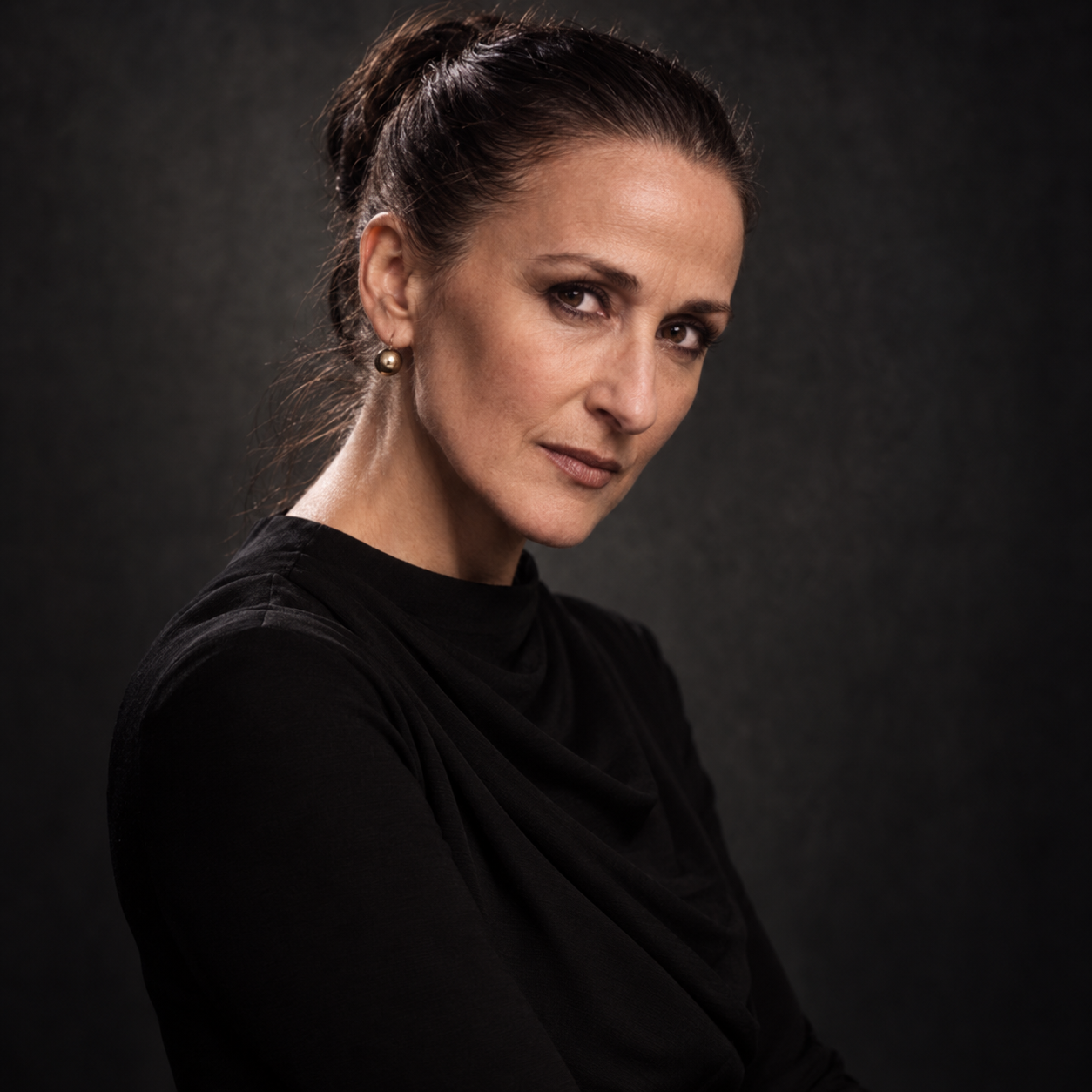
Tessa Souter
GREAT CHOICE: Tessa Souter!
Great music deserves to be discovered, enjoyed and shared.
CAN YOU SPARE A CUP OF COFFEE?
Audiophile-Streaming is a personal passion project, built with countless hours of discovering, selecting and sharing exceptional music.
I personally cover, without sponsors, the ongoing costs of hosting, software and subscriptions to keep the music discoveries coming. If you enjoy my work, your support is always appreciated.
A LITTLE THANK YOU IN RETURN
Just one coffee gives you lifetime access to the Coffee Club and all its playlists.
No subscriptions. No recurring fees.
Tessa Souter spent years working with words before she established herself as a jazz singer, and I think that background explains a great deal about her music. She approaches songs with the curiosity of a writer, looking beyond the familiar melody to discover what the music might have to say. Her warm, expressive contralto voice is immediately recognisable, but it is her choice of material that makes her particularly interesting to me. Classical compositions, jazz standards, folk songs and contemporary music all find a place in her repertoire. Rather than simply interpreting these different styles, she often writes new lyrics and creates something genuinely personal. For listeners who appreciate intelligent vocal jazz and carefully arranged audiophile recordings, she is an artist well worth discovering.
Born on April 3, 1956, in London, England, Souter grew up with English and Trinidadian roots, although the full story of her family background would only become clear much later. Her mother encouraged her to sing from an early age, and she studied piano before teaching herself guitar at twelve. During her teenage years, she developed an affection for British folk music, particularly artists such as Fairport Convention and Pentangle. Music was always important, but her professional life initially took a different direction. After studying English literature, she worked as a journalist and editor, contributing to publications including Elle, Vogue and The Guardian. I find that part of her history particularly interesting because her eventual move into jazz was not the result of following a conventional musical career from childhood.
Her development as a professional singer gained momentum after she moved to New York in 1997. She began performing at jazz sessions and studied with two remarkable vocalists, Mark Murphy and Sheila Jordan. Their influence can be understood in her willingness to experiment with phrasing, rhythm and musical interpretation rather than concentrating on vocal perfection alone. Her debut album, Listen Love, appeared on Nara Music in 2004 and already demonstrated an interest in music beyond traditional jazz standards. She continued with Nights of Key Largo on Venus Records in 2008 and Obsession on Motéma in 2009, the latter exploring an adventurous mixture of jazz and popular songwriting. Listening to her approach, I hear a singer who respects the original composition but is never afraid to change its character.
What appeals to me most about Souter’s voice is its combination of warmth, clarity and restraint. She has a naturally rich lower register, yet she can move into lighter phrases without making the transition feel forced. Her timing is especially attractive, sometimes allowing a note to arrive slightly behind the rhythm or holding a phrase just long enough to change its emotional meaning. She rarely seems interested in showing how many notes she can sing. Instead, she uses the spaces between phrases and the changing weight of individual words to hold my attention. That makes her music particularly rewarding on a revealing audio system, where small variations in vocal texture and dynamics can be heard without becoming exaggerated.
Beyond the Blue: Classical Music Meets Jazz
One of the most revealing albums in her catalogue is Beyond the Blue, originally released through Motéma Music in 2012, with additional editions on the Japanese Venus label. The idea is unusual but surprisingly natural: Souter takes melodies associated with classical composers such as Beethoven, Brahms, Chopin, Debussy and Fauré and presents them in a jazz setting. Several pieces receive her own lyrics, turning familiar instrumental themes into songs about love, relationships and human emotions. The musicians are excellent, including pianist Steve Kuhn, bassist David Finck, drummer Billy Drummond, vibraphonist Joe Locke, saxophonist Joel Frahm and accordionist Gary Versace. I particularly appreciate the way these arrangements preserve the beauty of the original melodies while allowing the musicians enough freedom to make the performances feel spontaneous.
The Lamp Is Low, based on Ravel’s Pavane pour une infante défunte, is a good example of how comfortably classical melodies can sit within her musical world. Another interesting performance is Beyond the Blue, which draws on Chopin’s Prelude in E minor and demonstrates her ability to introduce a lyrical narrative without losing the composition’s original character. What I enjoy here is the relationship between her voice and the instruments, especially the contrast between the rounded piano notes, the resonance of the bass and the more delicate instrumental colours. The arrangements leave room for each musician, giving the music a natural sense of depth rather than making everything compete for attention. For high-end audio listeners, it is a rewarding album for examining vocal realism, midrange transparency and the separation of acoustic instruments. I also like that the musical ideas remain interesting even when I stop paying attention to the recording quality.
Picture in Black and White: A Personal Discovery
The 2018 album Picture in Black and White, released on Noa Records, reveals another side of Tessa Souter. Its inspiration came from her discovery, at the age of 28, that the man she had been told was her biological father was not her father at all. She eventually met her biological father and discovered her Afro-Trinidadian ancestry, an experience that changed her understanding of her own identity. Years later, she used that personal history as the foundation for an album exploring ancestry, belonging and the connections between different musical traditions. I admire the decision to address such a complicated subject through music without turning the recording into a straightforward autobiography. The songs are personal, but the emotions behind them are easy to recognise even without knowing her story.
The musical arrangements are especially important to the success of this album. Guitarist Yotam Silberstein, bassist Yasushi Nakamura, percussionist Keita Ogawa, pianist Adam Platt, cellist Dana Leong and drummer Billy Drummond provide a varied instrumental setting that moves comfortably between jazz, folk and music from other traditions. On Kothbiro, originally associated with Kenyan musician Ayub Ogada, the combination of voice, piano, percussion and bowed bass creates a spacious and reflective atmosphere. A Taste of Honey offers a different experience, with the cello and voice working together in an intimate arrangement that allows the character of each instrument to emerge. I particularly enjoy the contrast between Souter’s warm vocal tone and the cello’s deeper resonance. The recording invites close listening, not because it relies on spectacular effects, but because the instrumental details support the emotional content of the songs.
Another important moment is Ana Maria’s Song, based on Wayne Shorter’s composition Ana Maria. Souter wrote lyrics for the piece and received a shared writing credit from Shorter, a significant acknowledgement of her work as a lyricist. The performance brings together her expressive voice and Silberstein’s guitar in a way that feels thoughtful and unhurried. I hear a singer who understands that the melody already contains much of the emotion and does not need unnecessary embellishment. The album’s original title track is equally revealing, addressing her relationship with the father she had not known during her childhood. For me, Picture in Black and White is probably the best introduction to Souter because it brings her songwriting, musical influences and interpretive ability together in one coherent recording.
Shadows and Silence: Finding New Words for Satie
With Shadows and Silence: The Erik Satie Project, released on NoaNara Records in 2025, Souter took another ambitious step. This time she turned to the music of French composer Erik Satie, whose restrained melodies and unusual harmonic language provide an intriguing starting point for vocal jazz. The project had developed over many years, beginning with her fascination for a wordless interpretation of Gnossienne No. 1 by French jazz vocalist Anne Ducros. Souter eventually wrote original lyrics for several of Satie’s compositions, including the Gnossiennes and Gymnopédies. Pianist Luis Perdomo created the jazz arrangements, supported by bassist Yasushi Nakamura and drummer Billy Drummond, with contributions from saxophonist Steve Wilson and trumpeter Nadje Noordhuis. I see this album as a natural continuation of the ideas introduced on Beyond the Blue, but with an even greater emphasis on simplicity and emotional expression.
A Song for You, based on Gnossienne No. 1, is particularly representative of the project. The melody unfolds at a measured pace, allowing Souter to concentrate on phrasing and the meaning of her words rather than vocal display. Holding On to Beauty, based on Gnossienne No. 3, offers another example of her skill in finding a new lyrical direction within an established composition. The piano arrangements are central to the atmosphere, while the bass and drums provide movement without making the music unnecessarily busy. On revealing speakers or headphones, this kind of restrained instrumentation makes the relationship between the musicians especially interesting to follow. There is little room for excess, and I appreciate how confidently Souter works within those limitations.
This album also demonstrates that her musical personality has continued to develop rather than settling into a familiar formula. The performances are often reflective, and listeners expecting energetic swing or conventional jazz standards may find the pace rather deliberate. I do not consider that a weakness, although I would probably choose one of her earlier albums when I want a more rhythmically varied listening session. Shadows and Silence requires attention to subtle changes in timing, vocal colour and instrumental dynamics. Those qualities become more apparent with repeated listening, particularly when the playback system can reproduce quieter passages without losing detail. Its recognition as the Best Vocal Jazz Album of 2025 by Germany’s Audio Stereoplay magazine also shows how strongly this approach has connected with listeners interested in both musical interpretation and recording quality.
What makes Souter important within contemporary vocal jazz is not simply the quality of her voice, but her willingness to reconsider what a jazz song can be. She has brought new lyrics to instrumental compositions, connected classical music with small-group jazz and used her personal history to give familiar songs different meanings. Her career has earned recognition from critics and fellow musicians, including the encouragement of Sheila Jordan and Mark Murphy, while her recordings show a consistent interest in artistic independence. For me, that is more meaningful than trying to measure her success through popularity or commercial recognition. She has established a recognisable musical identity without restricting herself to one particular style.
If I were introducing Tessa Souter to someone for the first time, I would begin with Picture in Black and White, then explore the classical influences of Beyond the Blue before moving to the more reflective Shadows and Silence. Together, these recordings explain how a London-born writer became a distinctive New York jazz vocalist and why her work deserves attention from serious music listeners. I appreciate the natural warmth of her contralto voice, the thoughtful contributions of her musicians and the way her arrangements reveal detail without sacrificing the emotional purpose of a song. Her music can be demanding in its quietest moments, but I find that far more interesting than a performance designed simply to impress. Ultimately, the quality that defines Tessa Souter for me is her ability to communicate meaning through remarkably precise and natural phrasing.