
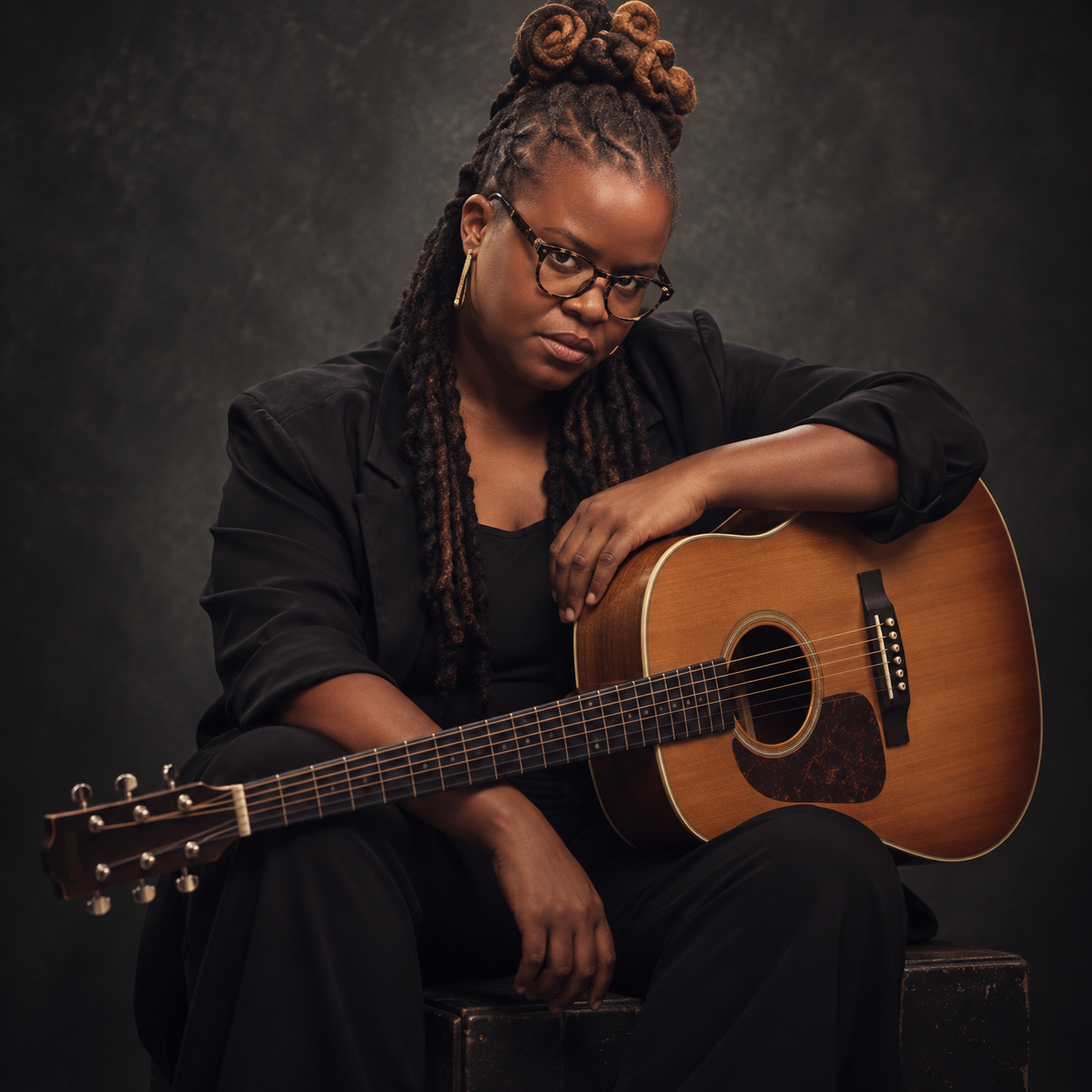
Yasmin Williams
GREAT CHOICE: Yasmin Williams!
Great music deserves to be discovered, enjoyed and shared.
CAN YOU SPARE A CUP OF COFFEE?
Audiophile-Streaming is a personal passion project, built with countless hours of discovering, selecting and sharing exceptional music.
I personally cover, without sponsors, the ongoing costs of hosting, software and subscriptions to keep the music discoveries coming. If you enjoy my work, your support is always appreciated.
A LITTLE THANK YOU IN RETURN
Just one coffee gives you lifetime access to the Coffee Club and all its playlists.
No subscriptions. No recurring fees.
Yasmin Williams has changed the way I think about acoustic guitar music. Watching her play is fascinating, but listening without seeing her is perhaps even more interesting. Her guitar often sounds like several instruments working together, with flowing melodies, deep bass notes and percussion appearing at the same time. Yet the music never feels like a technical demonstration designed to impress other guitarists. What attracts me most is the balance between her unusual playing technique and the relaxed, natural character of her compositions. She has developed a musical identity that is immediately recognisable, even when you have no idea how she is producing those sounds.
Born in Northern Virginia in the United States, Williams grew up in Woodbridge, surrounded by R&B, hip-hop, smooth jazz and the go-go music associated with Washington, D.C. Her musical journey took an unexpected direction when she became fascinated by the video game Guitar Hero II. After mastering the game, she persuaded her parents to buy her an electric guitar and began learning music by artists such as Jimi Hendrix and Nirvana. She initially wanted to become a rock guitarist, but eventually discovered that the acoustic guitar offered more interesting possibilities for writing her own music. She later studied music theory and composition at New York University, where she continued developing her personal approach to the instrument. I find that background important because her music doesn’t come from a traditional folk-guitar education. She arrived at her sound through curiosity, experimentation and a willingness to ignore established playing habits.
A Different Approach to the Acoustic Guitar
Williams frequently places her guitar flat across her lap, with the strings facing upward. Instead of relying on conventional fingerpicking, she uses both hands to tap notes directly onto the fretboard, allowing melodies, chords and rhythmic patterns to develop independently. She also strikes the guitar body for percussion and sometimes combines the instrument with a kalimba, harp guitar or even tap shoes. These unusual choices are not simply tricks added to an ordinary performance. They are part of the way she composes, and they give her music a rhythmic freedom that I rarely hear from solo acoustic guitarists. Her playing can be remarkably intricate, but the individual musical lines remain surprisingly easy to follow.
Her influences help explain this unusual combination of sounds. Alongside Hendrix and Nirvana, Williams has spoken about the importance of Elizabeth Cotten, Sister Rosetta Tharpe and Algia Mae Hinton, musicians who demonstrated different possibilities for guitar playing. Earth, Wind & Fire also played a role in her development, particularly through Maurice White’s use of the kalimba. I hear traces of several musical traditions in her work, but I would hesitate to describe her simply as a folk guitarist. Her sense of rhythm sometimes suggests African musical traditions, while her melodic phrasing can feel closer to contemporary instrumental music or jazz. What makes the combination successful, in my opinion, is that she does not appear interested in proving how many influences she can combine. She concentrates on making each composition work as a complete piece of music.
Her debut album, Unwind, released independently in 2018, introduced many of the ideas that would eventually define her career. It already demonstrated an unusually mature understanding of rhythm, melody and the relationship between different guitar techniques. I particularly appreciate how she allows simple musical ideas to develop without constantly adding complexity. Even when the playing becomes demanding, the melody remains central. That restraint is an important part of her musical personality and something that separates her from guitarists who make technical difficulty the main attraction. Unwind is a useful starting point for anyone interested in hearing how her distinctive approach developed before she attracted wider international attention.
Urban Driftwood and a Wider Audience
Her second album, Urban Driftwood, released through the Spinster label in January 2021, represented a major step forward. Written and recorded during a period shaped by the COVID-19 pandemic and social unrest in the United States, the album reflects feelings of uncertainty, reflection and hope without depending on lyrics. Williams expanded her instrumental vocabulary, incorporating instruments such as the kora and working with percussionist Amadou Kouyate on the title track. The result is music that feels more spacious and rhythmically varied than a conventional solo guitar recording. I find the album particularly appealing because it combines sophisticated arrangements with a sense of calm. There is plenty happening beneath the surface, but the music never demands that I concentrate on every technical detail to enjoy it.
The track Juvenescence is a good example of what makes Williams special. Its memorable melodic movement and intricate guitar patterns create a sense of forward motion without relying on a conventional drum arrangement. I enjoy the way individual notes seem to answer one another, creating the impression of separate musical voices. On a revealing stereo system, the relationship between the low guitar notes, brighter strings and small percussive details becomes especially interesting. The attack of each note is clearly different from its natural decay, and those subtle changes help reveal the precision of her playing. I prefer listening at a moderate volume, where the delicate passages retain their character without the sharper transients becoming dominant. For me, this is audiophile music because the small details genuinely contribute to the composition, not because the recording exists merely to demonstrate expensive equipment.
The success of Urban Driftwood brought Williams considerably more attention, including an NPR Tiny Desk performance and an appearance at the Newport Folk Festival in 2021. These opportunities helped introduce her music to listeners beyond the relatively specialised world of instrumental acoustic guitar. Her growing reputation also demonstrated that there was an audience for music that did not fit comfortably into established categories. As a Black female instrumentalist working in a field often associated with very different traditions and performers, she has helped broaden expectations about who can contribute to contemporary acoustic guitar music. I believe that influence matters just as much as her unusual technique. She has shown that musical individuality can be more valuable than following the rules of a particular genre.
Acadia: More Instruments, More Musical Freedom
With Acadia, released by Nonesuch Records in October 2024, Williams took another significant step. Rather than simply developing her solo guitar sound further, she invited other musicians into her compositions and explored a much broader range of arrangements. Contributors include singer Aoife O’Donovan, jazz saxophonist Immanuel Wilkins, guitarist Kaki King, violinist Darian Donovan Thomas and the vocal group Darlingside. The album moves between acoustic folk influences, jazz textures, atmospheric passages and more experimental instrumental sections. I hear a musician becoming increasingly confident about giving other performers room within her musical ideas. The guitar remains central, but it no longer has to provide every melody, rhythm and supporting texture.
One of the recordings I find particularly revealing is Dawning, featuring Aoife O’Donovan on vocals, Kafari on rhythm bones and Nic Gareiss contributing percussive dancing. The combination might sound unusual on paper, yet the arrangement feels remarkably coherent. O’Donovan’s clear, expressive singing adds a human presence that changes the emotional character of Williams’ instrumental writing. Beneath the voice, the guitar patterns and rhythmic details provide movement without becoming intrusive. What interests me is how carefully the different sounds fit together, particularly the contrast between the sustained vocal notes and the shorter, more percussive instrumental sounds. On headphones, I enjoy following those separate elements and hearing how they contribute to the overall arrangement. It is a recording that rewards attention without requiring a complicated explanation.
Another important moment on Acadia is Harvest, which brings Williams together with guitarist Kaki King and violinist Darian Donovan Thomas. The interplay between the two guitars creates overlapping harmonics and melodic patterns, while the violin introduces another layer of colour. I especially like the way the musicians allow notes to ring rather than filling every available space. The arrangement develops gradually, and the individual sounds remain connected even as the texture becomes richer. It also reveals something about Williams’ growth as a composer. She is no longer concerned only with the possibilities of her own instrument, but with how different musicians can contribute to a shared musical idea. For listeners interested in stereo imaging, instrumental separation and the natural decay of acoustic strings, Harvest offers plenty to appreciate without losing its musical purpose.
Williams has also expanded her work into film composition, including the original score for Saving Etting Street, released in 2026. That development seems entirely consistent with an artist whose music has always relied on atmosphere, rhythm and instrumental expression rather than conventional songwriting. Still, I think her greatest strength remains her ability to create memorable compositions from relatively small musical ideas. Sometimes her arrangements take an unconventional direction, and listeners expecting familiar folk structures may need time to adjust. I actually welcome that unpredictability, provided the melody and emotional direction remain clear. Her strongest performances achieve exactly that balance, combining technical imagination with music that feels accessible and genuinely personal.
For someone discovering Yasmin Williams, I would begin with Urban Driftwood before moving to Acadia. The earlier album captures the individuality of her guitar playing, while the later recording demonstrates how successfully she can extend that language through collaboration. Together with Unwind, they document a musician who moved from video-game-inspired experimentation to a distinctive place in contemporary instrumental music. I admire her technical ability, but I value her musical judgment even more. She knows when to introduce an unexpected sound, when to let a rhythm develop and when to leave a melody alone. Ultimately, what makes Yasmin Williams such a compelling artist for me is not the unusual way she plays her guitar, but her exceptional sense of musical timing.