
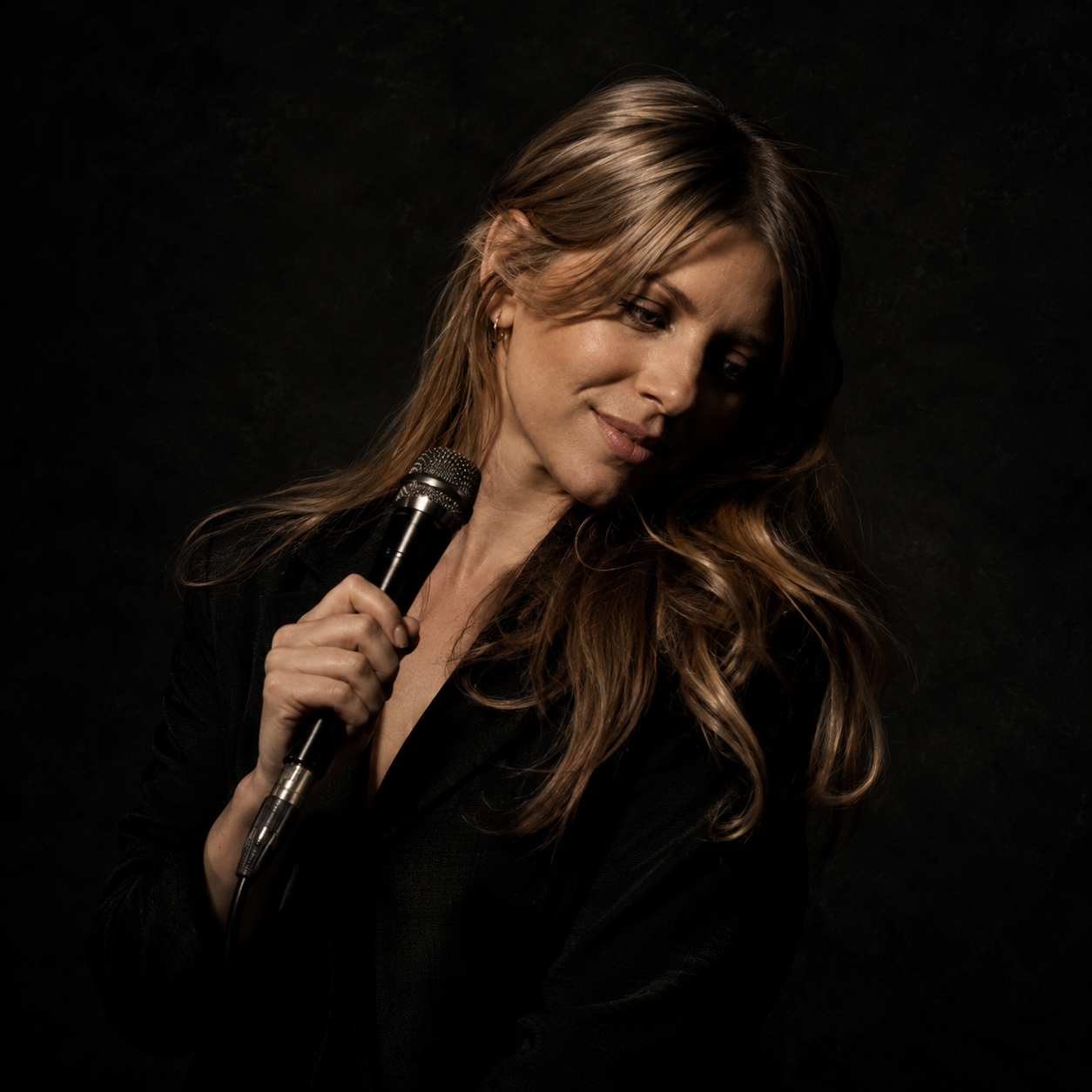
Anna Kolchina
GREAT CHOICE: Anna Kolchina!
Great music deserves to be discovered, enjoyed and shared.
CAN YOU SPARE A CUP OF COFFEE?
Audiophile-Streaming is a personal passion project, built with countless hours of discovering, selecting and sharing exceptional music.
I personally cover, without sponsors, the ongoing costs of hosting, software and subscriptions to keep the music discoveries coming. If you enjoy my work, your support is always appreciated.
A LITTLE THANK YOU IN RETURN
Just one coffee gives you lifetime access to the Coffee Club and all its playlists.
No subscriptions. No recurring fees.
Anna Kolchina belongs to a group of jazz singers who understand that a beautiful voice is only part of a convincing performance. Her real strength is the way she handles a melody, giving the words enough room to mean something without losing the natural movement of the music. I particularly enjoy her slightly husky tone, relaxed timing and ability to sound intimate without becoming sentimental. She has a clear affection for traditional vocal jazz, but her interpretations never feel like simple copies of earlier recordings. For me, she represents something I value in jazz singing: personality, musical understanding and the confidence to let a good song speak for itself.
Born on March 8, 1984, in Ufa, in the Republic of Bashkortostan, Russia, Anna Kolchina grew up in a musical family. Her father played the bayan, a type of accordion, while her older brother was a saxophonist who introduced her to recordings by Count Basie, Charlie Parker and John Coltrane. These musicians helped shape her early interest in jazz, particularly its rhythmic freedom and opportunities for individual expression. She also studied classical piano and explored dance and theatre before concentrating on singing. I find that background interesting because her performances show considerable awareness of rhythm and phrasing, qualities that cannot be explained by vocal technique alone.
Kolchina studied jazz vocals at the Ufa College of Arts, where Svetlana Slyaguzova was an important teacher, and worked with pianist Alina Kruglikova. She subsequently moved to Saint Petersburg to continue her education at the University of Culture and Arts, graduating in 2010. Alongside her jazz studies, she received classical vocal training from Elena Rubin and attended masterclasses with musicians including pianist Barry Harris. This combination of formal education and exposure to American jazz traditions helped develop a singer who understands both the structure of a song and the freedom available within it. What appeals to me is that she rarely allows her technique to become the main attraction. Her singing generally feels relaxed and carefully considered rather than designed to impress.
From Russia to Venus Records
An important turning point arrived in 2014, when Kolchina attended a jazz masterclass in Italy with the American singer Sheila Jordan. Jordan encouraged her to pursue a career in New York, while another meeting introduced her to Italian pianist Massimo Faraò. Their musical connection led to recordings that attracted the attention of the Japanese label Venus Records. In 2015, Kolchina released her debut album, Street of Dreams, recorded in Turin with Faraò on piano, Aldo Zunino on bass and Marco Tolotti on drums. It was an important beginning, giving her an international recording platform and establishing a musical partnership that would continue on her next album.
Street of Dreams presents Kolchina in a traditional small-group jazz setting, where the relationship between singer and musicians is central to the performance. I like this approach because it leaves little room to disguise weaknesses behind complicated arrangements or large ensembles. The piano provides the harmonic foundation, while the bass and drums give the songs movement without demanding constant attention. Kolchina’s voice fits comfortably into this environment, and her slightly dark vocal colour offers an appealing contrast to the brighter piano sound. Rather than treating every phrase as an opportunity for vocal decoration, she concentrates on melody and the character of the lyrics. That restraint is an important part of her musical identity.
Her second album, Dark Eyes, followed in 2016, again on Venus Records. The recording reunited her with Faraò, Zunino and Tolotti, while Alessandro Fabbri contributed drums and saxophonists Claudio Chiara and Fulvio Albano added further instrumental colour. Kolchina also prepared several arrangements herself, indicating her growing involvement in the musical direction of her recordings. The repertoire includes the traditional title song alongside familiar standards such as “The Shadow of Your Smile,” “My Old Flame,” “Time After Time” and “Witchcraft.” Compared with her debut, the additional instrumental voices create more variety, while her delivery remains recognisably personal.
I particularly appreciate the contrast between the songs on Dark Eyes. The title track brings a different musical character to the programme, while “My Old Flame” and “The Shadow of Your Smile” allow Kolchina to explore a more restrained, reflective style. Her phrasing is rarely aggressive, and she has a natural way of approaching the end of a musical line without making it sound overly calculated. Some listeners might prefer a jazz singer with greater vocal drama or more adventurous improvisation, but that is not where I hear her greatest strength. I value the balance she maintains between familiarity and individuality. She respects the melodies while finding enough space to make the interpretations her own.
Finding Her Place in New York
In 2017, Kolchina made her first visit to New York, a city she had followed from a distance through broadcasts from jazz clubs such as Smalls. That experience strengthened her determination to become part of the American jazz scene, and she moved to New York later that year. Her next recording represented another important step, bringing her together with pianist John Di Martino, bassist Peter Washington and drummer Willie Jones III. Recorded at Tedesco Studio in September 2017, Wild Is the Wind was released by Venus Records in December. The album placed her alongside three established New York musicians and gave her another opportunity to develop her interpretation of the American songbook.
Of her early recordings, Wild Is the Wind is the album I would recommend first to someone discovering Anna Kolchina. The programme includes Cole Porter’s “So in Love” and “You Do Something to Me,” along with “I Never Told You,” “A Fine Romance” and the title song. What interests me is how naturally her voice works with the trio, particularly when the arrangements leave room for the instruments to respond to her singing. Di Martino’s piano gives the music harmonic detail, Washington’s bass provides a firm rhythmic foundation, and Jones III supports the performances without making the drums unnecessarily prominent. It feels like a conversation between four musicians rather than a singer performing in front of an accompanying group.
The title song deserves particular attention. “Wild Is the Wind” is a demanding composition because it needs emotional weight without excessive vocal dramatics. Kolchina approaches the material with a measured delivery, allowing the melody and lyrics to establish the mood. Her voice has a slightly grainy quality that I find more interesting than a perfectly polished tone, especially in the quieter passages. The recording also offers something worthwhile for listeners interested in audiophile music, because the bass, piano and percussion have distinct musical roles that are easy to follow. I enjoy listening to the relationship between the bass notes and the piano chords, with Kolchina’s voice remaining the centre of attention rather than competing with the instruments.
The Venus Records production deserves a mention as well. Wild Is the Wind was recorded by Tom Tedesco, with mixing and mastering by Tetsuo Hara, and was subsequently issued on SACD in 2018. Venus has a recognisable approach to presenting small jazz ensembles, often favouring a full-bodied and immediate sound rather than a distant perspective. That presentation suits Kolchina’s warm vocal tone and the close relationship between the musicians. However, I would not describe every aspect of the recording as completely natural or neutral, because the production itself has a definite sonic character. For me, the musical communication is more important than whether the recording creates the largest possible soundstage.
Kolchina continued developing her career in New York, performing with different ensembles and making her debut at Birdland in November 2019. Her musical direction remained closely connected to jazz standards, but her choice of musicians and arrangements demonstrated a willingness to explore different settings. Rather than moving towards commercial pop or abandoning the repertoire that first inspired her, she continued refining the qualities that made her earlier work convincing. That consistency is something I respect, particularly in a musical environment where singers can sometimes feel pressure to reinvent themselves with every release.
A More Intimate Musical Direction
Her fourth album, Reach for Tomorrow, released by OA2 Records on February 20, 2026, introduces a particularly interesting change of approach. Instead of working with a conventional piano trio, Kolchina recorded a collection of voice-and-guitar duets featuring six guitarists: Paul Bollenback, Peter Bernstein, Ilya Lushtak, Romero Lubambo, Russell Malone and Yotam Silberstein. The recordings were made across several sessions between 2021 and 2025, with Kolchina herself producing the album. This more exposed format gives her fewer instruments to lean on and places greater emphasis on the relationship between melody, lyrics and accompaniment. I find the idea well suited to her musical personality because she has always been at her most convincing when she allows a song to develop naturally.
The choice of guitarists adds considerable variety without changing the basic character of the album. “Dancing in the Dark” features Ilya Lushtak, while Peter Bernstein accompanies her on “Who Can I Turn To?,” “Invitation” and “All or Nothing at All.” Romero Lubambo brings acoustic guitar to “What Now My Love?” and “So Many Stars,” and Russell Malone appears on “Vacation from the Blues.” The different guitar approaches give each performance its own character, from a more direct jazz sound to the softer textures of acoustic accompaniment. I especially like the idea that each song becomes a separate musical exchange rather than part of one fixed ensemble sound.
This is also the kind of recording where the smaller details matter. With just a voice and guitar, there is less competition between instruments, making the timing of individual notes and the shape of a vocal phrase especially important. A short pause can have as much meaning as an elaborate instrumental passage, and Kolchina’s controlled delivery gives the guitarists room to contribute. On a revealing stereo system, this type of arrangement can make it easier to concentrate on vocal texture, the attack and decay of guitar notes, and the way the two performers respond to one another. But the attraction is not simply technical. The exposed musical setting gives Kolchina an opportunity to communicate directly, and that is where I believe her voice works best.
Reach for Tomorrow also provides an interesting perspective on her development. The young singer who discovered jazz through her brother’s records has become an experienced performer capable of working with respected musicians across Russia, Europe and the United States. Her career has not been built around commercial hits or dramatic changes in musical direction, but around a steady commitment to interpreting songs with care. The influence of Sheila Jordan is particularly meaningful in this respect, because Jordan’s own career has long demonstrated the importance of musical freedom, close listening and emotional honesty. I hear a similar respect for the relationship between singer and accompanist in Kolchina’s work, although her vocal identity is distinctly her own.
What ultimately makes Anna Kolchina worth exploring is not an extraordinary vocal range or a desire to transform every familiar standard into something completely different. Her journey from Ufa and Saint Petersburg to recordings for Venus Records and OA2 Records has been shaped by education, important musical encounters and a clear commitment to jazz. Street of Dreams introduced her warm vocal character, Wild Is the Wind demonstrated her ability to work confidently with an excellent piano trio, and Reach for Tomorrow brought her singing into a more intimate and revealing setting. I appreciate the fact that her music remains accessible without becoming predictable, and that her interpretations invite attention to both the words and the musicians around her. For listeners who enjoy classic vocal jazz, natural musical interaction and expressive singing without unnecessary display, she has plenty to offer. Above all, what defines Anna Kolchina for me is her understated, thoughtful phrasing.