
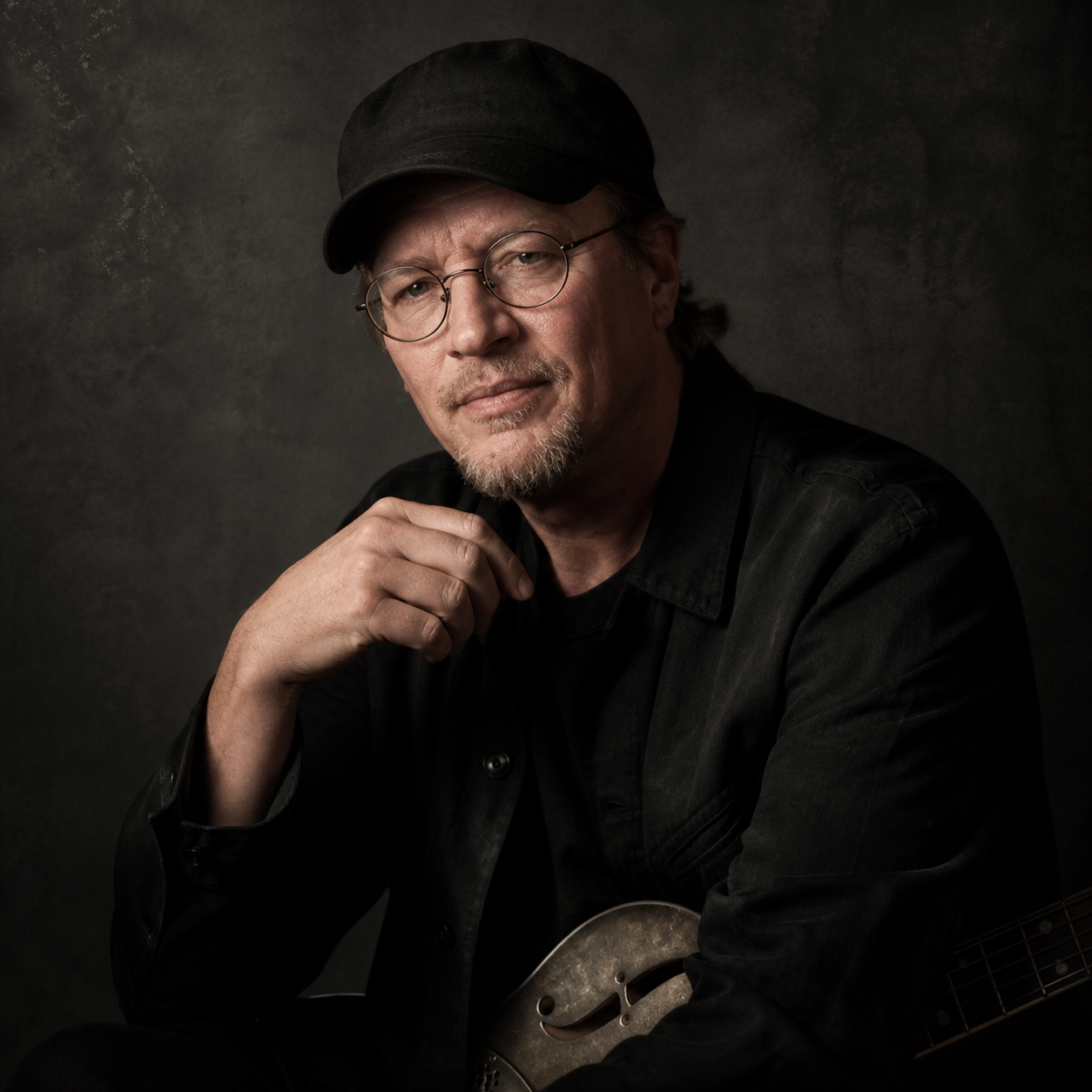
Chris Jones
GREAT CHOICE: Chris Jones!
Great music deserves to be discovered, enjoyed and shared.
CAN YOU SPARE A CUP OF COFFEE?
Audiophile-Streaming is a personal passion project, built with countless hours of discovering, selecting and sharing exceptional music.
I personally cover, without sponsors, the ongoing costs of hosting, software and subscriptions to keep the music discoveries coming. If you enjoy my work, your support is always appreciated.
A LITTLE THANK YOU IN RETURN
Just one coffee gives you lifetime access to the Coffee Club and all its playlists.
No subscriptions. No recurring fees.
Chris Jones had a rare ability to make a guitar sound both powerful and personal. His playing could be delicate and controlled one moment, then surprisingly forceful the next, without losing its natural character. For many audiophiles, his name is closely associated with Stockfisch Records and the exceptional recording quality of Roadhouses & Automobiles. But reducing him to a collection of impressive demonstration tracks would miss much of what made him special. I hear an accomplished musician who understood blues, folk, country and rock, but never allowed his technical ability to become more important than the music. His recordings are a pleasure on a good audio system, yet the real attraction is the personality behind the voice and guitar.
Christopher Paul Jones was born on November 11, 1958, in Reno, Nevada, United States. He started playing guitar at the age of five and showed considerable musical talent while still very young. His education included the Peabody Conservatory of Music in Maryland, where he received recognition as a young composer at the age of fourteen. Classical music was an important part of his early development, particularly the work of Johann Sebastian Bach, but he subsequently developed a strong interest in blues and American roots music. Artists such as Robert Johnson, James Taylor and Little Feat helped broaden his musical outlook. I think that combination explains a great deal about his later playing: the precision and independence of a classically trained guitarist, combined with the relaxed timing and expressive character of someone who genuinely understood the blues.
His musical career developed largely in Europe after he joined the United States Army in 1976 and was stationed in Germany. Over time, Germany became an important base for his work as a guitarist, singer, songwriter and studio musician. He built a reputation for versatility, moving comfortably between acoustic fingerstyle playing, electric blues, country-influenced arrangements and more energetic rock performances. What I appreciate about Jones is that these different styles never sound like separate musical identities. His guitar always has a recognizable sense of rhythm, with clearly articulated notes and a natural understanding of when to play and when to leave space. He could deliver complicated passages with remarkable control, but some of his most convincing moments involve surprisingly simple musical ideas.
A Long Relationship with Stockfisch Records
One of the most important developments in Jones’s career came in 1982, when he entered the Stockfisch studio in Northeim, Germany, to record his first album, No Looking Back. Working with recording engineer and producer Günter Pauler, he began a creative relationship with Stockfisch Records that would continue for more than twenty years. The album featured Jones on vocals, guitars and bass, alongside musicians including pedal steel guitarist John Heinrich, violinist Wojtek Bolimowski and fretless bassist Hans-Jörg Maucksch. These additional instruments brought different colours to his songs without overwhelming the arrangements. To my ears, the most appealing quality of this early work is its straightforward musical character. The production allows the instruments to remain distinct, but the performances still feel like musicians playing together rather than individual parts assembled to demonstrate recording technology.
No Looking Back is particularly interesting because it reveals how much of Jones’s musical identity was already established at the beginning of his recording relationship with Stockfisch. Songs such as “Where Are You Going”, “Morning Light” and the title track show his interest in direct songwriting, acoustic textures and arrangements that give each instrument a purpose. His voice is expressive without sounding exaggerated, and his guitar playing provides both rhythmic support and melodic detail. I enjoy the way the pedal steel and violin add warmth and movement around the central acoustic sound. There is enough separation to follow the individual instruments, yet they remain part of a convincing musical whole. The album was later included as a remastered bonus disc with Moonstruck and received a new vinyl release in 2017, giving listeners another opportunity to discover this important early recording.
Although Jones became strongly associated with Stockfisch, his career extended well beyond his own albums. He worked with singer-songwriters including Allan Taylor, Sara K. and Reinhard Mey, contributing guitar parts that supported very different musical personalities. His collaboration with blues harmonica player Steve Baker was another significant part of his career, producing recordings such as Slow Roll and Smoke and Noise. These projects demonstrated that Jones was not simply a talented solo performer but also an attentive musical partner. That distinction matters to me because the best session musicians understand how to strengthen someone else’s performance without dominating it. Jones had the ability to make his presence felt through tone, timing and small details rather than unnecessary displays of speed.
From Moonstruck to Roadhouses & Automobiles
By the time Moonstruck was recorded during the winter of 1999 and 2000, Jones had accumulated many years of experience as a performer and recording musician. Released by Stockfisch in 2000, the album presented a mature artist whose musical interests remained broad but whose approach had become increasingly assured. It also marked an interesting connection between his earlier and later work because Stockfisch included the remastered No Looking Back as a second disc. Jones himself acknowledged that his singing had improved over the years, while the personal importance of those early songs remained unchanged. I find that relationship between the two albums especially valuable. They allow us to hear an artist developing without abandoning the musical instincts that made his earliest work recognizable.
For me, however, Roadhouses & Automobiles from 2003 is the album that brings everything together. It is probably his best-known recording among high-end audio enthusiasts, and for understandable reasons. The production combines remarkable clarity with a full, substantial sound, while the music moves naturally between blues, country, folk and rock. Jones’s guitar playing is exceptionally well defined, but his expressive singing is just as important to the album’s character. The arrangements include Hammond organ, percussion, steel guitar and other instrumental textures that give the recordings depth and variety. Rather than concentrating exclusively on detail, I enjoy how the instruments interact and how confidently Jones moves between quieter passages and stronger rhythmic sections.
The track “No Sanctuary Here” has become particularly familiar in audiophile circles, and it is easy to understand its popularity. The opening establishes a strong rhythmic foundation, with deep bass and percussion creating an immediate sense of weight. Jones’s voice enters with an earthy, slightly rough character that gives the performance authority without sounding forced. On a well-balanced system, the bass should sound deep and controlled rather than simply loud, while the vocal remains clear and firmly positioned within the stereo image. I especially appreciate the contrast between the powerful low frequencies and the smaller details around the guitar and percussion. It is an excellent piece of reference music, but it also works because the rhythm is genuinely engaging. There is no need to concentrate on frequency response or equipment performance to enjoy what is happening.
The title track, “Roadhouses & Automobiles”, shows another side of his musical personality. Its spacious arrangement, relaxed groove and distinctive instrumental colours create a very different listening experience from the more immediate impact of “No Sanctuary Here”. The recording includes tuba and trumpet, giving the arrangement an unusual character that fits naturally with its American roots influences. I particularly enjoy the sense of width and the way the individual sounds occupy their own positions without feeling disconnected. Good stereo imaging makes the arrangement easier to follow, but it is Jones’s timing that keeps everything together. He never seems to hurry the performance, and that relaxed confidence allows the music to develop naturally.
The album also contains “Fender Bender”, an instrumental that demonstrates another important quality of Jones’s playing. Here, the guitar takes a more prominent role, displaying his technical control, rhythmic precision and ability to move through demanding passages without losing the groove. It is the sort of recording that can reveal differences in transient response and midrange transparency between speakers or headphones. Individual guitar notes should remain clear, even when the performance becomes busy, while the rhythmic foundation should retain its energy. What I enjoy most is that the technical difficulty never makes the performance sound mechanical. Jones plays with an easy confidence that makes challenging passages feel completely natural.
More Than an Audiophile Reference Artist
There is an important difference between music that sounds impressive and music that remains interesting after the initial excitement about recording quality has passed. Chris Jones belongs firmly in the second category. His albums certainly offer the detailed guitar reproduction, vocal realism, soundstage depth and dynamic control that make audiophile recordings enjoyable. However, I would not describe him primarily as an artist for testing loudspeakers, amplifiers or DACs. His recordings happen to be exceptionally useful for those purposes, but his musical personality deserves equal attention. The interaction between his voice and guitar, his flexible approach to rhythm and his willingness to move between different styles are ultimately more interesting than the technical qualities of the recordings.
His voice is another reason I value his work. Jones was not a polished vocalist in the conventional pop sense, and that was part of his appeal. There is a natural grain to his singing, with occasional rough edges that suit the blues and country influences in his material. He could deliver a phrase with considerable strength, then reduce the intensity without losing its meaning. A revealing audio system makes these changes in vocal character easier to hear, particularly in the midrange, where the smallest differences in articulation and expression become apparent. I prefer that kind of realism to a perfectly smooth recording that removes the human character from the performance.
Jones’s career was tragically cut short when he died on September 13, 2005, in Northeim, Germany, at the age of 46. His death was a considerable loss to the musicians who worked with him and to the audiophile community that had come to appreciate his recordings. His association with Stockfisch Records remains especially important because the label preserved his work with the care and attention it deserved. Roadhouses & Automobiles subsequently established itself as a familiar reference in listening demonstrations, while his collaborations continued to introduce his guitar playing to listeners discovering other Stockfisch artists. His legacy is therefore not limited to his solo recordings. It also survives in the many performances where his musical contribution helped another artist communicate more effectively.
For anyone discovering Chris Jones for the first time, I would recommend beginning with Roadhouses & Automobiles, particularly “No Sanctuary Here” and the title track, before exploring Moonstruck and the earlier No Looking Back. Together, these recordings reveal a musician whose early classical background, American roots influences and extensive studio experience developed into a distinctive and remarkably versatile style. His best recordings offer almost everything I enjoy about audiophile music: convincing vocals, natural instrumental timbres, strong dynamics, excellent separation and a soundstage that serves the performance rather than distracting from it. But I would never judge his importance by recording quality alone. His real achievement was making technically accomplished guitar playing sound spontaneous, accessible and emotionally convincing. For me, the quality that best defines Chris Jones is his natural musical timing.