
Sheffield
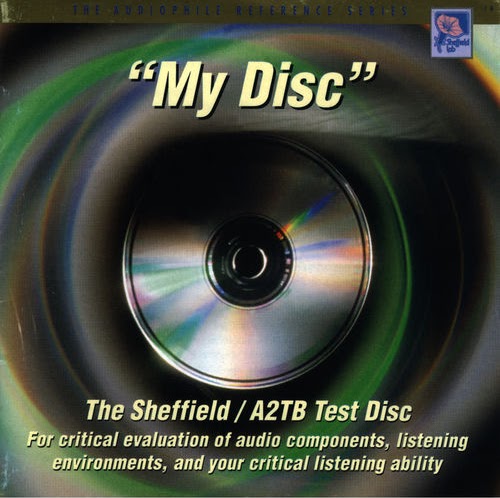
A2TB Test Disc ‘My Disc’
GREAT CHOICE: Sheffield A2TB Test Disc ‘My Disc’!
Great music deserves to be discovered, enjoyed and shared.
CAN YOU SPARE A CUP OF COFFEE?
Audiophile-Streaming is a personal passion project, built with countless hours of discovering, selecting and sharing exceptional music.
I personally cover, without sponsors, the ongoing costs of hosting, software and subscriptions to keep the music discoveries coming. If you enjoy my work, your support is always appreciated.
A LITTLE THANK YOU IN RETURN
Just one coffee gives you lifetime access to the Coffee Club and all its playlists.
No subscriptions. No recurring fees.
The combination of six carefully selected musical recordings and 80 technical test tracks makes Sheffield A2TB Test Disc ‘My Disc’ a rather unusual release. It is not a conventional compilation, and it was never intended to be one. Sheffield Lab created this disc for people who want to enjoy well-recorded music while also understanding what their audio systems are actually doing. I particularly like the idea behind it because I believe listening should always come before measurements. A test signal can tell me something about performance, but a convincing voice, a natural piano or a properly balanced orchestra tells me whether the result is musically satisfying.
Released in the mid-1990s, My Disc: The Sheffield / A2TB Test Disc was developed through a collaboration involving Richard Clark and David Navone of Autosound 2000 Tech Briefs, together with Oscar Ciornei and mastering engineer Doug Sax of Sheffield Lab. The original CD appeared in 1994, while the digital release is listed as 1995. The project brought together Sheffield Lab’s experience in audiophile recordings and the technical knowledge of specialists involved in acoustics, audio measurement and system design. With 86 tracks and a running time of approximately 74 minutes, it offers considerably more than a few familiar demonstration songs. What makes it interesting to me is that the musical selections were taken from Sheffield Lab’s established catalogue rather than produced simply as technical demonstrations.
Six musical recordings with very different strengths
The musical section opens with “Stranger in My Bed” by The Power of Seven, taken from Up Front. This is an energetic recording with several layers of percussion, keyboards, lead vocals and backing singers. The arrangement gives me plenty to concentrate on, particularly the relationship between the rhythmic instruments and the voices. Cowbells remain present behind the lead vocal, while the backing harmonies become especially interesting around the 1:12 mark, where six individual vocal parts can be distinguished. I like this kind of recording because the music is busy without losing its sense of direction. When the different voices and instruments remain clearly separated, the whole performance becomes easier to follow, and the rhythm feels more convincing.
The next selection, “Dish Rag” by Thelma Houston & Pressure Cooker, is historically important because it comes from Sheffield Lab’s celebrated 1975 album I’ve Got the Music in Me. That project helped establish the reputation of direct-to-disc recording, a technique in which performances were cut directly to the recording master without the usual intermediate tape stage. The recording demands careful playing and close cooperation between the musicians, qualities that become obvious in the arrangement. The opening introduces two distinct keyboard sounds before the brass instruments give the music considerably more weight. I particularly enjoy the way the trumpets and trombone occupy different positions across the stereo image, while the tambourine adds movement toward the left side. The result is lively, direct and refreshingly musical, with the character of a band playing together rather than a collection of separately assembled parts.
For me, one of the most interesting contrasts arrives with “Dance of the Knights” from Sergei Prokofiev’s Romeo and Juliet, performed by the Los Angeles Philharmonic Orchestra under Erich Leinsdorf. This selection comes from The Leinsdorf Sessions, Volume 1, recorded at MGM Sound Stage One. The music is powerful and deliberate, with heavy rhythmic figures and orchestral passages that build tension through changes in instrumental colour and intensity. I find the relationship between the strings, woodwinds, brass and percussion particularly revealing. Rather than simply listening for a wide soundstage, I want to hear how these sections relate to one another and how the orchestra maintains its structure when the music becomes forceful. The recording offers a very different listening experience from the opening two tracks, and that variety is one of the compilation’s strongest qualities.
Although those three selections are enough to demonstrate the musical range, the remaining recordings deserve attention as well. “Dirty Blue” features pianist Adam Makowicz with saxophonist Phil Woods, bringing a more intimate jazz character to the collection. Their musical interaction offers a useful contrast to the larger ensembles, particularly in the way the piano’s quick movements and the saxophone’s expressive phrasing work together. “Wishing Well” by Michael Ruff, originally from Speaking in Melodies, introduces another combination of voice, piano and carefully recorded percussion. Doug Sax specifically highlighted the microphone and preamplifier choices used on this recording, including Coles ribbon microphones and GML electronics for the percussion. Finally, Lincoln Mayorga and Distinguished Colleagues contribute “Dock of the Bay”, completing a musical selection that moves comfortably between popular music, jazz and classical repertoire.
Where the technical tracks become genuinely useful
After the six musical selections, Sheffield Lab changes direction completely. The remaining 80 tracks contain reference signals, channel identification recordings, polarity checks, frequency sweeps, pink noise, soundstage demonstrations and other tests. I appreciate the practical thinking behind this arrangement. Instead of expecting listeners to interpret measurements without context, the disc provides material that can help identify specific problems and then allows the listener to judge their musical consequences. For anyone experimenting with speaker placement or checking a stereo system after making changes, that approach makes considerable sense.
One particularly useful section concerns stereo imaging and the placement of voices. The disc includes recordings of three people describing their positions across a soundstage, followed by variations that change the presentation. This is valuable because spoken voices are familiar sounds, and most of us can recognise when a voice appears unnaturally stretched, poorly focused or positioned somewhere unexpected. I find these tests more immediately understandable than abstract numbers. They help establish whether the left and right channels are working together correctly and whether a stable centre image can be created between the speakers.
The channel identification and polarity tracks are equally practical. A reversed speaker connection can affect the relationship between the channels, particularly the apparent solidity of centrally positioned sounds. Sheffield Lab includes specific signals for checking these conditions instead of leaving everything to guesswork. Other tracks examine low-frequency performance, frequency response and changes in playback level. The disc also contains distortion-related demonstrations and recordings designed to explore dynamic behaviour. Some of these tests require proper interpretation, and I would never recommend treating every audible difference as proof that one component is better than another. Room acoustics, playback volume and recording levels can all affect the result.
There is even a short recording of activity at a racing circuit among the later tracks. It is a reminder that natural environmental sounds can be useful listening references because they contain changing levels, movement and complex combinations of sound. At the same time, I would not confuse these demonstrations with ordinary music listening. They have a specific purpose, and their value depends on understanding what they are intended to reveal. I also think test tones should be approached with care, especially when using headphones or playing high-frequency and low-frequency signals at elevated volumes. Louder does not automatically mean more informative.
A practical reminder of Sheffield Lab’s recording philosophy
Sheffield Lab built its reputation on recordings that placed great importance on musical performance, microphone techniques and preserving the character of the original sound. Doug Sax was a central figure in that history, and his involvement gives this project a clear connection to the label’s wider catalogue. The original musical selections demonstrate different approaches to recording, from the direct-to-disc energy of Thelma Houston & Pressure Cooker to the carefully controlled production of Michael Ruff. That diversity matters to me because no single recording can reveal everything about an audio system. A system that handles a large orchestra convincingly may still reveal weaknesses when reproducing closely recorded vocals or intricate percussion.
What I particularly appreciate about My Disc is that the musical recordings are enjoyable in their own right. The technical material is useful, but I would not want to spend an entire evening listening to test signals. The first six tracks provide enough musical variation to make the disc relevant even when no adjustments are being made. I can concentrate on the energy of Thelma Houston’s ensemble, the instrumental separation in The Power of Seven or the orchestral weight of Prokofiev without treating every moment as an examination. That is important because the purpose of a good audio system is to reproduce music convincingly, not simply to perform well during a technical demonstration.
There is also something appealingly straightforward about the philosophy behind this release. Sheffield Lab did not attempt to turn the test disc into a conventional greatest-hits collection. Instead, it selected recordings with identifiable musical and sonic characteristics and combined them with tools for examining specific aspects of reproduction. In today’s world of streaming services, digital room correction and increasingly sophisticated measurement software, some of these technical demonstrations may appear rather old-fashioned. Nevertheless, the basic questions remain relevant. Are voices positioned naturally? Does a piano retain its individual character? Can I follow different instruments during a complicated passage, and does the music remain coherent when the dynamics increase?
For me, Sheffield A2TB Test Disc ‘My Disc’ succeeds because it connects those questions to real performances. The Power of Seven demonstrates how demanding a layered arrangement can be, Thelma Houston & Pressure Cooker provide a wonderful example of direct musical energy, and Prokofiev’s Dance of the Knights brings orchestral scale and contrast into the picture. The additional technical tracks make the release a useful reference for anyone interested in understanding stereo reproduction, provided they are used sensibly. I value the music most, especially the way these very different recordings reveal the decisions and performances behind the sound. The measurements have their place, but it is the character of the musicians and the clarity of their interaction that ultimately tell me whether I am hearing something worthwhile.