
Spirit of Gambo
GREAT CHOICE: Spirit of Gambo!
Great music deserves to be discovered, enjoyed and shared.
CAN YOU SPARE A CUP OF COFFEE?
Audiophile-Streaming is a personal passion project, built with countless hours of discovering, selecting and sharing exceptional music.
I personally cover, without sponsors, the ongoing costs of hosting, software and subscriptions to keep the music discoveries coming. If you enjoy my work, your support is always appreciated.
A LITTLE THANK YOU IN RETURN
Just one coffee gives you lifetime access to the Coffee Club and all its playlists.
No subscriptions. No recurring fees.
The sound of several violas da gamba playing together has a character that is difficult to mistake for anything else. It is warmer and softer than a modern string quartet, but there is also a slightly rough, almost vocal quality to the instruments. Spirit of Gambo, the Dutch early music ensemble generally known as The Spirit of GAMBO, understands exactly how to use those qualities. Rather than presenting centuries-old music as something fragile or distant, these musicians give it movement, personality and a very natural sense of conversation. I particularly appreciate how the individual instruments remain recognisable while the musicians create a remarkably unified sound. For me, this is one of the most appealing ways to discover music written long before the modern orchestra existed.
Four musicians, one musical conversation
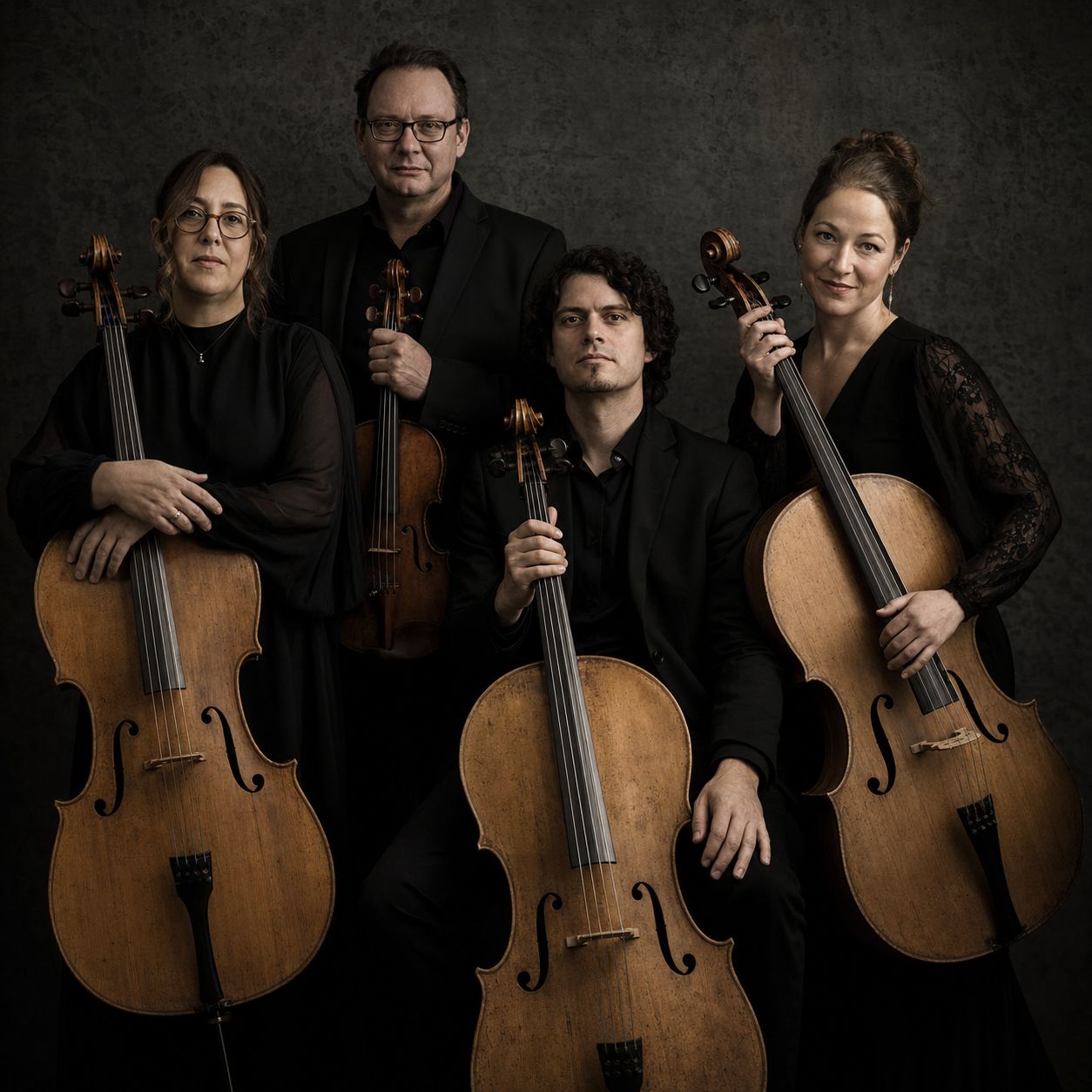
The Spirit of Gambo is not an individual artist but an ensemble specialising in historical performance, particularly the music of the viola da gamba. Its roots go back to the 1980s, with Freek Borstlap and Gesina Liedmeier as the founding musicians. Liedmeier has been involved with the group since 1989, and the ensemble has developed through several decades of concerts, recordings and musical collaborations. The established core consists of Freek Borstlap, Gesina Liedmeier, Ivanka Neeleman and Thomas Baeté, although additional musicians regularly participate in particular projects. Their repertoire includes composers such as John Dowland, Orlando Gibbons, John Jenkins, Henry Purcell and Johann Sebastian Bach. What connects these different composers is the ensemble’s interest in bringing historical instruments and their particular musical language back into active performance.
An important part of the group’s identity is the relationship between its musicians and their instruments. Gesina Liedmeier is not only a performer but also a specialist instrument maker, and she built violas da gamba specifically for the ensemble. These instruments feature painted decoration and individually carved animal heads, but their musical construction matters much more to me than their appearance. The use of gut strings contributes to a sound that has warmth, texture and a very direct response to the bow. A viola da gamba is held between the legs, has frets and uses a different tuning system from the modern cello. Its tone is generally less forceful than that of a modern bowed string instrument, which makes the balance between several players particularly important.
The ensemble’s approach is strongly connected to English consort music, a tradition in which several related instruments perform independent musical lines together. Freek Borstlap has devoted particular attention to composers such as Christopher Simpson, John Jenkins and Orlando Gibbons, whose music deserves far more attention than it usually receives outside early music circles. This is where I find the group’s musicianship most convincing. Each player has an individual line to follow, but nobody tries to dominate the performance. Melodies appear in one instrument, move into another and occasionally overlap in ways that become more interesting with repeated listening. The pleasure comes from hearing how these separate parts fit together without losing their individual character.
From English consort music to Stockfisch recordings
One recording that explains the ensemble particularly well is Jenkins: Consort Music of Four Parts, released in 2011 on Musica Ficta. John Jenkins, who lived from 1592 to 1678, was one of the most important English composers of instrumental chamber music during the seventeenth century. His compositions combine carefully organised musical lines with a surprising amount of melodic freedom. The Spirit of Gambo received a Diapason d’Or for this recording, an important recognition of its interpretation. I find it easy to understand the appreciation because the ensemble avoids making this complicated music sound unnecessarily intellectual. The individual phrases are clearly shaped, and there is a relaxed confidence in the way the musicians respond to one another.
For a newcomer, this Jenkins recording is an excellent introduction to the ensemble’s musical personality. The compositions do not depend on dramatic contrasts or spectacular virtuosity to hold my attention. Instead, much of their attraction lies in small changes of rhythm, the movement of a melody between instruments and the way a simple musical idea develops into something more complex. I particularly value the group’s sense of timing, because the performances maintain forward movement without sounding hurried. There is enough space around the individual phrases to understand the music, yet the musicians never let it become static. That balance between discipline and freedom is a large part of what makes The Spirit of Gambo distinctive.
The ensemble explored another important part of English music with Christopher Tye: Consort Music – In Nomine, released in 2014. Tye belonged to an earlier generation of English composers, and his instrumental writing offers a different perspective on the development of consort music. The In Nomine tradition developed around a pre-existing melody that composers used as the foundation for increasingly elaborate instrumental compositions. In these performances, I enjoy the contrast between the underlying musical structure and the independent lines moving around it. The music can initially sound quite restrained, but closer attention reveals considerable rhythmic activity and subtle changes in tension. This recording also received a Diapason d’Or, confirming the recognition the ensemble had already earned with its Jenkins interpretations.
Another side of the group’s work appears on The Silver Swan, a Stockfisch Records production devoted to the madrigals and motets of Orlando Gibbons. Here, the instrumental ensemble works with sopranos Claron McFadden and Aleksandra Anisimowicz, bringing the human voice into a musical world that is often associated with purely instrumental performance. The recording presents Gibbons’ complete First Set of Madrigals and Mottets of 5 Parts, originally published in 1612. I find this collaboration especially interesting because the vocal lines and the viols share a similar expressive character. The instruments do not simply provide accompaniment. They participate in the musical conversation, supporting the singers while retaining their own melodic importance.
The title composition, The Silver Swan, is an especially useful example of the ensemble’s sensitivity. Gibbons’ writing is delicate, and the performance benefits from careful control of phrasing and balance. I appreciate how naturally the voices and instruments can belong to the same musical texture without either becoming unnecessarily prominent. The recording was made in the Doopsgezinde Kerk in Haarlem, a location selected for its acoustic qualities, and Stockfisch released it as a hybrid SACD with stereo and multichannel programmes. The sense of space is particularly relevant to this kind of music because the performers need to remain connected while their individual lines are clearly audible. It is the kind of recording where midrange transparency and a believable acoustic environment contribute directly to the emotional effect of the performance.
The natural sound of historical instruments
My interest in The Spirit of Gambo also comes from its association with Stockfisch Records, a label I have followed for its attention to natural instrumental sound and recording quality. One particularly interesting production is The Galaxy Recordings, featuring seventeenth-century Dutch music by Johan Schenk, Christiaen Herwich and Philippus Hacquart. The participating musicians include Freek Borstlap and Ivanka Neeleman on viola da gamba, Haru Kitamika on harpsichord and guest violinist Judith Freise. The album was recorded at Galaxy Studios in Mol, Belgium, using the studio’s carefully controlled acoustic environment. Stockfisch produced stereo and 5.0 surround presentations for the hybrid SACD, making this an especially interesting release for listeners who enjoy examining the relationship between performance and recording technique.
What attracts me to this recording is the variety of sounds that can be heard from a relatively small group of musicians. The lower strings have a dry, textured character, while the upper notes reveal the delicate friction between bow and string. The harpsichord adds a clear, percussive element without overwhelming the softer instruments, and the violin introduces a different tonal colour. On a well-balanced stereo system, these contrasts are more valuable to me than an exaggerated sense of width or spectacular bass. Good speakers or headphones should allow the instruments to retain their individual identities while preserving the natural balance of the ensemble. The recording also makes it easier to appreciate how much expression the musicians achieve through small changes in articulation rather than large changes in volume.
The Spirit of Gambo continued its exploration of John Jenkins with Consort Music for Viols in Five Parts, released digitally in 2019 on Musica Ficta, and John Jenkins: Late Chamber Music, issued by Stockfisch Records in 2021. The latter was recorded in Haarlem in March 2019 and features Freek Borstlap, Ivanka Neeleman, Irene Klein and organist Jörn Boysen. It reflects another aspect of Jenkins’ musical development, as his later compositions reveal the transition from Renaissance instrumental traditions towards the emerging Baroque style. I appreciate that the ensemble approaches this music without treating historical performance as a fixed set of rules. The emphasis remains on musical communication, phrasing and the relationship between the performers. That consistency gives the group’s recordings a recognisable identity, even when the repertoire and instrumental combinations change.
There is one practical consideration for listeners approaching this music for the first time. Viola da gamba consort music rarely offers the immediate impact of a large orchestra, a modern jazz recording or a dramatic vocal performance. Its expressive range is often concentrated in quieter details, and several compositions may initially appear similar because of their instrumentation and musical structure. I do not consider that a weakness, but it does mean the listener needs to become familiar with the sound before the differences become obvious. Once the ear begins to recognise individual melodic lines and their relationships, the music becomes much more varied than its gentle character might initially suggest.
The importance of The Spirit of Gambo lies in its continued commitment to music and instruments that might otherwise remain familiar mainly to specialists. Through recordings for labels including Musica Ficta, Brilliant Classics and Stockfisch Records, the ensemble has helped make historical viol music available to a wider audience. Its international festival appearances and award-winning interpretations demonstrate that this repertoire still has an active place in contemporary musical life. I would recommend beginning with Jenkins: Consort Music of Four Parts to understand the group’s instrumental character, followed by The Silver Swan for the added expressive dimension of the human voice. The Galaxy Recordings is an excellent next choice for listeners particularly interested in instrumental timbre and recording quality. Across these different projects, my appreciation ultimately comes down to the same quality: the natural, attentive interplay between musicians who know how to make every individual musical line matter.