
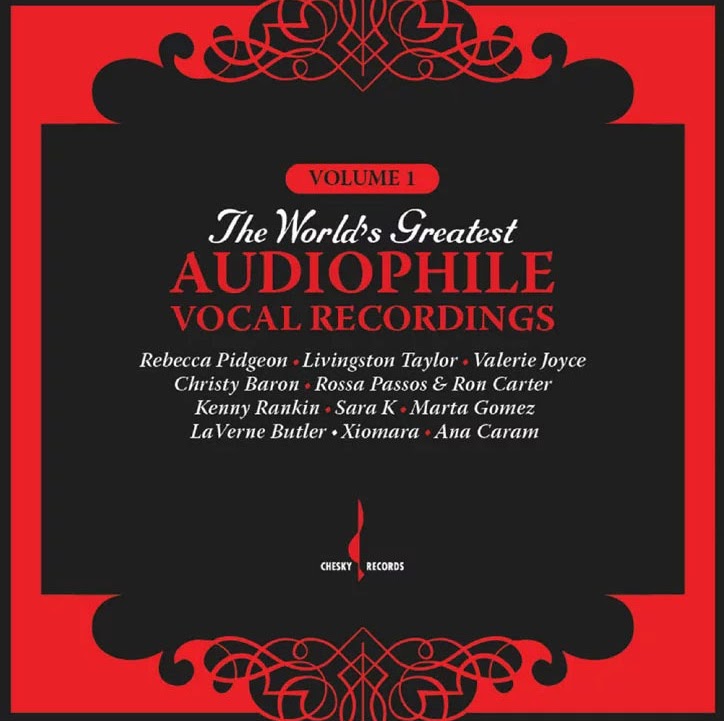
World’s Greatest Audiophile Vocal Recordings Vol. 1
GREAT CHOICE: World’s Greatest Audiophile Vocal Recordings Vol. 1!
Great music deserves to be discovered, enjoyed and shared.
CAN YOU SPARE A CUP OF COFFEE?
Audiophile-Streaming is a personal passion project, built with countless hours of discovering, selecting and sharing exceptional music.
I personally cover, without sponsors, the ongoing costs of hosting, software and subscriptions to keep the music discoveries coming. If you enjoy my work, your support is always appreciated.
A LITTLE THANK YOU IN RETURN
Just one coffee gives you lifetime access to the Coffee Club and all its playlists.
No subscriptions. No recurring fees.
The first thing that caught my attention about World’s Greatest Audiophile Vocal Recordings Vol. 1 was the choice of Rebecca Pidgeon’s “Spanish Harlem” as the opening track. It is a wonderfully simple way to introduce a collection that puts the human voice at the centre of the music. Originally released by Chesky Records in 2006, this compilation brings together singers from jazz, folk, blues and Brazilian music, each with a different way of expressing a song. I particularly like that the album does not depend on spectacular arrangements or impressive vocal gymnastics. Instead, it gives me twelve performances that demonstrate how much character, emotion and musical information can be found in a well-recorded voice.
Chesky Records has always interested me because of its approach to recording music. Founded by brothers David and Norman Chesky, the New York label built its reputation around natural acoustics, carefully chosen recording spaces and an emphasis on preserving the relationship between musicians. Rather than constructing an artificial soundstage through extensive studio processing, Chesky has generally preferred to capture performances with a convincing sense of space and musical interaction. This philosophy is particularly effective with vocal recordings, where even small differences in phrasing, breathing and microphone perspective can change the way I experience a performance. For me, this compilation is an excellent introduction to that approach, although its greatest strength is the variety of musical personalities rather than the recording technology itself.
Familiar Songs, Very Different Voices
Rebecca Pidgeon’s interpretation of “Spanish Harlem” is an ideal starting point. Originally written by Jerry Leiber and Phil Spector and made famous by Ben E. King, the song has been recorded by many artists, but Pidgeon gives it a particularly intimate character. Her voice is controlled and gentle, and she allows the melody to develop without unnecessary decoration. What I appreciate most is the balance between her singing and the instrumental accompaniment. Nothing seems to compete for attention, and the arrangement leaves enough room for the meaning of the song to come through. On a revealing stereo system, the separation between the voice and the instruments is easy to follow, but the real pleasure is how naturally everything works together.
Livingston Taylor follows with Stevie Wonder’s “Isn’t She Lovely”, bringing a completely different personality to the collection. Where Pidgeon is restrained and delicate, Taylor sounds relaxed, conversational and full of warmth. His interpretation moves the familiar song away from its original soul setting and gives it a more personal, acoustic character. I enjoy the rhythmic freedom in his performance and the way his voice communicates the happiness behind the composition without exaggerating it. It is also a useful reminder that an audiophile recording does not need to sound serious or formal to be valuable. Sometimes a good song, an engaging performer and an uncluttered arrangement are all I need.
Another performance that deserves attention is Christy Baron’s version of “Ain’t No Sunshine”, the Bill Withers classic. Baron approaches the song with a jazz-influenced vocal style that gives the familiar melody a different emotional character. Her phrasing is particularly interesting because she knows when to hold back and when to place more emphasis on a word. The relatively short performance concentrates on the essential elements of the song, allowing the melody and vocal expression to do most of the work. I like the contrast between the darker mood of this interpretation and the more cheerful character of Taylor’s contribution. It shows that this compilation is not simply a collection of beautiful voices, but a selection of artists with genuinely different musical instincts.
From American Jazz to Brazilian Bossa Nova
One of the reasons I find this album more interesting than a conventional vocal sampler is its international character. Brazilian singer Rosa Passos appears with legendary bassist Ron Carter on “The Girl From Ipanema”, a composition by Antônio Carlos Jobim and Vinicius de Moraes. This is a particularly attractive combination because Passos has a wonderfully understated approach to rhythm, while Carter brings decades of jazz experience to the performance. Rather than making the famous melody sound grand or overly polished, the musicians allow the bossa nova rhythm to develop naturally. I especially enjoy the relationship between the vocal line and the bass, where small rhythmic differences give the music its easy, flowing character.
The presence of Ron Carter also connects the compilation with a much wider jazz tradition. His work with Miles Davis, Herbie Hancock and countless other musicians has made him one of the most important bassists in modern jazz, but what matters here is his ability to support a singer without dominating the arrangement. His playing contributes weight and rhythmic direction while leaving Passos enough freedom to shape the melody. With good speakers, I want to hear the body of the bass as well as the definition of individual notes, without either becoming exaggerated. This recording offers an appealing balance between those qualities. More importantly, the bass and voice sound like parts of the same musical conversation.
Elsewhere, the album introduces the distinctive voices of Sara K., Marta Gómez, LaVerne Butler, Xiomara Laugart and Ana Caram. Their contributions move through acoustic songwriting, jazz interpretation and Latin American musical traditions, giving the compilation a broader identity than its title initially suggests. Kenny Rankin’s interpretation of “‘Round Midnight” adds another perspective, bringing his individual vocal phrasing to Thelonious Monk’s famous jazz composition. Valerie Joyce contributes a version of “Fever”, while Carlos Franzetti’s “Once Upon a Summertime” adds another change of mood. I appreciate these contrasts because they prevent the album from becoming too predictable. Although the selections share a similar attention to recording quality, the performers do not all sound as though they belong to the same musical category.
The Chesky Recording Philosophy
The original compilation was produced by David Chesky, with Norman Chesky serving as executive producer. The engineering credits include Nicholas Prout, Bob Katz and Barry Wolifson, while Prout also handled editing and mastering. These are significant names in audiophile recording, and their involvement helps explain the technical reputation of the release. The album was originally issued in 2006 as a hybrid Super Audio CD, and it subsequently appeared in other formats, including a 180-gram vinyl reissue in 2023 and another hybrid SACD edition in 2025. I like that these later releases have introduced the collection to listeners who may not have followed Chesky Records during its earlier years. The underlying performances remain the reason to explore it, regardless of the format.
What interests me most about the sound is the relationship between vocal presence and the surrounding instruments. With “Spanish Harlem”, for example, the voice is clearly established without needing to appear unnaturally large. The instrumental details remain audible, but they do not distract from Pidgeon’s delivery. On “The Girl From Ipanema”, the distinction between Passos and Carter is equally important because the arrangement depends on their rhythmic interaction. A good recording allows me to follow these details without separating the musicians into disconnected pieces. That is the kind of stereo imaging and midrange transparency I value, not simply the ability to hear every tiny sound.
The album also demonstrates why vocal recordings can be so revealing when evaluating a hi-fi system. Most of us know instinctively how a human voice should sound, even when we are unfamiliar with the singer. Too much emphasis in the upper midrange can make a vocal performance sound harder than intended, while an overly warm presentation can reduce the clarity of words and phrasing. The different singers on this compilation make those characteristics relatively easy to recognise. However, I would never judge the album only by how effectively it exposes weaknesses in speakers, amplifiers or headphones. The music is far too enjoyable to be reduced to a collection of test signals.
There is one aspect of this compilation that I think is worth considering. Because the tracks come from different artists and musical backgrounds, the album does not have the continuous development of a carefully conceived studio recording by one performer. The atmosphere, instrumentation and vocal character change considerably from one selection to another. For listeners who prefer a consistent musical mood, that variety may be less satisfying. Personally, I see it as part of the appeal, especially when I want to explore different singers without committing to an entire album. It also encourages me to discover the original Chesky releases from which these recordings were selected.
World’s Greatest Audiophile Vocal Recordings Vol. 1 is a compilation that earns my recommendation through its musical choices rather than its ambitious title. Rebecca Pidgeon’s intimate “Spanish Harlem”, Livingston Taylor’s cheerful “Isn’t She Lovely” and the beautifully judged collaboration between Rosa Passos and Ron Carter demonstrate three very different approaches to vocal music. The Chesky recording philosophy gives these performances a natural presentation, but the individual character of each singer is what makes the collection worthwhile. I particularly value the opportunity to hear familiar compositions interpreted with restraint, personality and respect for the musicians playing alongside the vocalist. For me, that combination of memorable songs, distinctive voices and carefully preserved performances is what makes this first volume such a rewarding introduction to the Chesky catalogue.