
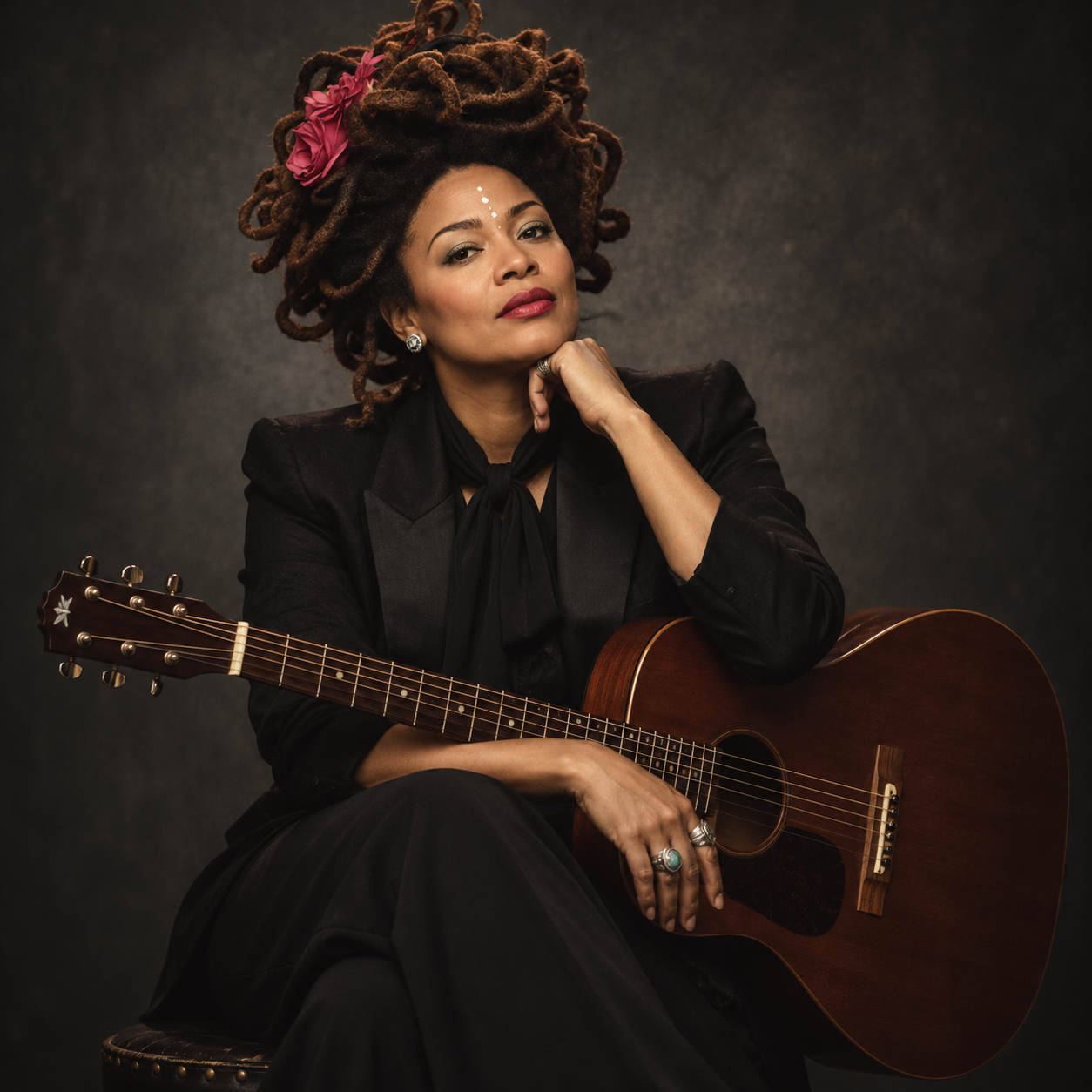
Valerie June
GREAT CHOICE: Valerie June!
Great music deserves to be discovered, enjoyed and shared.
CAN YOU SPARE A CUP OF COFFEE?
Audiophile-Streaming is a personal passion project, built with countless hours of discovering, selecting and sharing exceptional music.
I personally cover, without sponsors, the ongoing costs of hosting, software and subscriptions to keep the music discoveries coming. If you enjoy my work, your support is always appreciated.
A LITTLE THANK YOU IN RETURN
Just one coffee gives you lifetime access to the Coffee Club and all its playlists.
No subscriptions. No recurring fees.
Valerie June has one of those voices that immediately makes me forget about musical categories. It is high, slightly nasal, sometimes fragile, and wonderfully unconventional. Some listeners might need a little time to get used to it, but I find that its character is exactly what makes her music interesting. She moves between blues, folk, country, gospel, and soul without sounding as though she is trying to fit into any particular tradition. What attracts me most is how naturally she combines old American roots music with contemporary songwriting. Her records have a personality that I rarely encounter in more polished mainstream productions.
Born Valerie June Hockett on January 10, 1982, in Jackson, Tennessee, she grew up in Humboldt, a small town in the western part of the state. Her musical background was shaped by the sounds around her, including church gospel, blues, country, and rhythm and blues. Her father, Emerson Hockett, worked as a music promoter, giving her an early connection to the business as well as the music itself. She later moved to Memphis, where she developed her skills as a performer and taught herself instruments including guitar, banjo, and ukulele. I find those early influences particularly important because they explain why her music feels so connected to tradition without simply recreating recordings from another era.
Before reaching a wider audience, June released independent recordings, including The Way of the Weeping Willow in 2006 and Mountain of Rose Quartz in 2008. Her early career involved small performances, experimentation, and gradually developing a musical identity that she described as organic moonshine roots music. I rather like that description because it captures the unusual combination of musical traditions in her work. There is something deliberately uncomplicated about her approach, even when the arrangements become more adventurous. She does not seem particularly interested in correcting every rough edge, and to my ears, that decision is one of her strengths.
Finding Her Own Sound
Her major breakthrough came in 2013 with Pushin’ Against a Stone, released in the United States through Concord Music Group. The album brought her together with producers Dan Auerbach of The Black Keys, Kevin Augunas, and Peter Sabak, while musicians including Booker T. Jones and Jimbo Mathus contributed to the sessions. The recording took place across studios in Nashville, California, and Budapest, yet the resulting music retains a remarkably consistent identity. I hear a combination of country simplicity, earthy blues, and a more muscular rock influence. What I appreciate is that the production gives her voice enough room to remain distinctive instead of smoothing it into something commercially predictable.
One of the tracks I would recommend from this period is “Workin’ Woman Blues.” It introduces June’s character through a confident rhythm, an engaging vocal performance, and an arrangement that feels both traditional and contemporary. Her phrasing is particularly interesting because she does not always place her words exactly where I expect them. Sometimes she seems to lean into the rhythm, while at other moments she holds back just enough to create a little tension. That slight unpredictability makes the performance more human to me. I also enjoy how the instrumental backing supports her rather than competing with her unusual vocal tone.
The recording itself offers some worthwhile listening details. On “Workin’ Woman Blues,” I enjoy following the relationship between the rhythm section, guitar, and voice rather than concentrating exclusively on the singer. The instruments have enough individual character to make the arrangement easy to follow, while the performance retains a rough, energetic quality. Through revealing speakers or headphones, the differences between her sharper vocal attacks and softer phrases become especially noticeable. I would not describe this as a demonstration recording designed to impress with an enormous soundstage. Its attraction lies in the musical interaction and the sense that the musicians are working toward the same performance.
A More Personal Musical Direction
With The Order of Time, released on March 10, 2017, through Concord Records, June developed her songwriting and arrangements further. Produced by Matt Marinelli, the album explores love, family, struggle, and the passage of time, with musical influences extending beyond traditional American roots styles. The arrangements sometimes feel more spacious and reflective than those on her previous album. I hear an artist becoming increasingly comfortable with allowing her songs to develop at their own pace. Instead of relying on the contrast between her voice and an energetic backing band, she also explores quieter emotional territory.
The song “Shakedown” shows another side of her personality. It has an insistent rhythm and a strong sense of movement, but there is also a deeply personal connection behind the recording. Her father, Emerson Hockett, contributed vocals, alongside her brothers and Norah Jones, before his death in 2016. Knowing this gives the song an additional dimension, although I think the music communicates plenty without that background. The voices and rhythm create a lively, communal feeling, and I particularly enjoy the way June’s unmistakable singing sits within the larger ensemble. It demonstrates that she can be surrounded by other musicians and still remain the strongest personality in the recording.
Elsewhere on the album, songs such as “Astral Plane” reveal her more reflective side. The arrangement allows space around the melody, and June uses that freedom to stretch and shape her vocal lines. I like the relaxed pacing because it encourages me to follow the details of her delivery rather than waiting for a conventional chorus or dramatic climax. There are moments when her vocal style can sound almost unsteady, but I hear that as part of her expression rather than a weakness. Her singing is not about perfect control at every moment. It is about communicating a feeling in a way that belongs entirely to her.
For me, The Order of Time is an especially good starting point for listeners who want to understand Valerie June beyond the obvious blues and country influences. It combines accessible songwriting with enough unusual musical choices to remain interesting over repeated sessions. I also appreciate that the production does not push everything to the front. Some arrangements leave space for individual instruments and quieter vocal details, which gives the music a natural sense of movement. The result feels carefully made without becoming overly controlled.
Expanding the Musical Landscape
In 2021, June released The Moon and Stars: Prescriptions for Dreamers through Fantasy Records, another label within the Concord family. Working with producer Jack Splash, she introduced a broader palette of sounds, including orchestral strings, contemporary R&B, Afrobeat influences, and psychedelic textures. This was a significant development, but I do not hear it as a rejection of her earlier work. The traditional elements remain present, while the arrangements become richer and occasionally more experimental. I admire the ambition because she takes genuine musical risks without abandoning her identity.
“Call Me a Fool,” featuring Memphis soul legend Carla Thomas, is one of the most convincing examples of this development. The song has a classic soul character, but June’s interpretation prevents it from becoming a simple exercise in nostalgia. Her vocal delivery carries a mixture of vulnerability and determination, and Thomas adds an important connection to the Memphis soul tradition. The recording received a Grammy nomination for Best American Roots Song, an important recognition of June’s songwriting. For me, its greatest achievement is much simpler: the emotions are understandable without needing an elaborate arrangement or an excessively dramatic performance.
This is also a recording where I think good audio reproduction can contribute something meaningful. June’s voice has an unusual upper-midrange character, and a well-balanced system should preserve that individuality without making it unnecessarily sharp. On “Call Me a Fool,” I listen for the contrast between the lead vocal, the supporting voices, and the fuller instrumental arrangement. There is considerable musical activity, but the song works best when those elements remain distinguishable. Midrange transparency is useful here, not because the recording needs to become a technical demonstration, but because the personality of the voices is central to the performance.
The album also contains quieter and more experimental passages, including “Fallin,” “Two Roads,” and “Home Inside.” These pieces demonstrate that June is interested in atmosphere and musical development as much as traditional song structures. Some of the more elaborate arrangements demand more patience than her direct roots recordings, and I can understand listeners preferring the earlier material. Personally, I enjoy hearing her explore those possibilities, although I sometimes find her simplest performances more emotionally immediate. The larger productions are interesting because they show how far she can expand her musical language while retaining that unmistakable voice.
Her willingness to explore familiar material from different angles also appears on Under Cover, the 2022 EP featuring interpretations of songs associated with artists including Nick Drake, Mazzy Star, Bob Dylan, and Frank Ocean. I think this project says something important about her musical outlook. She is not particularly concerned with maintaining strict boundaries between genres or generations. Instead, she approaches a song through its emotional possibilities and decides how it can fit her own musical personality. That attitude helps explain why her original compositions combine so many influences without sounding like a collection of borrowed ideas.
June continued that exploration with Owls, Omens, and Oracles, released on April 11, 2025, through Concord Records. Produced by M. Ward and featuring contributions from The Blind Boys of Alabama, the album brought a stronger alternative-rock character into her music. Its opening single, “Joy, Joy!,” reflects the optimistic outlook that has become an important part of her songwriting. I find the contrast between its playful energy and her earlier, more reflective material particularly revealing. She is clearly willing to change the presentation of her music while keeping her central ideas about hope, resilience, and human connection.
In September 2026, she followed that direction with the Brighter Blue EP, returning to traditional material through songs including “Smokestack,” which combines elements of “Smokestack Lightning” and “In the Pines.” The project also includes “Trouble in Mind,” featuring Sam Amidon on fiddle, banjo, and backing vocals. I like the idea behind these recordings because it brings her musical development back to the blues and folk traditions that shaped her earliest work. Rather than treating those songs as museum pieces, she continues the long practice of rearranging and reinterpreting familiar material. It is a good reminder that American roots music has always developed through musicians adding something of their own.
Beyond her recordings, June has also written songs for artists including Mavis Staples and The Blind Boys of Alabama. Her career demonstrates how a singer-songwriter can work within established American traditions while developing an independent identity. I would not suggest that she invented a new genre, and I do not think that is the point. Her contribution is the unusual way she brings blues, gospel, folk, country, and soul together through her personal voice and songwriting choices. For listeners interested in contemporary Americana, she offers an example of musical individuality that does not depend on fashionable production or conventional vocal perfection.
What makes Valerie June particularly rewarding for me is the consistency of her personality across very different recordings. From the earthy arrangements of Pushin’ Against a Stone to the thoughtful songwriting of The Order of Time, the expansive production of The Moon and Stars: Prescriptions for Dreamers, and the more adventurous direction of her recent work, I hear an artist who understands her roots but refuses to be restricted by them. Her albums are not equally immediate, and some of her more unusual vocal choices may take time to appreciate. Nevertheless, I consider that individuality far more valuable than technical perfection or commercial polish. If I had to choose one musical quality that explains my appreciation of Valerie June, it would be the unmistakable honesty of her phrasing.